 파일명
파일명

|
U.S.–Europe Relations Through the Lens of U.S. Strategic Documents and the Greenland Issue: A Fissure in the Alliance or a Realignment? |
| February 3, 2026 |
-
Sungwon LEEResearch Fellow, Sejong Institute | sw.lee@sejong.org
-
It has been one year since the second Trump administration took office. At the outset of the administration, the foremost foreign policy slogan was "America First," under the banner of putting American interests first. Initially, the prevailing assessment was that this slogan would remain largely political rhetoric intended to consolidate domestic support. However, a review of U.S. foreign policy over the past year demonstrates that "America First" has evolved beyond a simple slogan and has become the central guiding principle of U.S. foreign strategy. Institutionalized through strategic documents, it is exerting a significant influence on security dynamics across multiple regions of the world. The release of the U.S. National Security Strategy (NSS) in December 2025, followed by the publication of the National Defense Strategy (NDS) in January 2026, has further clarified the core objectives, strategic priorities, and approaches the Trump administration seeks to advance through its foreign strategy.
Across the two strategic documents, several core messages are consistently and repeatedly emphasized. Maintaining stability and dominant influence in the U.S. homeland and the Western Hemisphere, and forging a favorable balance of power to deter China in the Indo-Pacific, have been established as the foremost priorities of U.S. security strategy. Of even greater significance is the shift in how the United States perceives its alliances. By redefining alliances not as relationships of unilateral dependence but as strategic partnerships grounded in equitable burden-sharing and reciprocity, the instrumental function of alliances is being brought to the fore. Europe in particular is identified in the strategic documents as a key region where alliance relationships must be recalibrated in the context of this broader shift in U.S. security strategy. The Trump administration has explicitly codified a reduction in the U.S. defense role in Europe amid the Russia-Ukraine War, while simultaneously designating the strengthening of European and NATO allies' autonomous defense capabilities and the expansion of their regional deterrence roles as policy priorities. In doing so, it has made clear its frustration with Europe's longstanding disproportionate defense burden-sharing, and is calling for a fundamental realignment of the alliance relationship as a whole. This strategic shift in alliance management is amplifying diplomatic tensions between the United States and Europe.
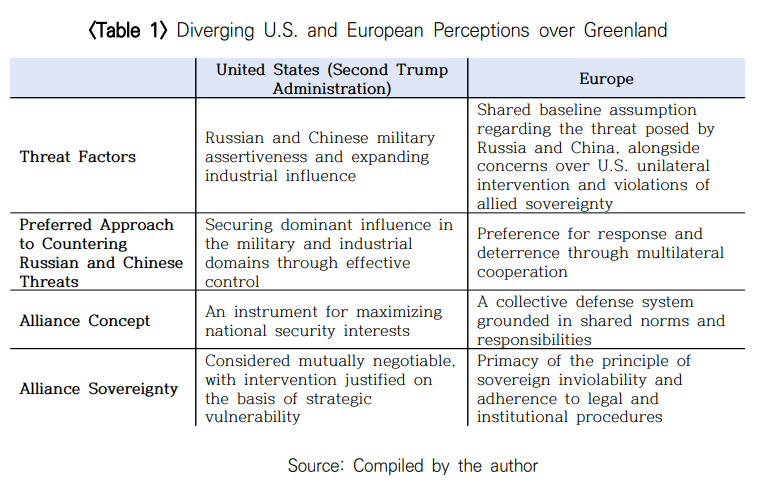
Furthermore, this conditionalized and instrumentalized conception of alliance has taken concrete form through the United States' full-scale intervention in the question of Greenland's sovereignty and territorial status, signaling a shift in U.S.-Europe tensions beyond a mere perceptual divergence toward substantive diplomatic and security friction. In a White House statement issued in January, President Trump declared that the acquisition of Greenland constitutes a core U.S. national security interest and a priority objective. Although the Trump administration's policy behavior toward Europe may appear inconsistent and contingent in certain respects, it is more appropriately understood as an extension of the alliance conception embedded in the strategic framework adopted by the current U.S. government. During a speech delivered in South Korea in January, U.S. Under Secretary of War for Policy Elbridge Colby characterized the administration's strategy as "flexible realism." The core elements of this flexible realism, as he outlined, include clarity of priorities, disciplined commitments, decisiveness in execution, and prudence in deterrence.1) Consistent with this orientation, the Trump administration has adopted a cost-benefit calculus across its foreign policy, while simultaneously pursuing "peace through strength," or "power-based international politics," by keeping all diplomatic, economic, and military instruments on the table and deploying them based on case-by-case assessments of national interest rather than normative considerations. This so-called realist approach that the United States is pursuing toward Europe is generating friction as it comes into conflict with the norm-based approach that Europe has long prioritized.
In a recent public annual lecture, Bronwen Maddox, Director of Chatham House, cited a series of U.S. actions over the past year, including its approach to pursuing a ceasefire agreement in the Russia-Ukraine War, the strike on Iranian nuclear facilities, the efforts to oust the Maduro regime in Venezuela, and the territorial claim over Greenland, before concluding that "This does mark the end of the Western Alliance." In the same vein, European Commission President von der Leyen characterized the friction between the United States and European nations over the Greenland issue as a "tectonic shift," emphasizing the need to build an entirely new form of European independence.
At this juncture, it is worth examining whether the diplomatic tensions and military friction between the United States and Europe will lead to a rupture in the alliance or instead signal a broader process of strategic realignment. This paper seeks to analyze U.S.-Europe tensions through the lens of alliance dynamics, focusing on the Greenland issue and recently released U.S. strategic documents. Given that the shifts in alliance relations emerging under the Trump administration are not confined to Europe alone, Europe's experience offers a valuable comparative lens through which to examine South Korea's own alliance dynamics. -
Misaligned Threat Assessments
The National Security Strategy (NSS) and the National Defense Strategy (NDS) constitute the highest-level strategic documents defining U.S. national security and military strategy, outlining the principal threat perceptions identified by the current U.S. government and the core objectives it seeks to achieve. The two strategic documents exhibit a significant degree of coherence and consistently convey several key messages from the Trump administration toward Europe and NATO. Notably, the assessment of the European region was strikingly dismissive, while the stated policy priorities and demands directed toward the region were articulated with clarity and directness.2)
Recently released U.S. strategic documents carry significant implications in that they reveal a growing fragmentation of threat perceptions between the United States and Europe. In particular, the divergence in their respective assessments of the Russia-Ukraine War is especially pronounced. The Trump administration has assessed that terminating hostilities in Ukraine would contribute to the broader stability of the Eurasian continent, facilitate Europe's economic recovery, and advance U.S. national interests. Threat perceptions of Russia likewise exhibit a clear divergence in both intensity and characterization. Whereas the Trump administration's first-term National Security Strategy (NSS) explicitly designated Russia as a "revisionist power," the NSS issued under the second Trump administration no longer maintains this explicit designation. The subsequently released National Defense Strategy (NDS) characterizes Russia as a "manageable threat," thereby circumscribing both the scope and severity of the threat it poses. Furthermore, the NDS suggests that Europe, despite possessing substantial conventional military capabilities, has contributed to regional instability by adopting inflated threat perceptions of Russia and pursuing unrealistic war aims. While the United States emphasizes the strategic necessity of coordination with Russia to ensure stability across Eurasia, Europe continues to perceive Russia as an existential security threat shaped by its historical experience. This divergence points to a weakening alignment of strategic objectives and threat perceptions within the alliance across both temporal and geographic dimensions.
A Conditionalized and Instrumentalized Alliance Mechanism
The Trump administration has underscored the inherent unfairness embedded in the defense free-riding of European allies, while clearly signaling its intention to reduce the U.S. role as a primary security provider in the European region. In this context, NATO is no longer framed as an alliance that operates unconditionally, but rather as a conditional arrangement predicated on mutual interests. Moreover, the Trump administration approaches NATO less as a normative or identity-based community and more as a functional instrument, whose level of U.S. engagement and mode of management may vary depending on its alignment with U.S. national interests. From this perspective, the administration emphasizes that Europe must move away from the assumption that NATO constitutes an automatically sustained and expanding alliance. In contrast, European states have traditionally regarded NATO as a normative defense community rooted in the mutual defense commitments established after World War II, serving as the central pillar of regional security. The deepening fragmentation of threat perceptions and core interests between the United States and Europe, combined with divergent expectations regarding roles and burden-sharing within the alliance, indicates that the contemporary transatlantic alliance is no longer fully aligned in its strategic orientation. -
Diplomatic tensions between the United States and Europe extend well beyond a mere fragmentation of threat perceptions or a misalignment of strategic objectives. In January, through posts on Truth Social and a formal White House statement, President Trump explicitly identified the acquisition of Greenland as a core U.S. national security interest and a priority objective, while indicating that a range of options, including military action, would remain under consideration, sending shockwaves through the international community. As disagreements between the United States and Europe over Greenland’s sovereignty and territorial integrity have come into sharper relief, what began as a divergence in alliance perceptions has evolved into a clash of concrete policies and actions, increasingly extending into the military and economic domains. This episode carries significant implications, as it demonstrates how misaligned strategic objectives within an alliance can, when catalyzed by a specific issue, escalate into tangible policy and military friction.
The Security Implications of Greenland for the United States and the Distinctiveness of the Trump Administration's Approach
President Trump has framed the necessity of acquiring Greenland in national security terms. This narrative is not, however, entirely new. The need to responsibly manage geopolitical competition and tensions in the Arctic has been a consistent theme across successive U.S. administrations. The importance of stability in the Arctic region was already underscored in the Bush administration's presidential directive, U.S. Arctic Policy (2009), and the Obama administration's National Strategy for the Arctic Region. The first Trump administration, through its Department of Defense Arctic Strategy (2019), explicitly framed the Arctic as an arena of defense competition, raising concerns about the expanding influence of Russia and China and the need to respond accordingly. The Biden administration similarly released the National Strategy for the Arctic Region (2022) and the Department of Defense Arctic Strategy (2024), highlighting the importance of climate considerations and sustainable development alongside the need to address the complex challenges posed by Russia and China. While administrations have differed in the degree to which they have framed the Arctic as a theater of strategic competition and in how explicitly they have designated Russia and China as threats, U.S. grand strategy toward the Arctic, including Greenland, is best understood not as a newly emergent posture but as a continuation of longstanding and accumulated threat perceptions. For President Trump, who envisions the development of the Golden Dome next-generation missile defense architecture, Greenland's geopolitical value as a critical node in Arctic defense is considerable.3) This reflects the judgment that securing Greenland could serve not only as a deterrent against Russia but also as a strategic foothold for countering potential threats from China amid an intensifying U.S.-China strategic rivalry. Where the second Trump administration diverges most sharply from its predecessors is not in its threat perceptions per se, but in its approach to managing and resolving those threats. Previous administrations emphasized stability, responsible stewardship, norm-based engagement, and crisis management through multilateral consultations involving international organizations and allies. The second Trump administration, by contrast, is pursuing the acquisition of Greenland and the establishment of effective territorial control as a means of directly securing military superiority and industrial influence in the region.
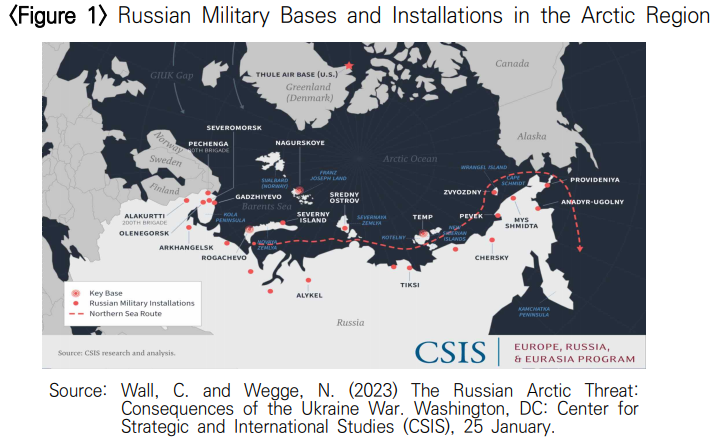
Why, then, does the United States express concern over great power competition surrounding Greenland, particularly over the growing influence of Russia and China? And is this threat perception existential? As the world's largest island, Greenland occupies a strategically pivotal position in Arctic geopolitics. While Russia does not share a direct territorial border with Greenland, its military and commercial influence across the region remains substantial. Russia views the Arctic as a critical strategic domain for defending military installations and key assets in its northwestern flank, protecting the Northern Fleet's strategic submarine forces, and securing the Northern Sea Route and natural resources.
Beyond defensive considerations alone, the Arctic also serves as a key corridor for Russia's gray zone operations and as a strategic platform from which military pressure and power projection can be directed toward newer NATO member states.4) Since the outbreak of the Russia-Ukraine War, NATO's northern expansion has heightened threat perceptions and increased geographic proximity, reinforcing the Arctic's strategic importance. Russia controls approximately 53 percent of the Arctic coastline, and across the vast territories facing Greenland, it has deployed extensive military infrastructure, including bases, airfields, and air defense systems designed to enable power projection and strike operations into the North Atlantic, as well as strategic submarine assets associated with the Northern Fleet. It is estimated that roughly 50 percent of all military installations in the Arctic are Russian facilities, a level roughly comparable to the combined total of all NATO member states' military infrastructure in the region.5)
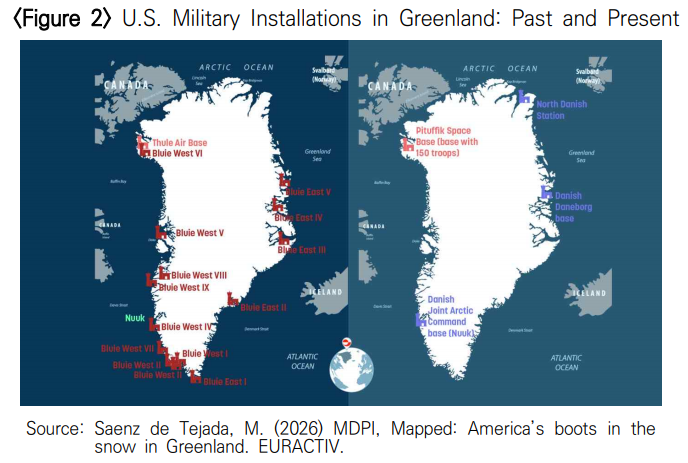
By contrast, as illustrated in Figure 2, the United States' military access to and presence in Greenland and the broader Arctic region have diminished considerably compared to earlier periods. With the exception of a limited number of space and early warning installations in Alaska and Greenland, the density of permanently stationed U.S. military infrastructure in the Arctic remains relatively low compared to Russia's. This structural disparity has led to growing assessments that securing operational and positional advantage over Russia in a contingency scenario would be challenging. Strategic assessments further indicate that European NATO member states' power projection capabilities in the Arctic region likewise remain considerably constrained in the context of the Russia-Ukraine War.6)7)
The Economic Potential and Limitations of Greenland Acquisition for the United States
Beyond national security considerations, President Trump has consistently framed the acquisition of Greenland as a strategic imperative for securing access to its abundant natural resources while simultaneously denying rival powers access to Arctic shipping routes. Greenland possesses substantial deposits of critical raw materials, including lithium, uranium, rare earth elements, copper, and graphite, as well as significant hydrocarbon resources. According to the U.S. Geological Survey (USGS), rare earth element reserves essential for battery production and the energy transition are estimated at approximately 1.5 million metric tons, with alternative estimates suggesting potential resources of up to 3.6 million metric tons. Greenland is also estimated to contain approximately 31 billion barrels of oil equivalent in undiscovered, technically recoverable hydrocarbon reserves. Assessed purely in terms of resource endowment, Greenland's geoeconomic significance in terms of energy and critical mineral resources is difficult to dispute.
Despite this considerable resource potential, substantial structural constraints impede the sustained extraction and commercial development of Greenland's natural resources. Approximately 80 percent of Greenland is covered by an ice sheet, posing significant technical challenges for exploration and extraction, while the infrastructure needed to support mining, production, and transportation remains extremely limited. Compounding these challenges, rising sea levels, ecosystem degradation, and the broader pressures of climate change have erected significant regulatory barriers. In 2021, for instance, the Greenlandic Parliament enacted legislation banning uranium exploration and restricting mining activities. When technical and environmental constraints, inadequate infrastructure, local community opposition, and development costs are considered in aggregate, Greenland emerges as a region whose short-term economic viability falls considerably short of what its resource endowments might suggest.8)9) -
Measured against these objective indicators, the Trump administration's threat perceptions regarding Greenland and its drive to expand U.S. influence in the region carry a degree of strategic logic. Yet deep skepticism has taken hold across Europe over whether Washington's foreign policy will make any meaningful contribution to peace and stability, and the effort to bring Greenland under U.S. sovereignty has garnered little sympathy among European NATO allies. A survey conducted by the German research institute Forschungsgruppe Wahlen in late 2025, polling 11,714 citizens across 23 European countries, found that only 26 percent of European respondents believed President Trump would make a positive contribution to peacebuilding, a result that speaks directly to the gulf in threat perceptions between Europe and the United States over Greenland.10) In Denmark, the most directly affected state, 46 percent of the public views the United States itself as a security threat to Greenland, while 78 percent oppose its incorporation into U.S. territory. Among Greenlanders themselves, opposition runs even higher, with 85 percent rejecting territorial incorporation.11)
European governments further maintain that Russia's permanent force deployments and readiness posture in its northwestern region do not, in and of themselves, indicate an intent to invade Greenland. Leading European think tanks, while not discounting Russia's offensive capacity, broadly assess that Russia's military activities in the Arctic are animated less by territorial ambition than by limited deterrence imperatives, principally interdicting NATO's sea lines of communication and denying allied reinforcement.12) Widely shared across Europe is the judgment that Russia, already bearing catastrophic human and material losses in a protracted war in Ukraine, stands to gain little political or economic advantage from invading Greenland or pressing territorial claims in the near term.13) In short, Washington is pushing for proactive control through the acquisition of Greenland to counter Russia's expanding military reach against a backdrop of acknowledged vulnerabilities in Arctic forward defense. The Trump administration's defensive logic has found little traction in Europe, particularly given its readiness to coerce a friendly state in the absence of any verified indication of Russian territorial designs.
Escalating Tensions over Greenland and the Current State of Diplomatic Adjustment
Following President Trump's January statements on Truth Social and in a formal White House address, relations between the United States, Greenland, and NATO allies took a sharp turn for the worse. A trilateral high-level meeting among the United States, Greenland, and Denmark was convened on January 14 in an attempt to defuse the situation. The talks ended without any meaningful outcome, with the two sides simply restating their irreconcilable positions: one insisting on a territorial transaction, the other on the inviolability of sovereignty. Tensions spilled over into the economic sphere as well, with the EU weighing tariffs of up to 93 billion euros on U.S. goods or restrictions on American firms' access to the European market.14) Greenland's Prime Minister was unequivocal: national sovereignty was not for sale. European governments responded with sharp criticism of Washington's territorial demands, its hints at military action, and the threat of punitive tariffs. Greenland and Denmark reportedly pressed NATO to reinforce its existing mission, establish a permanent rotational presence, and stand up a dedicated Arctic defense mission. Denmark announced a formal troop reinforcement in Greenland, and small contingents followed from Germany, Sweden, Norway, France, and the United Kingdom. The United States, for its part, deployed NORAD aircraft to Pituffik Space Base. These movements were modest in scale, amounting to routine patrols and training exercises, but their timing gave them an unmistakable symbolic charge. Within Europe, the Trump administration's strikes on Iran and its efforts to oust Maduro in Venezuela have fueled fears that military intervention over Greenland cannot be ruled out. This has lent new urgency to calls for European solidarity and a more robust defense posture in response to Washington's increasingly coercive conduct.15)
The diplomatic, military, and economic tensions eased somewhat following President Trump's address at the World Economic Forum in Davos, where he ruled out the use of force, offered to roll back tariffs on Europe, and expressed a willingness to work with NATO and Denmark toward a cooperative framework on Greenland's future. That said, with Trump, his Special Envoy for Greenland Jeff Landry, and Treasury Secretary Scott Bessent continuing to stress Europe's defense inadequacies and the necessity of U.S.-led security engagement in the region, the tensions and discord between Washington and Europe look set to persist for the foreseeable future. -
How should we assess the Trump administration's approach to its European alliances, as revealed through its strategic documents and the Greenland issue? Is the administration willing to accept a fracture in the alliance, or are we witnessing the early stages of a broader strategic realignment? No definitive answer is possible at this stage. What does seem clear, however, is that the second Trump administration has opened up a fundamental divergence in threat perceptions and alliance conceptions between the United States and Europe, and that the transatlantic relationship is exhibiting the characteristics of both fracture and realignment simultaneously.
First, viewed through the lens of alliance cohesion, the conditional and instrumental manner in which U.S. strategic documents define the identity and functional mechanisms of the alliance with Europe suggests a gradual weakening of the transatlantic relationship that has endured for nearly a century. The growing perception that a NATO member state could seek to acquire the territory and sovereignty of another member through coercive and non-normative means is likewise being interpreted as a destabilizing factor that calls into question the foundations of alliance relations within NATO. President Trump’s remarks alluding to the possibility of armed confrontation, or even conflict, between NATO members over Greenland, together with symbolic military signaling, represent a marked departure from established alliance practice and risk undermining trust among allies. More broadly, the use of economic instruments such as tariffs to exert pressure on issues of territory and security, both closely tied to national sovereignty, reflects a more transactional approach to alliance relations and suggests a broader erosion of norm-based alliance practices.
Signs of alliance fragmentation are also reflected in shifting European perceptions of the United States and NATO. According to a recent 2026 Gallup survey, support for U.S. leadership among NATO member states declined sharply during the first year of the second Trump administration.16) Among the 16 countries surveyed, 10 recorded declines of more than 10 percentage points, including particularly steep drops in Germany, down 39 points, and Portugal, down 38 points. This decline appears to reflect growing European concern over the United States' unilateral actions, as demonstrated in recent cases such as Venezuela and Greenland.
Alongside declining confidence in U.S. reliability, subtle shifts are also emerging in European perceptions of NATO amid increasing emphasis on strategic autonomy. According to a 2025 YouGov survey, NATO continues to enjoy broadly favorable perceptions, with an average approval rating of 70 percent across seven European member states surveyed. However, significant cross-national variation is evident in levels of support, perceptions of NATO's effectiveness in national defense, and views on the necessity of increased financial contributions. For example, frontline states facing more immediate Russian security concerns, including Denmark, Poland, and Lithuania, reported support levels exceeding 80 percent. By contrast, support remained in the 50 percent range in France, Italy, and Spain. Notably, in France, only 29 percent of respondents viewed NATO as important for national defense, indicating comparatively higher levels of skepticism. Divergence is also apparent in attitudes toward increased defense spending in response to U.S. pressure for greater burden-sharing. While majorities or pluralities in Denmark (74 percent), Poland (65 percent), Lithuania (54 percent), Germany (48 percent), and Spain (46 percent), viewed increased financial contributions as necessary, only 27 percent of respondents in both Italy and France expressed similar views. Taken together, these findings suggest that skepticism toward a U.S.-led NATO framework is becoming more pronounced in parts of Europe.17)
These trends suggest that European perceptions of the United States as a reliable ally are weakening. As confidence in the alliance erodes, the direction of Europe's alignment with the United States is also becoming increasingly uncertain. Within Europe, three competing strategic priorities appear to be emerging: maintaining U.S. engagement, preserving the institutional role of NATO, and strengthening Europe's own defense capabilities. Western European countries, facing a relatively lower level of direct threat from the Russia-Ukraine War, are showing a greater willingness to reduce dependence on the United States, reinforce indigenous defense capabilities, and foster a more autonomous European defense industrial base. By contrast, states on NATO's eastern flank emphasize the continued necessity of U.S. engagement and interoperability-driven operational cooperation to deter immediate threats. These countries therefore seek to preserve the U.S.-led structure and functional role of NATO, resulting in divergent strategic orientations within Europe regarding alignment with the United States.18) Under these conditions of emerging fragmentation, efforts to recalibrate alliance relationships and establish greater strategic autonomy are likely to involve significant political and institutional friction, both in terms of defining strategic objectives and implementing them in practice.
That said, despite clear signs that the traditional mechanisms of alliance operation are under strain, it would be premature to diagnose the current situation as the end or collapse of the transatlantic alliance. Through its strategic documents, the Trump administration has been critical of Europe's defense posture and has pressed for greater burden-sharing, while simultaneously affirming the continued necessity of cooperation with Europe and NATO in defense of core U.S. interests. What the current administration is pursuing, in this sense, is less the termination of the alliance than a fundamental recalibration of its operational logic. As noted earlier, this shift can be understood as an effort to restore a structure in which the U.S. security umbrella does not operate unconditionally, but instead reflects greater allied responsibility as primary actors in regional security, grounded in mutual rather than asymmetric interests.
What the strategic documents and the Greenland episode ultimately lay bare is a fundamental question about the nature of the alliance itself: whether it is to be understood as a trust-based arrangement rooted in shared norms and collective defense commitments, or as a strategic instrument for maximizing security interests through burden reduction and enhanced efficiency. From the perspective of the Trump administration, an ally's value is not fixed but contingent, determined by the capabilities it possesses, the contributions it is willing to make, and the extent to which it can share the burden borne by the United States. Alliances, in this view, are not relationships that guarantee unconditional protection but arrangements to be continuously managed and adjusted in accordance with U.S. strategic priorities and, where circumstances warrant, subjected to direct pressure or intervention. The strengthening of allied strategic autonomy, the sharing of capabilities in pursuit of mutual benefit, and the functional realignment of alliance roles appear likely to constitute enduring features of the evolving alliance framework.
What, then, should we make of Europe's situation? The NDS makes clear that the fractures and realignments playing out in Europe's alliance relationships are not a European-specific phenomenon, and it consistently calls on allies and partners around the world to participate in the process of rebuilding alliances along the lines that the United States is now redefining. South Korea, relative to its European counterparts, has generally been regarded by Washington as a model ally in terms of its indigenous defense capabilities, readiness posture, and defense cost-sharing. Six months into the new South Korean administration, the overall state of the bilateral relationship appears to be maintaining a reasonable degree of stability and predictability.
Yet within an increasingly multipolar and regionally fragmented international order, the dynamics of power-based interstate relations and the operational logic of alliances are becoming more unforgiving. Alliances are no longer fixed arrangements grounded primarily in shared norms and trust, but are instead evolving into relationships that are continuously evaluated on the basis of capabilities and levels of contribution. The criteria for what the United States considers a "sound alliance" center on aligned interests, shared risks, proportional contributions, and the generation of mutual benefit. Europe is experiencing alliance fracture amid partially misaligned interests and threat perceptions with the United States, as well as asymmetries in burden-sharing structures. From this perspective, South Korea likewise faces comparable structural risks. South Korea must distinguish between variables that may generate alliance friction and those that may drive alliance recalibration, and manage these dynamics through early warning indicators grounded in Korea-specific strategic scenarios. In the near term, friction variables may include the potential use of economic coercion linked to military and security issues, such as tariffs or industrial restrictions. Recalibration variables, by contrast, may involve renegotiations over alliance roles and cost-sharing arrangements, particularly expanded expectations regarding South Korea's roles and responsibilities in contingencies involving territorial sovereignty and regional security in the Indo-Pacific.
Although South Korea shares a substantial degree of strategic alignment with the United States in terms of core security interests and objectives, its threat perceptions toward China do not fully converge with those of Washington. Under these structural conditions, South Korea faces the strategic task of determining the appropriate scope and modality of its response to potential U.S. demands for expanded allied roles linked to evolving U.S. strategic priorities. This requires prior strategic alignment regarding the forms such demands may take, the domestic and international political and economic costs that may arise from accommodating them, and the institutional mechanisms necessary to mitigate associated risks. In this context, maintaining close and sustained communication through multilayered intergovernmental consultation channels with the United States will be essential.
From an alliance management perspective, South Korea must strategically leverage its industrial base, innovative technologies, and defense and defense industrial capabilities both to mitigate alliance frictions and to maximize its national interests in the process of alliance recalibration. In particular, a carefully calibrated approach will be required to determine how potential contribution assets, such as shipbuilding and naval defense industrial capabilities, can be employed as strategic leverage in negotiations over alliance cost-sharing and the allocation of roles and responsibilities.
While seeking to preserve a stable alliance relationship and promote regional stability, parallel efforts will also be necessary to address potential sources of instability originating from the United States. Europe, while reaffirming the necessity of its alliance with the United States and seeking to prevent the widening of alliance frictions, has also articulated a clear position emphasizing adherence to international law and the principle of sovereign inviolability in response to the Greenland issue. In addition, it has explored institutional countermeasures, including the potential use of tariff retaliation. South Korea, likewise, will need to articulate a clear and consistent position affirming compliance with international law and the principle of sovereign inviolability in response to instances of non-normative diplomatic behavior by the United States. In the event of coercive pressure within the region, South Korea should also be prepared to pursue calibrated responses using diplomatic, trade, and industrial policy instruments, while strengthening international partnerships with states that share both its normative commitments and strategic interests.
| Introduction
| The Message to Europe in U.S. Strategic Documents
| Discord Between the United States and Europe over Greenland
| Misaligned Strategic Objectives over Greenland and Europe's Response
Fracture or Recalibration? The U.S.-Europe Alliance and Implications for South Korea
1) U.S. Department of War (2026) Remarks by Under Secretary of War for Policy Elbridge Colby at the Sejong Institute in South Korea (as delivered), 26 January.
2) The crisis facing Europe, as diagnosed by the United States, is characterized by the weakening of indigenous defense capabilities, the dysfunction of the European Union and other supranational institutions, the failure of migration policies, restrictions on freedom of expression, declining birth rates, and the erosion of national identity and confidence. The United States warns that failure to overcome these structural challenges could place Europe on a path toward civilizational decline.
3) 박종원 (2026) ‘미 트럼프, 그린란드 “전면적 접근권” 원해… “골든돔” 강조’, 파이낸셜뉴스, 23 January.
4) Wall, C. and Wegge, N. (2023) The Russian Arctic Threat: Consequences of the Ukraine War. Washington, DC: Center for Strategic and International Studies (CSIS), 25 January.
5) 김현정 (2026) ‘북극 군사기지 나라 봤더니…66개 중 33개 “러시아”’, 아시아경제, 22 January.
6) Kobzova, J., Leonard, M., O’Brien, J., Puglierin, J., Shapiro, J., Tcherneva, V. and Westgaard, K. (2026) Arctic hold‘em: Ten European cards in Greenland, European Council on Foreign Relations, 16 January.
7) Redfern, D. (2026) Geopolitics in the Arctic: Greenland and Svalbard. A Level of Geography, 18 January.
8) Paul, J. (2026) Greenland is rich in natural resources – a geologist explains why, The Conversation, 8 January.
9) Blakemore, R. and Harmon, A. (2026) Greenland’s critical minerals require patient statecraft, Atlantic Council, 13 January.
10) Solletty, M. and Vadler, J. (2026) Europeans are gloomy about pretty much everything. Who can blame them?, POLITICO, 26 January.
11) Reuters (2025) Greenlanders overwhelmingly oppose becoming part of the United States, poll shows, 29 January.
12) Boulègue, M. (2024) Russia’s Arctic military posture in the context of the war against Ukraine. NATO Defense and Security Series 2024–2025, 31 October.
13) Martisiute, M. (2025) Russia’s undeclared war on the Northern Front. Policy Brief. European Policy Centre, 9 December.
14) 박미선 (2026) 「EU, ‘그린란드 갈등’에 美에 159조 보복 관세·무역 바주카포 검토」, 뉴시스, 19 January.
15) Bryant, M. (2026) ‘US attack on Greenland would mean end of Nato, says Danish PM’, The Guardian, 6 January.
16) Vigers, B. (2026) ‘U.S. Leadership Approval Drops Among NATO Allies’, Gallup News, 15 January.
17) YouGov (2025) ‘Europeans on defence and NATO’, European Political Monthly, 21 October.
18) 이성원 (2026) [세종정책브리프 2025-33] 유럽 안보 질서 재편을 둘러싼 동상이몽: 동유럽을 중심으로 본 위협 인식 분절과 전략적 함의, 세종연구소, 8 December.
※ The contents published on 'Sejong Focus' are personal opinions of the author and do not represent the official views of Sejong Institue