 파일명
파일명

|
Unlocking the Nuclear Submarine Era: A Roadmap for ROK-U.S. Nuclear Fuel Cooperation -Toward a Viable Framework for the Korean-Built, U.S.-Fueled Model- |
| December 15, 2025 |
-
Seong-Chang CheongVice President, Sejong Institute | softpower@sejong.org
-
On October 29, 2025, President Trump approved South Korea's construction of nuclear-powered submarines (hereafter "nuclear submarines") at the ROK-U.S. summit.1)
This marks a potential inflection point for South Korea's nuclear submarine acquisition, a policy debate that has persisted for over thirty years. Yet political approval alone does not put a nuclear submarine to sea. Operating the reactor at the heart of such a vessel requires nuclear fuel, and no concrete roadmap has yet been articulated for how that fuel is to be secured.
In the current strategic environment, characterized by an increasingly advanced North Korean nuclear and missile threat and intensifying U.S.-China strategic competition, South Korea's acquisition of nuclear submarines constitutes a strategic imperative tied directly to national survival. Nevertheless, the Korean government and public have yet to converge on a clear framework for what must be accomplished and in what order. In this context, the role of the academic community is to identify viable cooperative pathways ahead of government action and to provide a foundation for informed national deliberation.
This paper proceeds from that premise. It presents a draft "ROK-U.S. Nuclear Fuel Cooperation Roadmap," drawing on discussions that have taken place both publicly and privately within the academic community. The roadmap rests on two core assumptions. First, nuclear submarines will be domestically designed and built in South Korea. Second, reactor fuel will be supplied by the United States. The specific form of the fuel will be determined through future ROK-U.S. consultations and must align with the design specifications of the submarines South Korea intends to field.2) This approach is consistent with the spirit of the 2025 ROK-U.S. summit agreement and represents a realistic pathway for pursuing both alliance cooperation and autonomous defense capacity simultaneously.
A well-defined roadmap enables a clear-eyed assessment of phased requirements and risk factors, as opposed to reliance on vague expectations or unfounded concern. It will also support strategic communication with the National Assembly, the press, and civil society. Drawing on the AUKUS (Australia-United Kingdom-United States) precedent,3) this roadmap operates on a timeframe of five to seven years and is organized around three central pillars: U.S. domestic approval procedures, coordination with the international nonproliferation regime, and the operation of ROK-U.S. working-level consultative bodies. -
The decision to supply South Korea with nuclear fuel for submarine propulsion cannot be effectuated by presidential directive alone. It must clear a multi-layered process encompassing interagency review within the executive branch, legislative authorization by Congress, conclusion of a bilateral agreement, and security certification by the relevant regulatory agencies. Nuclear fuel is a special-category material in which military security, radiological safety, and technology controls converge in ways that distinguish it from conventional defense articles. This section sets out the U.S. procedural requirements across six stages.
Stage 1: Presidential Directive and Initiation of Joint Interagency Review
The starting point for all subsequent steps is a directive from the U.S. President authorizing cooperation with South Korea's nuclear submarine program. The requisite political foundation at the highest level has effectively been established through President Trump's public statement approving South Korea's nuclear submarine acquisition. Acting on that directive, the Departments of State (DOS), Defense (DOD), and Energy (DOE) initiate a joint interagency review.
Their respective roles are as follows. The Department of State assesses whether the cooperation is consistent with the Nuclear Non-Proliferation Treaty (NPT) and International Atomic Energy Agency (IAEA) obligations, and whether it supports regional strategic stability. The Department of Defense evaluates whether South Korean nuclear submarines would make a meaningful contribution to combined ROK-U.S. operations, and whether the transfer of nuclear fuel would implicate U.S. military classified equities. The Department of Energy, acting through the National Nuclear Security Administration (NNSA), determines the form and quantity of fuel to be provided and assesses South Korea's capacity to meet applicable physical protection standards.4) Responsibility for determining the form of fuel to be supplied is likely to rest with the Department of Defense alone, or jointly with the Department of Energy. (Lead agencies: Department of State (coordination), Department of Defense, Department of Energy; Estimated timeframe: 6 months to 1 year)
Stage 2: Presidential Determination5)
Based on the findings of the joint interagency review, the U.S. President issues a formal determination that South Korea's nuclear submarine program is consistent with U.S. national security interests. This stage converts the President's initial political directive into an official instrument carrying legal and administrative effect. (Lead agency: White House NSC; Estimated timeframe: 1 to 3 months)
Stage 3: Congressional Authorization: The Critical Stage
The most consequential stage is legislative authorization by the U.S. Congress. In the AUKUS case, in which the United States agreed in 2021 to transfer nuclear submarine technology to Australia, Congress enacted dedicated enabling legislation, the Naval Nuclear Propulsion Information Act (2023). South Korea's case is expected to require similarly tailored legislation, tentatively referred to here as the South Korea Naval Nuclear Propulsion Act.
Three political conditions must be satisfied to secure congressional authorization. First, demonstrating strategic contribution: South Korean nuclear submarines must be assessed as making a tangible contribution to U.S. Indo-Pacific strategy. Second, establishing nonproliferation credibility: South Korea must provide the United States with firm assurance that it is rigorously fulfilling its international nonproliferation commitments. Third, ensuring shared benefits for U.S. industrial stakeholders: the cooperative framework must be structured to accommodate meaningful participation by U.S. shipbuilding and nuclear industry stakeholders. This last condition may prove decisive in generating the domestic political support necessary for congressional action.
In practice, relevant legislation would move through the Senate and House Foreign Relations and Armed Services Committees. Both governments must bring the full range of available diplomatic tools to bear, including 2+2 ministerial consultations (Foreign and Defense Ministers), legislative engagement, and other mechanisms, to build and sustain support within Congress. Because the conclusion of a special safeguards agreement with the IAEA may be a prerequisite for congressional authorization, coordination with the international nonproliferation regime must proceed on a parallel track. (Lead: U.S. Congress; Estimated timeframe: 1 to 2 years)
Stage 4: Conclusion of the ROK-U.S. Nuclear Fuel Supply Agreement
Following enactment of enabling legislation by Congress, the two governments conclude a bilateral agreement governing the supply of nuclear fuel for submarine propulsion. The existing ROK-U.S. Agreement for Cooperation Concerning Civil Uses of Atomic Energy (revised 2015) is limited in scope to the peaceful uses of nuclear energy and does not extend to military nuclear propulsion; a separate agreement is therefore required. The agreement would address: the form and enrichment level of the fuel; supply quantities and delivery schedule; end-use restrictions (limited exclusively to submarine propulsion); safeguards and physical protection obligations; conditions governing the management and return of spent nuclear fuel; and prohibitions on the disclosure of technical information and transfer to third countries. The agreement would enter into force through the enabling legislation on the U.S. side and through National Assembly ratification on the Korean side. (Lead agencies: Foreign ministries of both governments; Estimated timeframe: 6 months to 1 year)
Stage 5: Nuclear Material Security Certification (NNSA and NRC)
Following conclusion of the bilateral agreement, the United States conducts security certification of nuclear fuel handling facilities within South Korea. The NNSA6) and the NRC7) conduct direct inspections to assess whether South Korea's nuclear fuel storage facilities, transportation systems, and shipyard reactor-installation infrastructure meet applicable standards for physical and cybersecurity. South Korea will be required to undertake facility upgrades, develop qualified personnel, and conclude a nuclear material handling Memorandum of Understanding (MOU). (Lead agencies: DOE/NNSA, Nuclear Regulatory Commission (NRC); Estimated timeframe: 1 to 2 years)
Stage 6: Nuclear Fuel Transport Authorization and Implementing Arrangements
The final stage involves conclusion of the arrangements necessary to govern the physical transfer of nuclear fuel from the United States to South Korea. The transport of military nuclear fuel is subject to stringent security and safety requirements. Both governments must reach prior agreement on transport routes, escort protocols, secured storage infrastructure in South Korea, and the disposition of spent nuclear fuel. Because fuel supply may be structured on a phased basis, covering testing, demonstration, and operational deployment, consultations on the relevant implementing arrangements must proceed concurrently. (Lead agencies: U.S. Department of Defense and Department of State; Estimated timeframe: 6 months) -
For South Korea's nuclear submarine acquisition to proceed without triggering international concern, cooperation with the International Atomic Energy Agency is essential. Once South Korea receives nuclear fuel from the United States, that material becomes subject in principle to IAEA safeguards (monitoring and verification).8)
However, military nuclear fuel may qualify for a safeguards exemption under certain conditions, and the AUKUS case has established a precedent in which fuel to be provided to Australia for nuclear submarine use was granted such an exemption.
Stage 1: Application of Article 14 of the IAEA Safeguards Agreement
South Korea formally notifies the IAEA that nuclear submarine fuel will be used exclusively for non-explosive military purposes. This triggers the application of Article 14 of the standard IAEA comprehensive safeguards agreement (INFCIRC/153), under which the application of routine comprehensive safeguards to the relevant nuclear material may be suspended, with special procedures under a separate arrangement applied in their place. The term "non-explosive military use" refers to use exclusively for military purposes such as reactor propulsion, with no application to nuclear weapons detonation.9)
Stage 2: Conclusion of a Special Safeguards Arrangement between South Korea and the IAEA
South Korea concludes a separate special safeguards arrangement with the IAEA covering nuclear submarine fuel. The arrangement would address: the type and enrichment level of the fuel; the specific scope of the safeguards exemption; procedures for fuel loading and spent fuel retrieval; an explicit prohibition on uranium reprocessing; and measures to prevent the loss or diversion of nuclear material.
Stage 3: Measures to Establish International Nonproliferation Credibility
The Korean government reaffirms its commitment to NPT compliance and provides written assurances that nuclear material cannot be diverted to weapons use. Where necessary, a joint statement by the ROK, the United States, and the IAEA would be issued to secure confidence within the international community. (Estimated timeframe for IAEA consultations and arrangements: approximately 1 year) -
For South Korea's nuclear submarine construction to proceed with pace and efficiency, the early establishment of a Nuclear-Powered Submarine Program Office directly under the Office of the President is essential. This national program office should include participation from the Ministry of National Defense, the Ministry of Trade, Industry and Energy, the Ministry of Science and ICT, the Ministry of Foreign Affairs, the Nuclear Safety and Security Commission, the Republic of Korea Navy, the Defense Acquisition Program Administration, the Agency for Defense Development, the Korea Atomic Energy Research Institute, KEPCO Nuclear Fuel, domestic shipyards, and Doosan Enerbility. A monthly program management review and a quarterly presidential briefing cycle would constitute the appropriate governance structure.10)
South Korea maintains a world-class regulatory and safety framework for civilian nuclear energy, but lacks a separate regulatory regime for military reactors.11) Domestic institutional reform across the following four areas must be completed as a prerequisite for nuclear submarine acquisition. To that end, the enactment of dedicated legislation governing nuclear submarine construction, tentatively designated the Naval Nuclear Propulsion System Act, warrants serious consideration.12)
Reform of Laws and Regulations Governing Military Reactors
Existing nuclear-related statutes should be revised to establish a clear legal basis for nuclear submarine acquisition. A Naval Reactor Safety Directorate, established within the framework of the Nuclear Safety and Security Commission, would be charged with dedicated safety regulation and oversight of military reactors.
Expansion of Dedicated Naval Nuclear Submarine Package Facilities and Creation of a Reactor Operations Organization
Dedicated dry docks and maintenance facilities for nuclear submarines should be developed within the Navy, along with a new organizational unit responsible for the professional operation and maintenance of submarine reactors and the training and development of relevant personnel. Practical training may be conducted with the cooperation of the U.S. Navy or through international cooperation with other nations pursuing nuclear submarine acquisition, such as Australia.13)
Development of Integrated Shipyard and Reactor Infrastructure
Dedicated facilities capable of installing and integrating submarine reactors must be established at domestic shipyards. This includes the provision of radiation shielding infrastructure and the installation of security facilities meeting NNSA requirements.
Establishment of a Spent Nuclear Fuel Management Framework
A management plan for spent nuclear fuel generated from nuclear submarine operations must be developed. At present, repatriation to the United States is the most likely disposition pathway; however, the development of interim storage facilities and a management framework within South Korea should be proactively examined in anticipation of contingencies. -
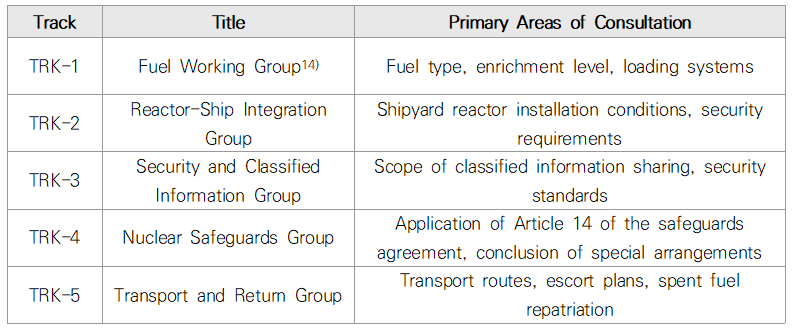
To advance the foregoing procedures in an efficient and coordinated manner, the ROK and the United States may establish and operate five working-level consultative tracks.
-
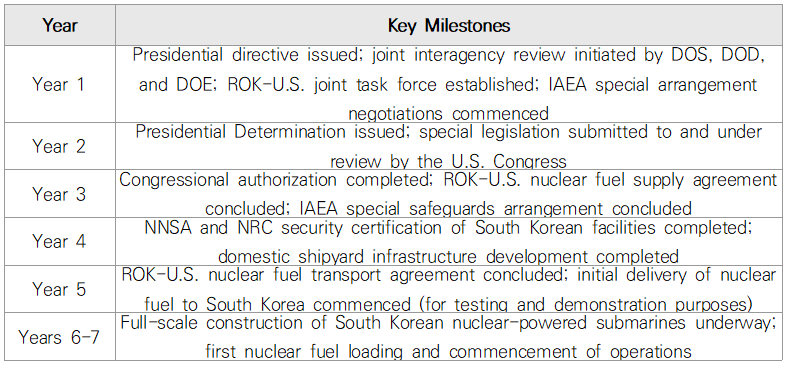
Individual stages may be pursued on a partially concurrent basis, and the overall program is projected to require a minimum of five years and a maximum of seven. The actual timeline, however, may vary significantly depending on domestic political conditions in the United States.
-
The "South Korea builds, U.S. supplies fuel" model is not simply an acquisition arrangement. It is a strategic choice that pursues alliance cooperation and autonomous defense capacity in parallel. Its implications are as follows.
Balancing Burden Sharing and Strategic Autonomy
A structure in which South Korea builds nuclear submarines domestically while the United States supplies the fuel is a complementary model that reduces the burden on the United States while expanding the military autonomy of the ally. This is consistent with the U.S. emphasis on greater defense burden sharing among alliance partners. At the same time, by building the core capability domestically, South Korea gains opportunities for technology accumulation and industrial development.
Strategic Utilization of the AUKUS Precedent
The transfer of nuclear submarine technology to Australia through the AUKUS framework in 2021 demonstrated that naval nuclear propulsion cooperation with non-nuclear-weapon states is achievable within the international nonproliferation regime. AUKUS represents the first instance in which such cooperation was institutionalized within the nonproliferation regime. The procedures and conditions were stringent, but the case provides a precedent in which legal and technical obstacles were managed through political resolve.
The Path to Full Nuclear Submarine Operator Status
This roadmap charts a course for South Korea not merely to acquire a single nuclear submarine, but to emerge as a fully capable nuclear submarine operator with indigenous construction, operation, and maintenance systems in place. It is a blueprint designed not for short-term force acquisition alone, but for the long-term development of independent operational capacity and a sustainable maintenance framework.
Contribution to Regional Security Balance
South Korea's possession of nuclear submarines would strengthen deterrence against North Korea's nuclear and submarine-launched ballistic missile (SLBM) threats, and would contribute to the broader balance of undersea power in the region. A structure may take shape in which South Korea assumes a share of the mobile deterrence capacity of ROK-U.S. combined undersea forces, in response to the growing submarine capabilities of North Korea and China. -
The acquisition of nuclear submarines has been debated in South Korea for over thirty years, yet a concrete path to realization has remained elusive. Now that the 2025 ROK-U.S. summit has opened a political breakthrough, what is required is the clarification of phased tasks and the building of national consensus.
The roadmap presented in this paper is not a finished plan. It is a point of departure for deliberation. It must be refined and made more concrete through the development of a more detailed government-level roadmap, review by the National Assembly and civil society, and working-level consultations between the two governments. What matters is that nuclear submarine acquisition, as a national undertaking, moves beyond vague aspiration and political rhetoric and is translated into a concrete, executable plan.
The key to opening the era of nuclear-powered submarines lies ultimately in designing a viable pathway for nuclear fuel cooperation. It is the author's hope that this roadmap serves as a first step toward that end.
I. Introduction: The Need for a Roadmap
II. U.S. Approval Procedures: The Highest Gate (Six Stages)
III. Coordination with the International Nonproliferation Regime
IV. Establishment of a National Program Office and Domestic Institutional Reform
V. Structure of the ROK-U.S. Joint Consultative Framework: Five Tracks
VI. Projected Implementation Schedule: A Five-to-Seven-Year Roadmap
VII. Strategic Implications and Conclusion
VIII. Conclusion
1) On the morning of October 30 Korean time (October 29 Eastern Time), President Trump stated via Truth Social: "I have approved South Korea to build nuclear-powered submarines instead of the outdated and less maneuverable diesel submarines they currently have." While some have interpreted this announcement as placing the date of U.S. approval on October 30, the fact sheet summarizing the summit agreements explicitly states that "the United States has approved South Korea to build nuclear-powered submarines." It is therefore more accurate to conclude that U.S. approval was granted at the October 29 summit, and that President Trump's Truth Social post on the 30th constituted an early disclosure of select summit outcomes, preceding the official release of the fact sheet.
2) The author fully endorses the view that South Korea should keep in sight its potential entry into the highly enriched uranium (HEU)/large-displacement nuclear submarine market, taking into account future operational requirements, co-development opportunities, and export considerations. See Ryu Seong-gon, "Analysis of the U.S./AUKUS Submarine Market and a Comparative Assessment of the Technical Advantages and Disadvantages of Domestic versus U.S.-Based Construction," in Proceedings of the Forum on Successful Construction of Nuclear-Powered Submarines (Forum co-hosted by Rep. Bu Seung-chan and others, December 4, 2025), p. 25. For the present, however, the author holds that priority must be given to making the "South Korea builds, U.S. supplies fuel" model succeed.
3) AUKUS (Australia-United Kingdom-United States) is a security partnership among the United States, the United Kingdom, and Australia, launched in September 2021, designed to provide Australia with nuclear-powered submarines. See Park No-byeok, "Environmental Analysis, Challenges, and Response Directions for the Introduction of a Korean Nuclear-Powered Submarine," in Policy Direction for the Introduction of Nuclear-Powered Submarines (Forum co-hosted by Rep. Kim Byeong-gi, Floor Leader of the Democratic Party of Korea, and others, December 8, 2025).
4) The export of nuclear-related equipment and technology from the United States is governed by the DOE, DOS, Department of Commerce (DOC), and Nuclear Regulatory Commission (NRC). The DOE administers civilian nuclear technology exports through the NNSA. The NRC regulates the export of civilian nuclear equipment and materials, including enriched uranium and reactor components. Export controls over U.S. nuclear materials and facilities are administered by the NRC as the primary regulatory authority under the Atomic Energy Act (AEA), the Nuclear Non-Proliferation Act of 1978 (NNPA) (Sections 305, 309, and 402), and 10 CFR Part 110; authority over nuclear technology transfers and services is vested in the DOE as the primary agency under the AEA, Section 305 of the NNPA, and 10 CFR Part 810. See Lee Byeong-uk et al., Nuclear Non-Proliferation Handbook (2024 Revised Edition) (Jeju: Jeju National University, 2024), p. 218. Section 91 of the AEA governs domestic military program authority; transfers to foreign nations require compliance with Section 123 procedures and separate enabling legislation.
5) In U.S. practice, a "Presidential Determination" refers to an administrative act by which the President formally issues, in official document form, a judgment that a specific statute has delegated to the President, thereby producing legal effect. Sections 91 and 123 of the Atomic Energy Act, among others, establish a framework permitting exceptions where the President has made a formal determination on the basis of national security or foreign policy interests for the transfer of specific nuclear materials or technologies. See Lee Byeong-uk et al., Nuclear Non-Proliferation Handbook (2024 Revised Edition).
6) The National Nuclear Security Administration (NNSA), within the U.S. Department of Energy, has overall responsibility for nuclear weapons and naval nuclear propulsion programs.
7) The Nuclear Regulatory Commission (NRC) is an independent agency responsible for safety regulation of civilian nuclear facilities, though it is also involved in security certification of military nuclear materials.
8) INFCIRC/153 is the standard model document for the comprehensive safeguards agreement concluded between the IAEA and non-nuclear-weapon states party to the NPT.
9) Article 14 of INFCIRC/153 provides that IAEA safeguards may be suspended or applied on a special basis when nuclear material is used in non-explosive military activities.
10) See Moon Geun-sik, "Urgent Priority Tasks for the Public Launch of the Nuclear-Powered Submarine Program," in Policy Direction for the Introduction of Nuclear-Powered Submarines (Forum co-hosted by Rep. Kim Byeong-gi, Floor Leader of the Democratic Party of Korea, and others, December 8, 2025), pp. 30-31. Yun Jeong-sang, Senior Advisor at LIG Nex1, notes that India pursued its nuclear submarine construction program under Navy leadership, a process that took over thirty years, whereas the United States and the United Kingdom established large-scale national project organizations with active whole-of-government support and achieved their objectives within approximately a decade. See Yun Jeong-sang, "Strengthening Nuclear Submarine Construction Capacity," in Policy Direction for the Introduction of Nuclear-Powered Submarines (Forum co-hosted by Rep. Kim Byeong-gi, Floor Leader of the Democratic Party of Korea, and others, December 8, 2025), p. 57.
11) See Jeong Il-sik, "Progress and Prospects for South Korea's Nuclear Submarine Development," in Proceedings of the Forum on Successful Construction of Nuclear-Powered Submarines (Forum co-hosted by Rep. Bu Seung-chan and others, December 4, 2025), p. 19.
12) See Choi Yong-seon, "MASGA Cooperation and Nuclear-Powered Submarines," in Proceedings of the Forum on Successful Construction of Nuclear-Powered Submarines (Forum co-hosted by Rep. Bu Seung-chan and others, December 4, 2025), p. 53; Yun Jeong-sang, "Strengthening Nuclear Submarine Construction Capacity," p. 57.
13) See Choi Yong-seon, "MASGA Cooperation and Nuclear-Powered Submarines," p. 52.
14) See Moon Geun-sik, "Urgent Priority Tasks for the Public Launch of the Nuclear-Powered Submarine Program," p. 32.
※ The contents published on 'Sejong Focus' are personal opinions of the author and do not represent the official views of Sejong Institue