 파일명
파일명
|
A New Security Architecture for the Post-Extended Deterrence Era — A Proposal for the 'Middle Power 5 (MP5)' Security Consultative Mechanism among Korea, Japan, France, the UK, and Germany — |
| February 24, 2026 |
-
Seong-Chang CheongVice President, Sejong Institute | softpower@sejong.org
- * In this paper, 'MP5 (Middle Power 5)' refers to a proposed security consultative mechanism comprising five nations: Korea, Japan, France, the United Kingdom, and Germany. While these countries are not superpowers on the scale of the United States, China, or Russia, they are 'middle powers' in possession of independent strategic assets and world-class defense industrial capabilities. The framework aims to build an autonomous middle-power security network that complements the existing U.S.-led security architecture.
-
The Trump administration's National Security Strategy (NSS), released in December 2025, omitted 'Extended Deterrence'—a term that had appeared in every previous NSS without exception. The same was true of the National Defense Strategy (NDS) published in January 2026. More significantly, the 2026 NDS explicitly states that 'Korea must bear primary responsibility for deterring North Korea, while the United States will provide critical but more limited support.1) This signals a fundamental transformation of the security architecture on which Korea has relied since the end of the Cold War.
It would, of course, be premature to conclude that U.S. extended deterrence has evaporated overnight. At the fifth meeting of the Korea-U.S. Nuclear Consultative Group (NCG) in December 2025, the United States reaffirmed its 'extended deterrence commitment' and designated the NCG a 'permanent bilateral consultative body.' Yet the deletion of extended deterrence provisions from official policy documents is no mere semantic change. Given that the 2010, 2018, and 2022 Nuclear Posture Reviews (NPR) had consistently proclaimed a 'strengthening of extended deterrence,' this latest shift presages a fundamental reorientation of U.S. nuclear strategy. The Congressional Research Service (CRS) itself noted, with unusual candor, that the 2026 NDS makes no explicit mention of extended deterrence.2)
The 2026 NDS reveals a clear hierarchy of priorities: ① defense of the Western Hemisphere and the homeland, ② deterrence of China, ③ expanded burden-sharing by allies, and ④ strengthening the defense industrial base. This ordering eloquently conveys that defending allies is no longer America's foremost concern.3) With respect to the Korean Peninsula, the NDS characterizes North Korea as 'a threat to Korea and Japan,' signaling that U.S. attention will be confined to missile capabilities that can strike the American homeland.
This shift represents the full-scale implementation of the international relations concept of 'offshore balancing.' The existing trilateral Korea-U.S.-Japan security framework only functions when the United States plays its role as the central 'hub'; as U.S. transactionalism deepens, this structure becomes structurally fragile. Japan, for its part, is both reinforcing the Japan-U.S. alliance by increasing its defense budget to 2% of GDP and acquiring counter-strike capabilities, while simultaneously pursuing expanded strategic autonomy through joint development of a next-generation fighter aircraft (GCAP) with the UK and Italy. Korea likewise urgently needs a diversification strategy that transcends dependency on the United States.
The Limitations of G7 and the Quad, and the Case for MP5
Despite ranking twelfth in world GDP and among the top five in conventional military power, Korea is not embedded in any of the major existing multilateral security frameworks. Italy and Canada are members of the G7, but Korea is not. Korea is similarly absent from the Quad (U.S., Japan, India, Australia).
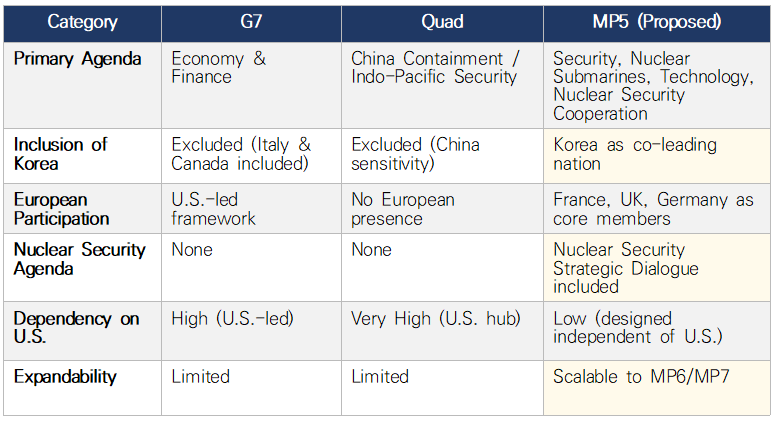
- MP5 simultaneously addresses three structural gaps: the G7's economic bias, the Quad's anti-China framing, and Korea's exclusion from both. Most importantly, by proactively proposing MP5, Korea can transcend its periphery-of-four-powers diplomacy and open a new chapter in middle-power statecraft.
-
This paper proposes rendering 'Middle Power' in Korean not as 'Joong-gyun-guk, 중견국(中堅國)' but as 'Joong-gang-guk, 중강국(中强國).' The term 'Joong-gyun-guk, 중견국' evokes an image of 'pillar' or 'buttress,' carrying a strong normative connotation of 'role and responsibility.' By contrast, 'Joong-gang-guk, 중강국' more accurately reflects the actual capabilities and strategic stature of mid-sized states that, while falling short of superpower status, are unmistakably in the ranks of major powers.
Korea, Japan, France, the United Kingdom, and Germany cannot become superpowers in the mold of the United States, China, or Russia in terms of land area or population. But they are genuine great powers—possessing independent nuclear forces, economies within the world's top ten, and advanced defense technologies. To characterize them merely as 'mid-sized countries,' as 'Joong-gyun-guk, 중견국' implies, does far less justice to their reality than 'Joong-gang-guk, 중강국,' which conveys 'mid-sized great power.' In the 2026 Global Firepower (GFP) ranking of conventional military strength, Korea, France, Japan, and the United Kingdom occupy positions five through eight, while Germany ranks twelfth. These are, in the truest sense, middle powers.
France: Architect of Independent Nuclear Forces and 'Independent Solidarity'
France places 'strategic autonomy (autonomie stratégique)' at the core of its national identity, distinguishing itself from the United States. It operates four strategic ballistic missile submarines (SSBN) and Barracuda-class (Suffren-class) nuclear-powered attack submarines (SSN), and possesses independent uranium enrichment facilities. Notably, the Barracuda class uses low-enriched uranium (LEU), which means the legal and political barriers to technology cooperation with Korea are comparatively lower from a non-proliferation standpoint.4)
France's updated Indo-Pacific Strategy (July 2025) designates France as an 'Indo-Pacific resident power,' with approximately 7,000–8,000 troops permanently stationed in overseas territories. In May 2025, President Macron became the first European head of state to deliver a keynote address at the Shangri-La Dialogue, where he proposed to Asian and European partner nations the formation of a 'coalition of independents'—one beholden to neither Washington nor Beijing.5) MP5 is the most concrete institutional embodiment of the Macron vision. The 140th anniversary of Korea-France diplomatic relations in 2026 presents an ideal opportunity to elevate the bilateral strategic partnership.
The United Kingdom: Five Eyes Intelligence and the AUKUS Precedent
The United Kingdom is a core member of the Five Eyes intelligence alliance, possessing world-class signals intelligence (SIGINT) and cyber capabilities. While expressions such as 'Global Britain' and 'Indo-Pacific tilt' have been removed from official documents since the Labour government took office in July 2024, substantive military engagement has in fact intensified. 'Operation Highmast' in April 2025—centered on the HMS Prince of Wales carrier strike group, carrying 24 F-35Bs and achieving full operational capability—was the UK's second Indo-Pacific carrier deployment, involving some 4,500 personnel from 13 nations.
Through AUKUS (September 2021), the United Kingdom took the unprecedented decision to transfer nuclear submarine technology to Australia, a non-nuclear-weapons state, making it an important reference point for any discussion of nuclear propulsion technology cooperation with Korea. The UK-France Northwood Declaration of July 2025 was the first public statement in history to explicitly note that 'the two countries' nuclear forces are independent but can be coordinated,' and a UK-France Nuclear Steering Group was also established. This declaration could serve as an institutional model for the MP5 Nuclear Security Strategic Dialogue.
Germany: The Heart of the EU and a New Actor in Nuclear Discourse
Germany is the EU's largest economy and holds the greatest potential military power among NATO's European members. Following its 2022 Zeitenwende declaration, it earmarked a special defense fund of 100 billion euros. In August 2025, the Franco-German Defence and Security Council formally launched a 'strategic dialogue on nuclear deterrence.'6) At the February 2026 Munich Security Conference, Chancellor-elect Merz publicly referenced 'confidential nuclear conversations' with Macron. Germany's submarine construction capabilities (TKMS) and precision sensor technologies are highly complementary with Korea's defense industry.
Germany did, however, permanently renounce possession of WMDs under the 1990 Two Plus Four Treaty, and domestic anti-nuclear sentiment remains entrenched. It is therefore realistic to assign Germany the role of 'observer' in MP5's nuclear security dialogue, while focusing its substantive contributions on defense, cyber, and space cooperation.
Japan: Korea's Core Asian Partner and Co-Leading Nation
Japan faces identical security challenges to Korea—North Korean nuclear and missile threats, China's military expansion, and uncertainty about U.S. security commitments. While reinforcing the Japan-U.S. alliance through defense budget increases (2% of GDP) and acquisition of counter-strike capabilities, Japan is simultaneously pursuing expanded strategic autonomy through joint development of GCAP with the UK and Italy. The combination of Korea's world-class shipbuilding capacity and Japan's maritime technology, synergized with French and British nuclear propulsion and sensor technologies, could dramatically enhance the Indo-Pacific's autonomous surveillance and defense capabilities. It is also significant that Korea and Japan's co-leadership of MP5 would allow Korea-Japan security cooperation to be institutionalized in a future-oriented manner, decoupled from historical grievances.
Korea: The Catalyst of MP5 and the Standard-Bearer of 'K-Diplomacy'
Korea is among the world's top ten economies and holds global competitiveness in semiconductors, shipbuilding, and defense industries. The global advance of K-Defense demonstrates that Korea has earned its credentials not as a security consumer but as a security provider. Yet there are critical gaps in nuclear submarines, uranium enrichment and reprocessing, and strategic intelligence networks. MP5 is a 'win-win' platform that fills these gaps while offering Korea's manufacturing and IT capabilities to its European partners.
Above all, if Korea—having been excluded from both the G7 and the Quad—were to take the lead in founding MP5, this would be a historic turning point: where K-Diplomacy takes up the torch lit by K-Culture (the Korean Wave) and K-Defense. Korea can proactively design a new era of diversified diplomacy, one that transcends the framework of diplomacy centered on the four surrounding major powers and forges solidarity with like-minded middle powers. -
Nuclear Submarine and Nuclear Energy Technology Cooperation
The Lee Jae-myung government is pursuing the construction of nuclear-powered submarines as a national policy priority. In October 2025, President Trump approved Korea's development of nuclear-powered submarines at the Gyeongju Korea-U.S. summit. However, substantive cooperation on technology transfer and nuclear fuel supply from the U.S. Department of Energy (DOE) remains opaque.
France's Barracuda class employs LEU reactors, which face lower political and legal barriers than HEU from a non-proliferation standpoint. If Korea were to initiate joint research on LEU-based nuclear propulsion technology with France, this would both provide a technological alternative to U.S. HEU dominance and send a powerful diplomatic signal: 'Korea is pursuing independent nuclear technology cooperation with Europe.' The United Kingdom is also an important cooperation partner, having set the precedent of transferring nuclear submarine technology to a non-nuclear-weapons state through AUKUS.
This paper proposes the establishment under MP5 of a 'Maritime Security and Nuclear Propulsion Technology Working Group.' Korea, France, and the UK would serve as core members, with Japan and Germany as observers, to address joint research on LEU-based nuclear propulsion technology and approaches to ensuring compatibility with the non-proliferation regime.
Technology Security Cooperation and Construction of an Autonomous Defense Supply Chain
The Trump administration displays a contradictory posture: demanding that allies increase defense spending while strictly controlling the transfer of core technologies. Building an autonomous defense supply chain that reduces U.S. dependency—by combining manufacturing powers (Korea, Japan) with basic science and defense industry powers (France, UK, Germany)—is a strategic imperative. Four specific areas of cooperation are envisaged:
▸ Construction of an autonomous maritime domain awareness (MDA) network combining Korea's AI and semiconductor capabilities with French and British maritime sensor and satellite technologies. ▸ Joint development of unmanned systems (UAS/UUV): integrating Korea's drone manufacturing, Japan's underwater robotics, French and British military drones and unmanned submarines, and German precision sensors to develop an autonomous surveillance and strike system independent of U.S. systems. ▸ Joint design and construction of maritime surveillance assets, combining Korea's world-class shipbuilding capacity with French and British aviation and sensor technologies. ▸ Cybersecurity cooperation with UK GCHQ and France's ANSSI, and space cooperation with France (CNES) and Germany (DLR).
Regional Linkage Security and the Eurasian Maritime Security Initiative
The alignment of the 'revisionist quartet'—Russia, China, North Korea, and Iran—demonstrates that European and Asian security cannot be separated. Cooperation between IP4 (Korea, Japan, Australia, New Zealand) and NATO has developed rapidly since 2022, but two limitations have emerged. First, this cooperation has largely been 'brokered by the United States,' whereas the Trump administration is disinclined to continue doing so—a dynamic that led to the non-attendance of three of the four IP4 heads of state (Korea, Japan, Australia) at the June 2025 The Hague NATO Summit.7) Second, IP4-NATO cooperation remains predominantly dialogue-focused and has not sufficiently transitioned to substantive operational, defense, and technology cooperation.
This paper proposes the creation within the MP5 framework of a 'Eurasian Maritime Security Initiative (EMSI).' In 2025, the French Charles de Gaulle carrier strike group and the British Queen Elizabeth-class carrier strike group were already regularly deploying to the Indo-Pacific. Institutionalizing these as joint exercises with Korean and Japanese naval forces would tangibly strengthen deterrence.
Nuclear Security Dialogue in the Post-Extended Deterrence Era
The weakening of U.S. extended deterrence is propagating the same anxiety across Europe. In May 2025, Poland and France concluded the Treaty of Nancy, establishing a mutual defense commitment and the foundations for nuclear-related strategic dialogue. The UK-France Northwood Declaration of July 2025 was the first public proclamation by both countries of the possibility of coordinating their nuclear forces. In August 2025, the Franco-German nuclear strategic dialogue officially launched. And in February 2026, the Munich Security Conference European Nuclear Study Group (ENSG) published its 'Mind the Deterrence Gap' report, urging an expansion of nuclear dialogue at the European level.8) For Korea to commence nuclear security dialogue with France and the UK is to join a trend already underway in Europe—not to make a radical departure.
This paper proposes the establishment within MP5 of a 'Nuclear Security Strategic Dialogue (NSSD).' It would take the form of an 'extended nuclear security forum' modeled on NATO's Nuclear Planning Group (NPG), with Korean and Japanese participation. Crucially, this dialogue is not a demand for an extension of French and British nuclear umbrellas. Since France's nuclear doctrine ties 'vital interests' strictly to French territory, the MP5 nuclear dialogue focuses not on 'nuclear deterrence extension' but rather on: alternative deterrence strategies for the post-extended deterrence era; the potential contribution of French and British nuclear forces to Asian security; and coordination of common positions for the maintenance of the nuclear non-proliferation regime. -
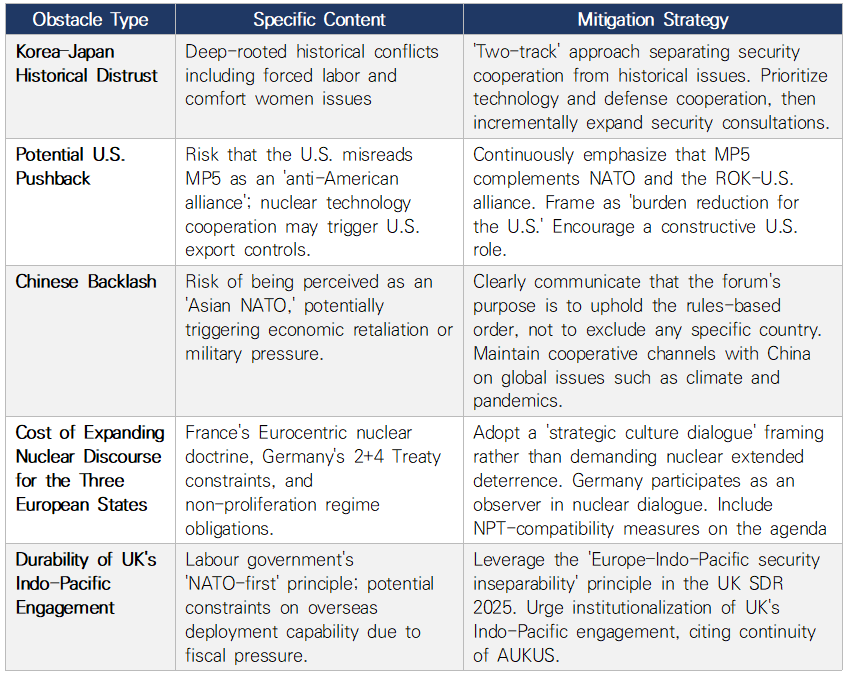
For the MP5 concept to succeed, it is necessary to confront structural obstacles squarely and devise strategies to overcome them. The principal limitations and mitigation approaches are summarized below.
-
Phased Roadmap
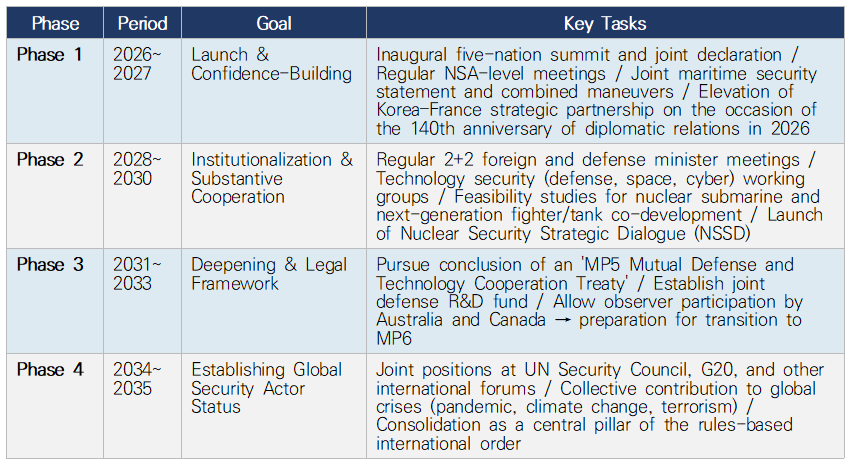
MP5 → MP6 → MP7: Phased Expansion of the Middle-Power Security Consultative Mechanism
MP5 is not the final form of a middle-power security consultative mechanism. It is equally possible to expand incrementally after 2031 by accommodating the participation of like-minded middle powers such as Australia and Canada, evolving into MP6 or MP7. The criteria for expansion are twofold: first, commitment to democratic values; and second, possession of core strategic assets that are complementary to those of the existing five members.
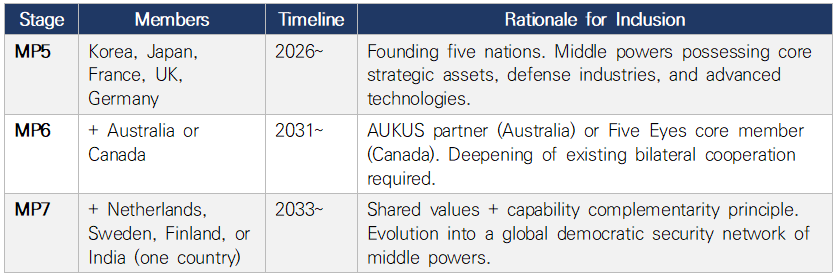
-
The essence of the MP5 concept is 'complementarity,' not 'replacement.' It is not a call to abandon the Korea-U.S. alliance, but to secure additional security assets at a time when the Korea-U.S. alliance alone is no longer sufficient. This concept precisely aligns with what the United States demands—'strengthened alliance autonomy' and 'expanded burden-sharing'—while simultaneously employing a 'dual signaling' strategy: sending the message to Washington that 'allied nations are forming an autonomous security network,' thereby restraining excessive alliance drift.
If K-Culture (the Korean Wave) opened a new frontier of soft power, and K-Defense elevated Korea's standing in the global defense market, then MP5 can be the symbolic starting point of 'K-Diplomacy'—Korea's transformation from a passive beneficiary of the global security architecture to an active designer of it. By taking the lead in MP5, a Korea excluded from both the G7 and the Quad fundamentally redesigns the framework of its periphery-of-four-powers dependent diplomacy.
To the United States, Korea must persuade that this consultative mechanism is by no means an 'Anti-American' or 'Post-American' alliance—but rather the voluntary effort of responsible allied nations to reduce America's burden and contribute to stability in the Indo-Pacific region. To China, Korea must clearly explain that this mechanism is not an 'Asian NATO' designed to exclude or confront any specific country.
President Macron's proposed 'coalition of independents,' Germany's initiation of a strategic nuclear dialogue, and the UK-France Northwood Declaration—all of these currents signify that middle powers have begun designing their own security in the post-extended deterrence era. Will Korea stand on the periphery of this historic current, or design a new security order from its very center? The MP5 'Middle-Power Security Consultative Mechanism' can be the bold first step on that journey.
| The End of Extended Deterrence and the U.S. Return to 'Offshore Balancing'
| Why These Five? The Strategic Complementarity of the MP5
| Core Agenda of MP5
| Limitations of the MP5 Concept and Mitigation Strategies
| Policy Recommendations: MP5 Implementation Roadmap and Expansion Framework
Conclusion: K-Diplomacy, Toward a New Era of Middle-Power Statecraft
1) U.S. Department of Defense, 2026 National Defense Strategy, January 23, 2026, pp. 4, 14. Mark F. Cancian and Chris H. Park, 'The 2026 National Defense Strategy by the Numbers,' CSIS, January 27, 2026.
2) Congressional Research Service, 'U.S. Extended Deterrence and Regional Nuclear Capabilities,' IF12735, updated February 6, 2026.
3) Mark F. Cancian and Chris H. Park, 'The 2026 National Defense Strategy by the Numbers: Radical Changes, Moderate Changes, and Some Continuities,' CSIS, January 31, 2026.
4) France's Barracuda-class (Suffren-class) submarines are built by Naval Group and are equipped with the K15 reactor. See: CHEONG Seong-Chang, 'Korea-France Nuclear Submarine Cooperation Strategy and Roadmap,' Sejong Focus, February 10, 2026.
5) USNI News, 'French President Macron Calls for Independent Coalition Between Europe, Asia,' Shangri-La Dialogue, May 30, 2025. Macron proposed the formation of an independent coalition to Asian and European partner nations seeking to align with neither Washington nor Beijing.
6) Élysée, 'Conclusions of the Franco-German Defence and Security Council,' September 2, 2025.
7) Korea sent National Security Adviser Wi Sung-lac as special envoy, who reached agreement with the NATO Secretary-General on establishing a defense industry cooperation working group. United States Studies Centre, 'Beyond Alignment: Moving the NATO-IP4 Partnership Forward,' December 16, 2025.
8) Munich Security Conference European Nuclear Study Group, 'Mind the Deterrence Gap,' February 2026. The proliferation of nuclear discourse within Europe—the Poland-France Treaty of Nancy (May 2025), the UK-France Northwood Declaration (July 2025), and the Franco-German nuclear strategic dialogue (August 2025)—constitutes a self-help response to the weakening of U.S. extended deterrence.
※ The contents published on 'Sejong Focus' are personal opinions of the author and do not represent the official views of Sejong Institue