 파일명
파일명
|
The Dawn of the 'Kim Jong-un 2.0 Era' and Its Implications for the Kim Ju-ae Succession System — An Assessment of Power Elite Changes at North Korea's 9th Workers' Party Congress — |
| February 27, 2026 |
-
Seong-Chang CheongVice President, Sejong Institute | softpower@sejong.org
-
North Korea's most important political event, the Workers' Party Congress, was held in Pyongyang from February 19 to 25, 2026. At the 9th Party Congress, Kim Jong-un appeared wearing a 'Kim Il-sung and Kim Jong-il badge,' while all other officials wore 'Kim Jong-un badges.' North Korea had already signaled Kim Jong-un's intent to step out from under the shadow of his grandfather and father by removing their portraits from the presidium at the 8th Party Congress in January 2021. This time, however, officials were required to wear 'Kim Jong-un badges' in lieu of the 'Kim Il-sung and Kim Jong-il badges,' demonstrating that they are now expected to pledge absolute loyalty to Kim Jong-un's own ideology and will. The congress also completed a generational transition in leadership, with the second-generation anti-Japanese partisan group making a full exit from the top leadership. The author therefore assesses that the 9th Workers' Party Congress marks the inauguration of a 'Kim Jong-un 2.0 era,' distinct from all previous phases of his rule.
On the fourth day of the congress (February 22), 138 full members and 111 candidate members of the Party Central Committee — the core elite group that steers North Korea — were 'nominated' and 'elected.'1) On the fifth day (February 23), through the First Plenary Session of the 9th Central Committee (Enlarged), new appointments to the Politburo, the Secretariat, and the Central Military Commission (CMC) were announced.2) This congress is assessed as a historic milestone, representing the most sweeping generational overhaul of the power elite since Kim Jong-un came to power. Also noteworthy is that the personnel reshuffle was carried out in a two-stage process: key appointment measures first advanced at the 11th Plenary of the 8th Central Committee in December 2024 were now institutionally ratified and consolidated.
The reshuffle's five defining features are as follows.
First, the complete exit of the 'second-generation partisans' and the old guard. Choe Ryong-hae, Chairman of the Supreme People's Assembly Presidium (born 1950) and the most prominent representative of the second-generation anti-Japanese partisan group, along with O Il-jong, former Director of the Civil Defense Department (born 1954), were both entirely dropped from the Central Committee — both full members and candidate members. Senior military marshals, including Pak Jong-chon (former CMC Vice Chairman) and Ri Pyong-chol (former General Adviser for munitions policy, born 1948), were likewise excluded from the new leadership roster. In this way, the old guard that had led North Korea under Kim Il-sung and Kim Jong-il has effectively exited the stage of history.
Second, the full ascendancy of practical, technocratic figures. The retention and consolidation of Premier Pak Thae-song's seat on the Politburo Standing Committee is the most symbolic example. It should be noted, however, that Pak Thae-song built his career in party organizational work — as deputy director of the Organization and Guidance Department, party secretary of South Pyongan Province, and propaganda secretary — as a close associate of Kim Jong-un from the early days. He is clearly distinct from pure science-and-education professionals such as Choe Dong-myong, confirmed as Science and Education Secretary concurrently serving as Director of the Science and Education Department, who appeared in the presidium list at the 9th Party Congress. His rise is best understood not as the adoption of a pure technocrat, but as reflecting a personnel policy oriented toward cultivating 'organizationally grounded, practical party cadres' capable of overseeing economic construction. Pak Thae-song's status as second in the hierarchy at the 9th Congress's executive body proclaims economic construction as the foremost priority for the next five years. His Standing Committee status had already been conferred simultaneously with his appointment as Premier at the 11th Plenary of the 8th Central Committee in December 2024; the 9th Congress reaffirmed and consolidated that status.
Third, the functional reorganization of the Politburo Standing Committee. While the five-member structure was maintained, its composition changed substantially. The Standing Committee is now composed of Kim Jong-un (General Secretary), Pak Thae-song (economy), Cho Yong-won (designated SPA Presidium Chairman), Kim Jae-ryong (organization and guidance), and Ri Il-hwan (propaganda and agitation). The fact that Cho Yong-won — who had served as Central Committee Organization Secretary and Director of the Organization and Guidance Department — was not newly elected to the Secretariat or to a departmental director post signals that he has been designated to succeed Choe Ryong-hae as SPA Presidium Chairman. That Ri Il-hwan is called out second on the list of Central Committee departmental directors suggests he holds the second most important specialist department: the Propaganda and Agitation Department. Noteworthy is the fact that on opening day (February 20), the presidium list described Ri Il-hwan only as 'Party Secretary,' while Ju Chang-il was still designated 'Director of the Party Propaganda and Agitation Department.' This indicates that the transition of the Propaganda and Agitation Department directorship from Ju Chang-il to Ri Il-hwan was formalized only on February 23, at the First Plenary of the 9th Central Committee. Ju Chang-il's new position has not yet been publicly disclosed; based on the order in which names are called, he is presumed to have been appointed director of the Workers' Organizations Department. In the past, one or two members of the Politburo Standing Committee represented the military; this time, military figures are entirely absent, replaced instead by the secretary in charge of propaganda and agitation.3) This signals that over the next five years, propaganda targeting cadres and citizens to reinforce loyalty to party leadership will be a task of special importance.
Fourth, a major expansion (from 8 to 12 members) and functional specialization of the Party Secretariat. A clear functional division of responsibility has been assigned to each secretary. At the 7th Party Congress held in May 2016, the Secretariat (then called the 'Presidium') consisted of 10 members including Kim Jong-un;4) at the 8th Party Congress, that number was reduced to 8.5) It has now grown to 12 including Kim Jong-un, suggesting that the Secretariat's role will be further strengthened going forward.
After Kim Jong-il was internally formalized as Kim Il-sung's successor within North Korea's leadership in 1974, the center of power shifted from the Central Committee Politburo to the Secretariat and the Organization and Guidance Department.6) And as the number of Central Committee secretaries continued to decline during the Kim Jong-il era, the number expanded to 11 when Kim Jong-un's succession was formally launched through the 3rd Party Representatives' Conference in 2010.7) In light of this historical precedent, it is difficult to entirely rule out the possibility that the Secretariat's expansion from 8 members at the 8th Congress to 12 at the 9th Congress is connected to the process of building Kim Ju-ae's succession system. This is because if the still-young Kim Ju-ae were to be named Kim Jong-un's successor in the near future, the Secretariat — rather than the Central Committee Politburo — would likely become the primary institutional base for expanding her influence, just as it was for Kim Jong-il in the 1970s.
Fifth, restructuring of the military control framework. With Jong Kyong-thaek, a former Chief of the General Political Bureau, appointed as Central Committee Secretary concurrently serving as Director of the Military Political Guidance Department and assuming the post of CMC Vice Chairman in place of Pak Jong-chon, a former Chief of the General Staff, the military control structure has been reorganized to prioritize the party's political and ideological control over the military rather than operational command expertise.8) If Kim Jong-un seeks to position Kim Ju-ae as his successor, cultivating the military's loyalty to her will become a critically important task going forward. As early as 2024, defector testimony from former military personnel indicated that 'among North Korean officers and generals, Kim Ju-ae is referred to as the Respected Young Lady and the Rising Star Female General.' North Korean military study materials reportedly portray Kim Ju-ae as a 'computer genius,' emphasizing images of science, technology, and the future.9)
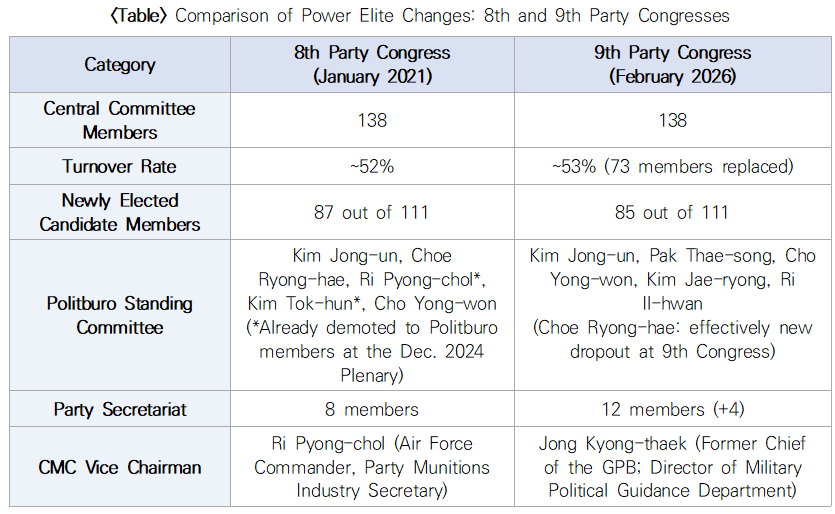
- * Ri Pyong-chol and Kim Tok-hun had already been demoted from Standing Committee to Politburo members at the 11th Plenary of the 8th Central Committee in December 2024; therefore, the only individual effectively newly dropped from the Standing Committee at the 9th Congress was Choe Ryong-hae.
-
1. Newly Risen Key Figures
Kim Jae-ryong (born 1959) served as Premier from 2019, then as Director of the Organization and Guidance Department (concurrently Organization Secretary) from 2020 to 2022, and as Chairman of the Central Inspection Commission from 2022 to 2024. At this congress, he was appointed to the most influential position — Politburo Standing Committee member and Director of the Organization and Guidance Department — giving him overall control of party-wide organizational functions. This appointment marks his second term as Organization Secretary and represents the redeployment of a proven figure who already has experience leading the Organization and Guidance Department. This signifies that Kim Jong-un has brought back a trusted organizational expert to a key position for the purposes of systemic stability and strengthening internal discipline. The Central Inspection Commission chairmanship that Kim Jae-ryong had held was already assigned to Ri Hiyong, former Secretary of the North Pyongan Province Party Committee (who had previously served as First Deputy Director of the Organization and Guidance Department), at the 11th Plenary in December 2024; the 9th Congress reconfirmed this.
Jo Chun-ryong (born 1960) has been a fixture overseeing the munitions industry for years — serving as a National Defense Commission member in 2014, Chairman of the Second Economy Committee in 2019, Director of the Munitions Industry Department from the 5th Plenary of the 8th Central Committee in June 2022, and Munitions Industry Secretary from the 9th Plenary in December 2023. The particularly notable development at the 9th Party Congress is that Jo Chun-ryong joined the Central Military Commission (CMC) for the first time. This signifies his full integration into the integrated party-military command structure, and formally strengthens his role in advancing the 2nd Five-Year Weapons Development Plan (2026–2030).
The appointment of Kim Song-nam (born 1953), Director of the International Department of the Central Committee, as Party Secretary concurrently serving as departmental director — thereby reviving the position of International Secretary — is also a noteworthy change. This is read as a signal that North Korea intends to restore and strengthen its relations with China, with which it had maintained a somewhat strained relationship for some time.
2. Key Departures and Their Implications
The complete departure of Choe Ryong-hae is the most notable aspect of this personnel overhaul. Since the Chairman of the Supreme People's Assembly Presidium holds a concurrent seat on the Politburo Standing Committee ex officio, it is institutionally near-impossible for him to retain the chairmanship having been dropped even from the Central Committee. It is therefore highly likely that Cho Yong-won will be elected as his successor at the next session of the Supreme People's Assembly.
The dropping of former United Front Department directors Kim Yong-chol and Ri Son-gwon from the Central Committee foreshadows a structural shift in policy toward South Korea. With the dismantling of the dedicated inter-Korean negotiation and engagement line, North Korea's South Korea policy is expected to maintain a hardline posture grounded in the 'hostile two-state doctrine' for the foreseeable future. -
1. Strengthening of Kim Yo-jong's Status
Kim Yo-jong (born 1988) achieved a dual enhancement of her status at this congress — being promoted from Vice Director to Director (ministerial level) of a Central Committee department, and re-entering the Politburo as a candidate member for the first time in five years. This marks both a return to the Politburo five years after her exclusion at the 8th Party Congress in 2021, and the first time she has officially acquired the title of 'director.' The name of the department she heads has not been disclosed. Since Ri Il-hwan already holds the Propaganda and Agitation directorship, suggestions by some analysts that Kim Yo-jong might be appointed as its director lack merit. And given that North Korea has designated South Korea as a 'hostile separate state' and fully dismantled the inter-Korean engagement line, the possibility that she heads a South Korea affairs department is also remote. Noteworthy is the fact that among the 17 party directors, 11 concurrently hold Secretariat secretary and Politburo member positions, while only 6 — including Kim Yo-jong — remain as candidate members of the Politburo. While Kim Yo-jong is called out first among Politburo candidate members, this suggests that her substantive authority has real limits.
2. Comparison with the Kim Kyong-hui Precedent
There is a precedent in the history of North Korean power succession in which a female blood relative of the supreme leader played a role in managing and supporting the successor's rise. In September 2010, Kim Jong-il's younger sister Kim Kyong-hui received the title of General alongside Kim Jong-un and was elected to the Central Committee Politburo, supporting the construction of Kim Jong-un's succession system. Kim Yo-jong's promotion to director and re-entry into the Politburo as candidate member is analyzed as a re-enactment of this 'Kim Kyong-hui pattern.' Kim Yo-jong, from the moment Kim Ju-ae first appeared in public in November 2022, has been assessed as having played the most critical role in 'elevating Kim Ju-ae's profile' in her capacity as Vice Director of the Propaganda and Agitation Department. Just as Kim Kyong-hui, as Kim Jong-il's own sister and Kim Jong-un's paternal aunt, supported the process of building his succession system and power transition, Kim Yo-jong is likely to support the process of building Kim Ju-ae's succession system in her role as aunt. -
Kim Ju-ae's positioning at the dead center of the formation at the New Year's visit to the Kumsusan Palace of the Sun on January 1, 2026 — the spot where Kim Jong-un himself would normally stand — had provided grounds to anticipate the possibility of her being formally elected to an official post at this congress. The actual outcome, however, was that her name did not appear on any publicly disclosed leadership list.
It is therefore most likely that Kim Ju-ae was not elected to any important party post at the 9th Congress. In that case, North Korea is expected to continue Kim Ju-ae's succession apprenticeship and formalize her status as successor at the 10th Party Congress, anticipated around 2031.
However, based on historical precedent, the possibility cannot be entirely ruled out that Kim Ju-ae was formally elected to an official post but that this was not disclosed publicly. There are precedents that support this. At the 8th Party Congress in 2021, the position of 'First Secretary of the Central Committee' was created, but the person elected to it has not been publicly disclosed to this day. In 1974, Kim Jong-il was endorsed as Kim Il-sung's successor within the Korean Workers' Party, but his name was not publicly disclosed until the 6th Party Congress in 1980.
If North Korea has elected Kim Ju-ae to an important post but is not disclosing it, this would reflect a strategic judgment that public disclosure at the present moment is premature. The strategic reasons for maintaining non-disclosure are multifaceted. First, it is a phased disclosure strategy designed to minimize internal elite resistance to a teenage female successor. Second, given Kim Jong-un's currently stable health and governing capacity, there is no compelling incentive to rush the formalization of a successor.
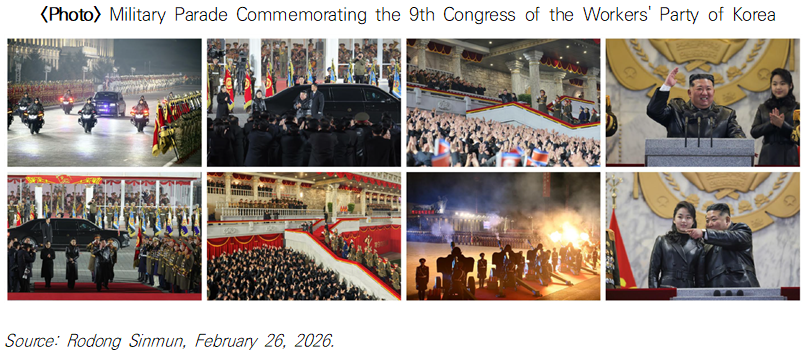
North Korea held a military parade commemorating the 9th Party Congress on the evening of the final day, February 25. At this event too, North Korea's Rodong Sinmun released a large number of photographs focused on Kim Ju-ae, suggesting that the 'elevation of Kim Ju-ae's profile' will continue regardless of whether she was formally elected to an official post.
-
1. South Korea Policy: Personnel Institutionalization of the 'Hostile Two-State Doctrine'
The complete departure of the dedicated inter-Korean negotiation and engagement line (Kim Yong-chol, Ri Son-gwon) and the absence of former United Front Department Director Jang Kum-chol from any key position signifies that the structural possibility of resuming inter-Korean dialogue has been foreclosed for the long term. North Korea has institutionalized the 'hostile two-state doctrine' through its personnel decisions, clearly signaling its intent to maintain a hardline posture regardless of regime change in South Korea or proposals for dialogue.
2. Nuclear and Military Strategy: Advancing the 2nd Five-Year Weapons Development Plan
Jo Chun-ryong's first-ever inclusion in the Central Military Commission strongly suggests that North Korea will pursue a 2nd Five-Year Weapons Development Plan (2026–2030). Following the 1st Plan (2021–2025), which secured multiple strategic weapons systems including the Hwasong-17 and -18 ICBMs and tactical nuclear weapons, the 2nd Plan is expected to target the precision enhancement and diversification of both nuclear and conventional forces, along with the advancement of nuclear command-and-control systems.
3. South Korea's Response Direction
The power elite reshuffling at the 9th Party Congress signifies not merely a personnel development but the official inauguration of 'Kim Jong-un System 2.0.' With the complete exit of the 'second-generation partisans' and the old guard, the legitimacy of North Korea's leadership has been entirely transferred from the revolutionary legacy of Kim Il-sung and Kim Jong-il to Kim Jong-un's own governing record. The new leadership, populated by practical experts, will conduct state affairs over the next five years along three axes: economic construction, nuclear force advancement, and a hardline posture toward South Korea.
Above all, what demands attention is the opening of the succession preparation era. Kim Yo-jong's strengthened official status, the reorganization of the Secretariat, the generational turnover of the Military Commission, and Kim Ju-ae — absent from the public list but positioned at the very center of the formation at the Kumsusan Palace New Year's visit — all of these elements point in a single direction. North Korea is quietly and meticulously designing the future of power at an unprecedentedly early juncture, while the current leader maintains formidable governing authority.
South Korea's government and expert community must not remain at the level of short-term personnel analysis, but should treat the power elite changes at the 9th Party Congress as the starting point for medium-to-long-term strategic analysis that anticipates the fundamental restructuring of the North Korean system going forward. South Korea's policy response to the power elite changes at the 9th Party Congress should proceed in three directions. First, substantive reinforcement of extended deterrence: the concurrent ascendancy of nuclear and military experts foreshadows that North Korea's nuclear and conventional weapons threats will continue to intensify, making it urgent to enhance the credibility of ROK-US extended deterrence and strengthen indigenous defense capabilities. Second, medium-to-long-term preparation for the Kim Ju-ae succession variable: scenario-based North Korea policies must be developed in anticipation of a potential generational leadership transition within North Korea within the next 10 to 15 years. Third, strengthening international coordination: security cooperation with the United States and middle powers possessing comparable military or economic capabilities — including Japan, France, the United Kingdom, and Germany — should be deepened,10) while China must be continually pressed to cooperate in restraining North Korea's nuclear advancement, limited as its influence over Pyongyang may be.
| Five Key Features of the 'Kim Jong-un 2.0 Era' and Power Elite Reshuffling
| Rise and Fall of Key Figures
| Kim Yo-jong's Rise and Its Implications for the Kim Ju-ae Succession System
| Assessment of Kim Ju-ae's Continued Absence from Official Posts and the Possibility of Undisclosed Election
| Policy Implications
1) Rodong Sinmun, February 23, 2026.
2) "Communiqué on the First Plenary Session of the 9th Central Committee of the Korean Workers' Party," Rodong Sinmun, February 24, 2026.
3) Ibid.
4) Rodong Sinmun, May 10, 2016.
5) Rodong Sinmun, January 11, 2021.
6) CHEONG Seong-Chang, Contemporary North Korean Politics: History, Ideology, and the Power Structure (Seoul: Hanul Academy, 2021), pp. 288–322.
7) "Central Committee Secretariat," Korean Central News Agency, September 28, 2010.
8) On the Central Military Commission, see CHEONG Seong-Chang, A Study on the Status and Role of the CMC as the Supreme Military Command Authority in the Kim Jong-un Era (Seoul: Sejong Institute, 2025).
9) Kim Myong-song, "'Computer Genius Female General Who Participated in Nuclear Construction': Kim Ju-ae Idolization Begins," SAND Times, January 7, 2026.
10) CHEONG Seong-Chang, "A New Security Architecture for the Post-Extended Deterrence Era: A Proposal for a Korea-Japan-France-UK-Germany 'Middle Power Five (MP5) Security Consultative Body,'" Sejong Focus, February 24, 2026.
※ The contents published on 'Sejong Focus' are personal opinions of the author and do not represent the official views of Sejong Institue