File
File

|
Designing a Commercial–Defense Integrated Space Architecture for the Realization of the Golden Dome: Strategic Implications of Integrating Commercial and Military Satellites |
| October 20, 2025 |
-
Kwang Sup JooVisiting Research Fellow, Sejong Institute | myjohj1@naver.com
-
On January 27, 2025, President Trump officially launched the next-generation missile defense initiative, the “Golden Dome,” through Executive Order 14186, and further elaborated on the concept on May 20 by unveiling an architecture incorporating space-based sensors and interceptors.1)
This initiative can be seen as the latest iteration of the United States’ pursuit of “absolute security,” following President Ronald Reagan’s Strategic Defense Initiative (SDI) of the 1980s and the National Missile Defense (NMD) program launched under the George W. Bush administration in 2001.2)
However, unlike previous initiatives, the Golden Dome brings space into the center of the battlefield, extending beyond the traditional domains of land, sea, and air. In this regard, it is not simply a missile defense network, but rather possesses the characteristics of a Space-Based Integrated Deterrence System.
The United States and South Korea reorganized the core decision-making structure of extended deterrence by launching the Nuclear Consultative Group (NCG) through the Washington Declaration in 2023.3)4) The United States is adjusting its cooperation framework to raise the priority of homeland defense while calling for a greater role from its allies in extended deterrence beyond its borders. Within this transition, the Golden Dome has emerged as both a new deterrence infrastructure designed to reduce America’s strategic burden and a core instrument in the competition for space dominance, allowing the United States to maintain its global influence.
Another defining feature of this initiative is its integration with the commercial space industry. Facing fiscal constraints, the United States seeks to enhance efficiency by actively incorporating commercial satellite constellations such as Starlink, Maxar, and Planet Labs into its Information, Surveillance, and Reconnaissance (ISR) assets. This signals a shift away from a traditional, closed military-satellite architecture toward what the original draft describes as “a structure in which commercial satellites and military assets operate as a single network.” In this system, the integration, processing, and resilience of data are emerging as complementary and indispensable components of national defense, alongside the performance of missile interceptors. President Trump’s remark that “private innovation is the foundation of America’s security” likewise reflects the intended direction of this Commercial–Defense Integrated Space Architecture.5)
Such developments had already been articulated as a concrete conceptual framework in RAND’s March 2025 report, Operational and Policy Implications of Integrating Commercial Space Services into DoD Operations. The military integration of commercial satellites and privately generated data enhances operational efficiency, yet it also brings accompanying legal and institutional challenges, including the establishment of a Data Trust Framework, as well as requirements related to insurance, liability, and cyber and physical protection. This aligns directly with the premise of the present study that these shifts represent a transition toward a data-centric deterrence ecosystem.6)
Ultimately, the Golden Dome is an experimental arena for a new deterrence paradigm. It expands deterrence beyond homeland defense and brings together space, AI, data, and allied cooperation. This paper examines, within this broader structural transformation, the strategic implications of integrating commercial and military satellites for the effectiveness of the deterrence system, as well as the forms of participation and autonomy that South Korea can secure amid these changes. -
The Trump administration’s Golden Dome initiative is being designed not as a traditional missile defense system, but as a Commercial–Defense Integrated Space Architecture that connects the ground, maritime, and space domains into a single integrated network. Its objective is not the simple enhancement of interceptor or weapons platform performance, but rather the construction of a unified network in which data collection, processing, decision-making, and response circulate in real time, thereby strengthening both the United States’ strategic deterrence posture and its battlefield command and control capabilities.
The Golden Dome is fundamentally based on the following Three-Layer Network.7)
<Figure 1> Data-Centric Missile Defense Architecture8) 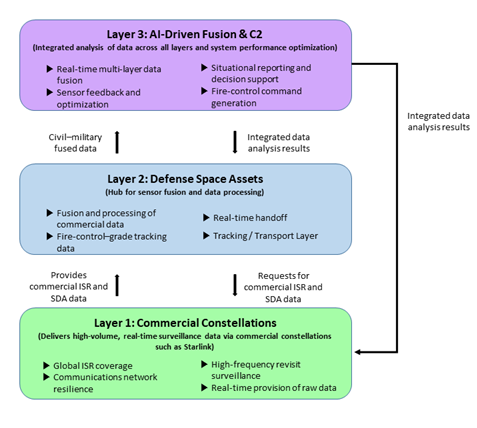
1. Layer One: Commercial Constellations Layer
The lowest layer consists of commercial satellite constellations such as Starlink, OneWeb, and Amazon Kuiper. These networks provide high-capacity communications and imagery transmission infrastructure made up of thousands of small Low Earth Orbit (LEO) satellites. Because they offer much shorter orbital revisit cycles than military reconnaissance satellites and can support automated image identification using AI, the United States seeks to employ them as an “expanded ISR (Information, Surveillance, Reconnaissance) platform.”
Commercial satellite constellations provide real-time observations of battlefield conditions worldwide and constitute a critical component of the early detection and warning phases of contemporary military operations. Starlink, in particular, demonstrated during the war in Ukraine an ability to sustain communications and maintain command and control (C2) continuity despite persistent adversary-induced electromagnetic interference. Golden Dome incorporates these commercial systems as its “first-layer detection, communications, and situational awareness” tier, with the aim of establishing a Dual Infrastructure in which commercially derived data is systematically integrated and rendered operational for military use.
The imagery and communications data collected at this layer are transmitted in real time to military satellite constellations and ground control elements, where they are immediately processed within the “AI-Driven Fusion and C2 Layer.” In effect, commercial constellations operate not as an auxiliary resource but as the forward-detection layer within the broader space-based deterrence architecture.
2. Layer Two: Defense Space Assets Layer
The intermediate layer consists of military satellite constellations led by the U.S. Department of Defense’s Space Development Agency (SDA), together with Overhead Persistent Infrared (OPIR) early-warning and reconnaissance satellites, as well as regional space units such as the Osan Space Squadron of U.S. Forces Korea. This layer constitutes the core operational segment of the Golden Dome architecture, performing the functions of interception and defensive engagement.
SDA is currently constructing a constellation of more than one thousand medium- and low-Earth orbit satellites under the Proliferated Warfighter Space Architecture (PWSA). These satellites conduct a range of missions, including surveillance, reconnaissance, target acquisition, and data transport, and they immediately share battlespace information when integrated with commercial data feeds.
Within the Golden Dome system, the key functions of ① Early Launch Detection, ② Trajectory Tracking, and ③ Guidance and Fire Control for interceptor assets are concentrated in this military-satellite layer. Supported by an AI-aided decision-support system, this layer is designed to enable attack–and-defense decisions within seconds, dramatically reducing response times against hypersonic glide vehicles (HGVs) by minimizing the need for human intervention.
The Osan Space Squadron of U.S. Forces Korea serves as a regional node within this multilayered network. By linking reconnaissance and surveillance assets operating over the Korean Peninsula to the Golden Dome’s global data architecture, it enables forms of space ISR sharing within the ROK–U.S. alliance. Over time, this arrangement could evolve into the foundation for an Extended Deterrence Space Link in which South Korea plays a direct and active role.
3. Layer Three: AI-Driven Fusion and C2 Layer
The uppermost layer consists of an AI-driven data fusion platform. This platform functions as the “brain” of the architecture, integrating in real time the vast quantities of data collected from commercial and military satellites in order to generate comprehensive battlespace awareness, analysis, and operational decision-making.
AI algorithms process information from multiple sensors, including satellites, radar, infrared systems, and electronic signals. Through sensor fusion, the system eliminates redundancies, detects anomalies, selects the most reliable data, and transmits it to operational command networks. By compressing the entire detect–assess–respond cycle into seconds, the system enables an Auto-Deterrence Loop that operates five to ten times faster than traditional human-centered decision processes.
This fusion platform functions not merely as a technical command-and-control mechanism, but as a meta-platform for strategic deterrence. In this framework, the speed and resilience of real-time data flows are directly linked to deterrence power. The AI system autonomously evaluates data reliability, activates backup pathways in the event of an attack, and is engineered to maintain operational continuity even under cyberattacks, electromagnetic interference, or the destruction of satellites.
This aligns with RAND’s emphasized concept of “Resilience by Design.”
4. Strategic Implications of the Integrated Network
This three-layer architecture represents “a paradigm shift from a weapon-centric defense system to a data-centric deterrence system.” In this framework, the decisive factor is not the performance of missile interceptors but the quality, speed, and resilience of information. Golden Dome treats the capacity to rapidly collect, process, and distribute data as a form of “force” in its own right.
Such an architecture also creates a new form of interdependence in allied cooperation. The military use of commercial satellite constellations inherently entails risks stemming from tensions between commercial interests and national security objectives, as well as the possibility that these assets become targetable entities. As a result, establishing a Data Trust Framework that ensures legal clarity and data sovereignty among allies becomes essential. This framework would enhance the flexibility of the ROK–U.S. extended deterrence posture and could be directly linked with South Korea’s independently developing systems, including the Korea Air and Missile Defense (KAMD), the national satellite-based surveillance architecture, and LIG Nex1’s manned–unmanned teaming (MUM-T) capabilities.
In essence, Golden Dome functions both as an industrial model for space-based deterrence and as a mechanism that accelerates the formation of a Data Alliance among allies. Within this system, data is not simply operational information, but becomes the currency of deterrence that underpins trust among states. -
The Trump administration’s Golden Dome initiative immediately elicited strong opposition from China and Russia. In a joint statement released on May 8, 2025, following the Putin–Xi summit, the two countries criticized the United States’ space-based missile defense network for “undermining the principle of the indivisibility of strategic offensive and strategic defensive weapons and threatening global strategic stability.”9)
They further characterized Golden Dome as Washington’s pursuit of “Strategic Absolute Security” and formally committed to strengthening their cooperation to counter it.
1. Expected Response Scenarios by China and Russia
Recent developments suggest that China and Russia are intensifying their cooperation across the space, electromagnetic, and cyber domains, raising the possibility that they are developing multilayered response strategies to the United States’ Golden Dome initiative. Although they officially maintain an anti-militarization stance on outer space, their technical and operational activities indicate preparations for response scenarios such as building a joint satellite network, conducting Integrated EW-ISR Operations, and integrating cyber and information warfare capabilities.
Their major anticipated response scenarios are as follows.
(1) Joint Satellite Constellation
China and Russia accelerated the development of their “joint satellite network” after June 2025. Russia’s Sfera Project (2024–2030) and China’s Guowang (GW) constellation, which aims to deploy 12,992 satellites, are being designed for interoperability, allowing shared functions for real-time surveillance, data relay, and communications redundancy. The integrated system could operate as an “anti–Golden Dome alternative space network” should the Golden Dome become active, providing the basis for a continuous joint surveillance and strike architecture that links ASAT capabilities, laser interference systems, and electronic intelligence (ELINT) assets.
China’s Guowang constellation, in particular, is designed as a dual-use system similar to Starlink and is being expanded through low-Earth orbit (LEO) multi-link connections to cover even Russia’s polar regions. Through this integrated architecture, China and Russia aim to ensure redundancy and communications resiliency during wartime by complementing each other’s satellite capabilities.
(2) Enhancing Space–Electromagnetic Warfare Integration (Potential for Networked Electronic–Electromagnetic Warfare, NEEW)
China and Russia are enhancing space–electromagnetic warfare integration, positioning Networked Electronic–Electromagnetic Warfare (NEEW) as a central component of their response strategy in parallel with the integration of their satellite constellations. Russia has upgraded the Krasukha-4 and Tirada-2S systems to strengthen their ability to disrupt satellite and ground communications, while China has expanded its Integrated EW–ISR Operations experiments through the deployment of the Hongyun-1 and Shenlong EW satellites.
The NEEW framework is designed to degrade the detection, tracking, and intercept accuracy of United States and allied satellite networks by conducting jamming, inducing data corruption, and executing signal spoofing. Russia is also modernizing its Peresvet laser interference system, and China is reportedly conducting ASAT tests using the Shenlong-II platform. These developments suggest an effort to build the technical capabilities necessary to potentially disrupt the Golden Dome’s upper-layer detection and communications architecture, including OPIR systems and relay satellites. Collectively, these activities indicate not only a military countermeasure but also the emergence of a “gray-zone strategy” that employs outer space as an active operational domain.
(3) Gray Zone Strategy and Multi-Domain Diffusion
China and Russia are developing a “multilayered asymmetric response structure” that integrates the satellite, electromagnetic, and cyber domains. This structure is designed to simultaneously disrupt, partially degrade, and fragment data flows within U.S. space networks while remaining below the threshold of open military conflict.
This approach reflects a combination of selective disruption and continuous coercion, with the objective of gradually degrading the Golden Dome’s detection, tracking, and command and control loop in a stepwise manner.
2. Institutional Fractures in Strategic Stability
These actions are fundamentally destabilizing the institutional foundations of strategic stability. Russia’s withdrawal of its ratification of the CTBT in 2024, the anticipated expiration of the New START treaty with the United States in 2026, and China’s expansion of its nuclear warhead stockpile along with the deployment of new MIRV equipped ICBMs have accelerated the “de facto collapse” of the arms control system.10) The Golden Dome is functioning as a catalyst for this fracture. As the United States pursues “comprehensive homeland defense,” China and Russia have strengthened the Strategy of Instability, expanding competition across nuclear, space, and cyber domains into a broader multi-domain race.
Such a dynamic reflects a classic stability–instability paradox, in which greater stability at the upper nuclear tier heightens instability in lower, non nuclear, and asymmetric domains.11) Indicators of this trend are already visible. Russia has intensified GNSS and GPS interference, China has expanded its ELINT collection efforts, and both states have undertaken measures to obstruct satellite data retransmission in regions such as the Russian Arctic and the South China Sea. In turn, securing Data Continuity has emerged as a central requirement for space based deterrence architectures.
3. Spillover Effects on the Korean Peninsula and the Role of South Korea
Escalating instability in the emerging regional security structure is already exerting direct pressure on the Korean Peninsula. North Korea is expected to portray the United States’ strengthening of missile defense and the advancement of the Golden Dome program as infringements on its “right to self defense,” a framing that will likely justify expanded nuclear and missile testing, along with intensified cyber and electronic warfare operations. China and Russia may leverage this narrative to deepen military and technological cooperation with North Korea and to position the Peninsula as a “strategic buffer zone” within their broader regional competition with the United States.
South Korea is expected to experience partial linkage to the Golden Dome network through the U.S. Space Operations Squadron at Osan. While this linkage will reinforce extended deterrence, it simultaneously increases South Korea’s exposure to Chinese and Russian targeting risk. For this reason, South Korea should avoid viewing the current environment solely as a crisis and instead turn it into “an opportunity for structural renewal” by advancing three strategic priorities: ① strengthening internal force posture with an emphasis on data resilience, ② institutionalizing space and information protection regimes, and ③ expanding South Korea’s role as a co designer in allied space deterrence architecture.12) -
The activation of the Golden Dome signals major shifts for both the ROK-U.S. extended deterrence architecture and South Korea’s broader strategic environment. As the United States concentrates increasingly on homeland-centric defense and places greater expectations on allies to share responsibility for out-of-area deterrence, South Korea must redefine its role, not as a passive beneficiary but as an active strategic partner. Ensuring strategic stability on the Korean Peninsula will require prioritizing U.S. extended deterrence, particularly the development of integrated deterrence and, within it, Conventional-Nuclear Integration (CNI), which currently represents the most viable course of action.
However, the effectiveness of integrated deterrence depends on resilience against cyber and AI-enabled attacks on space assets and the terrestrial communications and control architecture that connects them, including satellite control stations, data centers, and user terminals. Space systems rely as heavily on the survivability of ground infrastructure as on satellites in orbit, and disruption of these ground networks can paralyze the entire deterrence architecture. For this reason, the concept of “Resilience by Design,” or pre-embedded resilience, must be expanded beyond the space domain to encompass terrestrial infrastructure as a whole. Protecting ground networks should be recognized as a core determinant of the sustainability of any space-based defense architecture.
First, policy and institutional measures are essential.
To institutionalize the military use and protection of commercial satellite data, South Korea should enact a National Space Security Act (tentative title). The law should set out clear legal response mechanisms, insurance provisions, and protection measures for cases in which commercial satellite networks are targeted. This would not be a simple regulatory measure for the space industry, but a step toward establishing the domestic legal foundation for extended deterrence. Unlike the Space Development Promotion Act (2008), the Framework Act on National Informatization, or the National Cybersecurity Basic Plan, the proposed legislation would differ in three key respects: formally codifying commercial–defense integration, establishing provisions for data sovereignty, and creating protection-and-insurance regimes. It would also be the first national-level framework to explicitly define “data trust” and “cyber protection,” distinguishing it from Japan’s Space Security Act (2023) and the U.S. Commercial Space Launch Competitiveness Act (2015).
Second, practical participation in the technological and industrial domains is important.
South Korea must secure data interoperability with the U.S. space C2 network, based on the country’s space AI, data-trust infrastructure, and commercial–defense fusion ISR assets, so that an AI-based Defense Data Hub jointly involving domestic defense industries and commercial space companies can compensate for the budgetary and feasibility debates occurring in the United States and substantively strengthen the resilience of the GD. This platform will serve as the foundation for transforming South Korea’s space industry from a simple subcontracting structure into a “Data Alliance” model of joint operation and joint development.
Third, deeper cooperation at the alliance level is necessary.
South Korea and the United States should establish a Space Deterrence Working Group under the Extended Deterrence Strategy and Consultation Group (EDSCG) framework to discuss space information sharing, the protection of commercial satellites, and policies on commercial–defense data fusion. This working group must operate in a manner that is policy-coordinated with the Nuclear Consultative Group (NCG). Through this process, South Korea can establish its status not as a “protected state” under U.S. extended deterrence, but as a “co-designer” of the ROK–U.S. deterrence architecture.
Fourth, strategic communication and balanced diplomacy must proceed in parallel.
To prevent participation in the Golden Dome from being interpreted as anti-China balancing or as an expansion of military blocs, South Korea must maintain a clear policy frame that emphasizes “enhancing defense efficiency through data sharing.” This serves as the minimum diplomatic mechanism for easing unnecessary tensions with neighboring states while sustaining trust within the alliance.
Finally, securing autonomous capabilities for a Korean space-based deterrence posture is essential in the long term.
South Korea must accumulate core technologies in AI, satellite communications, radar, and electromagnetic warfare so that it can function not as a subordinate subsystem of the ROK–U.S. alliance, but as an autonomous cooperation partner. To this end, South Korea should establish institutional and infrastructural foundations in the short term, including the enactment of a National Space Security Act and the creation of a civil–military Defense Data Hub; strengthen technological independence in the medium term through the development of AI-based space C2 platforms and demonstrations of interoperability; and, in the long term, complete the construction of indigenous satellite navigation and reconnaissance systems to secure autonomous deterrence capabilities represented by “K-Space Deterrence 2035.” Such an approach will minimize technological dependence within the alliance and provide a practical means of ensuring South Korea’s strategic autonomy within global deterrence architectures such as the Golden Dome.
In sum, South Korea should view the Golden Dome era not as “a variable within the alliance,” but as an opportunity to advance space defense innovation and the growth of commercial–defense fusion industries. South Korea’s role as “a central pillar of the emerging Data Alliance and a coordinator of strategic balance in Northeast Asia” is no longer optional, but essential. -
The Trump administration’s “Golden Dome” is not simply a missile defense network, but a symbol of the emergence of an integrated deterrence architecture that brings together space, AI, and commercial data. It marks a turning point in twenty first century security paradigms, representing a shift away from the Cold War era of “arms competition” toward competition centered on data and networks.
Yet the United States’ concept of “absolute security” has prompted counter responses from China and Russia, widening strategic instability across the nuclear, space, and cyber domains. Within this structural uncertainty, South Korea must pursue a role not as a passive beneficiary of the alliance, but as an active designer and coordinator.
To achieve this, South Korea must- build a commercial–defense integrated space defense infrastructure that connects commercial and military data,
- securing leadership in institutional and policy standard setting by using the GD’s conceptual and policy gap phase to enable South Korea to take a leading role ahead of other allies in the design and demonstration of standard models such as combined C2 and trusted ISR and AI sharing networks, thereby establishing its position as a co designer of the future space security environment,
- pursue long term autonomous deterrence capabilities and technological independence.
The era of the Golden Dome shows that security can no longer be guaranteed by “defense” alone. The ability to control, interpret, and protect data, in other words “data sovereignty,” has become a new measure of national deterrence.
South Korea must position itself as a central pillar of the emerging Data Alliance and as a coordinator of strategic balance in Northeast Asia. This will serve as a sustainable solution for South Korea’s security in an age of uncertainty.
| Preface: Trump’s Second Term and the Realization of Space Warfare through the Golden Dome
1) The White House. (2025, May 20). The Golden Dome Missile Defense Shield. https://www.whitehouse.gov/videos/the-golden-dome-missile-defense-shield/1
2) 전성훈. 「트럼프의 골든 돔과 부시의 NMD 그리고 한미동맹」. 세종포커스, 2025-07-01.
3) The White House. Washington Declaration. 2023-04-26.
4) U.S. Department of Defense. Readout of the Inaugural U.S.–ROK Nuclear Consultative Group Meeting. 2023-07-18.
5) 전성훈. 「전략적 안정(Strategic Stability)에 대한 미-러, 미-중 갈등과 정책적 시사점」. 세종포커스, 2025-05-26.
6) RAND Corporation. Operational and Policy Implications of Integrating Commercial Space Services into U.S. Department of Defense Operations (RRA2562-2). 2025-03-04.
| The Integrated Commercial–Defense Architecture Under the Golden Dome Initiative
7) RAND Corporation. Operational and Policy Implications of Integrating Commercial Space Services into U.S. Department of Defense Operations (RRA2562-2). 2025-03-04.
8) Reconstructed with reference to related materials
| China and Russia’s Backlash and the Emerging Crisis of Strategic Stability
9) The Kremlin, “Joint Statement by the Russian Federation and the People’s Republic of China on Global Strategic Stability,” 2025-05-08.
10) 이상현·피터 워드, 「제3차 핵시대에서의 전략적 안정성」, 세종포커스, 2025-06-09.
11) RAND Corporation, Operational and Policy Implications of Integrating Commercial Space Services into DoD Operations (RRA2562-2), 2025-03-04.
12) The arguments presented in points ① and ③ draw upon and reference the analysis of Seong Whun Cheon, “Trump’s Golden Dome, Bush’s NMD, and ROK-U.S. Alliance” Sejong Focus, July 1, 2025.
| Directions for South Korea’s Strategic Posture
9) 유종규·신진, 「한국군의 ‘사이버전자전’ 수행을 위한 전략 분석」, 『한국군사학논집』 77권 3호, 2021
10) It refers to a cyber threat and defense knowledge framework developed by the MITRE Corporation in the United States.
11) 이주환·나승학, 「사이버 전쟁에서의 인지전 전략과 미래 방향성」, 『안보군사학연구』 20권 2호, 2023
12) The NATO Cooperative Cyber Defence Centre of Excellence (CCDCOE) serves as NATO’s principal hub for cyber defense research and training.
13) A representative U.S.-led cyber defense exercise program that simulates real-world network environments and enables participants to practice defending against cyberattacks in a realistic joint training setting.
| Conclusion: The Era of the Data Alliance and Strategic Autonomy
※ The contents published on 'Sejong Focus' are personal opinions of the author and do not represent the official views of Sejong Institue