File
File
|
Evaluation and Challenges of the Lee Jae-myung Administration’s Policy on Public Access to North Korea–Related Materials - Issues and a Roadmap from a Freedom of Information Perspective - |
| January 13, 2026 |
-
Seong-Chang CHEONGPrincipal Research Fellow, Sejong Institute | softpower@sejong.org
-
Freedom of access to information constitutes a core foundation of democracy. Article 19 of the Universal Declaration of Human Rights (UDHR) affirms that “everyone has the right to freedom of opinion and expression; this right includes freedom to hold opinions without interference and to seek, receive, and impart information and ideas through any media and regardless of frontiers.”1)
The Constitution of the Republic of Korea likewise guarantees freedom of expression and the public’s right to know under Article 21. In light of these universal principles, the long-standing policy of restricting access to North Korean materials, maintained for more than 55 years, has reached a point where fundamental re-examination is warranted.
On December 19, 2025, President Lee Jae-myung raised this issue during a Ministry of Unification policy briefing, criticizing restrictions on access to the Rodong Sinmun (Workers' Newspaper) as “unduly underestimating the level of public consciousness” and questioning whether such policies treat citizens not as autonomous agents but as individuals presumed to be susceptible to propaganda. President Lee further stated that lifting restrictions on access to the Rodong Sinmun could enable the public to understand the realities of North Korea more accurately and to reach the conclusion that “this is not a path to be followed,” thereby issuing a directive to move toward openness.2)
The government moved quickly to implement follow-up measures. On December 26, it convened an inter-agency consultative body responsible for overseeing restricted materials and decided to reclassify the Rodong Sinmun as general material. As a result, from December 30 onward, ordinary citizens were able to access the Rodong Sinmun without undergoing special procedures. In addition, the Ministry of Unification announced plans to lift access restrictions on approximately 60 North Korea–related websites, including those of the Korean Central News Agency and the Rodong Sinmun.3)
Notably, this policy direction is not exclusive to progressive administrations. In July 2022, under the Yoon Suk-yeol administration, the Ministry of Unification reported in its policy implementation plan that it would pursue the gradual opening of inter-Korean media, publishing, and broadcasting in order to expand mutual understanding and restore a sense of national homogeneity. At the time, Tae Yong-ho, a People Power Party lawmaker and former North Korean diplomat, expressed support for greater disclosure of North Korean materials, stating that “the level of consciousness among the Korean public is very high” and that citizens are no longer easily swayed by communist propaganda.4)
Nevertheless, a key distinction lies in the current Lee Jae-myung administration’s shift toward a comprehensive rather than incremental approach to openness. As this policy has been actively pursued, segments of the opposition have reacted strongly, characterizing the move as “unilateral disarmament” or “surrender to North Korea,” thereby intensifying political controversy.
Against this backdrop, this paper evaluates the Lee Jae-myung administration’s policy on public access to North Korean materials from the universal perspective of freedom of information, analyzes the core issues surrounding the policy, and proposes a policy roadmap that extends beyond the scope of official government announcements. -
Reclassification of the Rodong Sinmun as General Material
South Korea’s policy on controlling access to North Korea–related materials originates in the “Guidelines on the Handling of Special Materials” established in 1970 by the Korean Central Intelligence Agency, now the National Intelligence Service. Based on provisions of the National Security Act, including Article 7 concerning praise and incitement, these guidelines have long divided North Korean materials into two categories: first, “special materials” that praise or propagate the North Korean regime or deny the free democratic order; and second, “general materials” that do not fall into this category. Management and access have been strictly differentiated on this basis.5) For decades, the Rodong Sinmun, a North Korean state newspaper, was classified as a special material on the grounds that it contained content praising or propagating the activities of an anti-state organization. As a result, access was limited to a small number of designated institutions, such as the Ministry of Unification’s North Korea Information Center and the National Assembly Library.
Against this backdrop, on December 26, 2025, an Inter-Ministerial Consultative Body for the Oversight of Special Materials was convened, with participation from six government entities: the National Intelligence Service, the Ministry of Unification, the Ministry of Culture, Sports and Tourism, the Ministry of Education, the Ministry of Science and ICT, and the Korea Media and Communications Commission. The meeting formally decided to reclassify the Rodong Sinmun from special material to general material. As a result, from December 30 onward, members of the general public have been able to access the Rodong Sinmun at approximately 20 libraries nationwide where it is held, without the need for identity verification or prior authorization. That a North Korean newspaper has come to be treated on the same basis as ordinary publications for the first time in 55 years can be assessed as a historically significant measure to enhance the public’s right to know.
Nevertheless, substantial challenges remain. The reclassification of the Rodong Sinmun applies only to access to the print edition. Additional measures are required to allow online access to North Korean media in a manner consistent with the digital era, as access to North Korean online outlets remains blocked domestically.
Plans to Lift Access Restrictions on North Korean Websites
Following the easing of restrictions on access to the Rodong Sinmun, the Ministry of Unification announced that it would also pursue the lifting of access blocks on approximately 60 websites operated by North Korea, including the Korean Central News Agency and Korean Central Television. In a press briefing, Vice Minister of Unification Kim Nam-jung emphasized that the government plans to continue expanding access to North Korean information so that citizens, as sovereign actors, can freely obtain such information and, based on a mature level of civic awareness, independently compare, evaluate, and assess the realities of North Korea.6)
However, implementing the removal of online access restrictions requires legal adjustments. At present, the Korea Communications Standards Commission blocks access to North Korean websites on the basis of provisions in the Information and Communications Network Act, including Article 44, which allows the restriction of online content deemed to facilitate acts prohibited under the National Security Act. It is therefore difficult to lift these restrictions through executive action alone, making legislative revision necessary. In fact, in December 2025, members of the ruling party introduced an amendment to the Information and Communications Network Act that would continue to prohibit the distribution of North Korea–related content while permitting access and viewing.7) -
The debate surrounding the Lee Jae-myung administration’s policy of expanding public access to North Korea–related materials can be distilled into three core issues. This section outlines and analyzes the main arguments on each issue.
Issue 1: Can the public’s capacity for independent judgment be trusted?
Supporters emphasize that South Korean citizens are internationally recognized for their high levels of education and democratic competence. They argue that assuming large numbers of adult citizens would be easily swayed by crude North Korean propaganda effectively treats the public as minors in need of paternalistic supervision.
Opponents counter that North Korean media constitute hostile outlets produced for the explicit purpose of propagating the North Korean system and idolizing the Kim family. They warn in particular that vulnerable groups, such as adolescents, may be exposed to such propaganda without sufficient critical capacity.
[Analysis] The case of West Germany offers important lessons. From the 1960s onward, West Germany did not prohibit access to East German television or radio, yet West German citizens were not persuaded by communist propaganda. Moreover, it is highly unlikely that the MZ generation, accustomed to platforms such as Netflix and YouTube, would be captivated by North Korea’s anachronistic personality cult broadcasts. In practice, even a single hour of viewing Korean Central Television is likely to strike most viewers as outdated rather than persuasive. In this sense, direct exposure can more vividly imprint the backwardness of the North Korean system than abstract warnings, suggesting that openness itself may function as an effective form of security education.
Issue 2: Does information openness weaken security or strengthen it?
Supporters argue that inter-Korean system competition has effectively ended and that a country whose per capita income is roughly fifty times that of North Korea has little reason to fear North Korean information. They further point out that North Korea specialists in the United States, Japan, and China routinely analyze Korean Central News Agency dispatches and the Rodong Sinmun on a daily basis, while South Korean citizens and experts, who arguably need this information most, have long been denied access. This, they argue, amounts to deliberately blinding oneself.
Opponents criticize the policy as running counter to the Constitution’s commitment to liberal democratic and peaceful unification, characterizing it as an act of unilateral disarmament. They warn that unfiltered exposure to hostile propaganda could undermine ideological security.
[Analysis] It is important to note that under Kim Jong Un, the informational value of North Korean media has increased substantially. Analysis of the succession trajectory surrounding Kim Ju-ae is a representative example. In November 2025, Japan’s Nikkei newspaper reported, based on AI facial recognition analysis, that Kim Ju-ae appeared more than 600 times on Korean Central Television over a three-year period following her first public appearance.8) Her associated honorifics were also successively elevated, from “beloved child” to “respected child,” and eventually to “the great personages of guidance.”9) On January 1, 2026, during the visit to the Kumsusan Palace of the Sun, Kim Ju-ae was positioned at the exact center where Kim Jong Un himself would normally stand.10) Through systematic analysis of North Korean media, it is therefore possible to track Kim Jong Un’s health, succession planning, and shifts among elite power holders. From this perspective, information openness constitutes not a security risk but a means of strengthening analytical capacity on North Korea.
Issue 3: How can legal consistency be ensured?
A key concern is that while access to the Rodong Sinmun is now permitted, citing or using its content in certain contexts may still constitute a violation of the National Security Act, potentially creating legal ambiguity. Critics argue that it remains unclear where the boundary lies between permissible access and impermissible use, particularly in relation to discussion and citation.
[Analysis] Existing judicial precedents require not mere possession or reading, but specific acts of praise, incitement, or propaganda to establish a violation. On this basis, it is legally feasible to delineate the boundary between openness and punishment. For example, citing North Korean media for purposes of criticism or analysis can be permitted, while endorsement or promotion of the North Korean system can remain punishable. The government should therefore present clear guidelines that protect academic and public-interest use while distinguishing such activity from genuine pro-North Korean conduct. -
First, there are clear limits to practical accessibility. The current measures are confined to access to printed newspapers. In order to read the Rodong Sinmun, individuals must still visit one of roughly twenty designated institutions nationwide, while access to related websites remains blocked. In the digital era, allowing access only to printed newspapers while maintaining online restrictions amounts to a partial and inadequate measure, comparable to permitting books to be read in a library while prohibiting any form of copying.
Second, legal and institutional adjustments remain necessary. Lifting blocks on access to North Korean websites requires amendments to the Information and Communications Network Act. Under the current legal framework, this law provides the basis for blocking information deemed to violate the National Security Act, making it difficult to remove website restrictions through administrative action alone.
Third, there is a problem of differential application. Government ministries, the National Assembly, and accredited journalists and experts have long been able to access North Korean media on a regular and lawful basis. In a context where the media cite the Rodong Sinmun on a daily basis, restricting access to original sources only for the general public raises concerns of fairness. The effectiveness of such regulation is also questionable. Circumvention through VPNs is already widespread, meaning that individuals who wish to access North Korean materials are, in practice, often already doing so. -
The abandonment of North Korea’s peaceful unification discourse and the logic of information openness
During the Cold War, North Korea openly pursued communist unification through a so-called “South Korean revolution.” In that context, restrictions on access to North Korean propaganda had a certain internal logic. That context, however, has fundamentally changed. In December 2023, at a plenary meeting of the Workers’ Party of Korea Central Committee, Kim Jong Un declared that “inter-Korean relations are no longer relations among one people or a homogeneous nation, but relations between two hostile states, two belligerent states at war.”11)
This declaration does not imply the disappearance of military threats. At the same meeting, Kim emphasized the need to “continue accelerating preparations for a great decisive event to subjugate the entire territory of South Korea by mobilizing all physical means and capabilities, including nuclear forces, in case of contingency.”12) What merits closer attention, however, is that the logical foundation of the past strategy of “South Korean revolution through propaganda and agitation” has been dismantled by North Korea itself. If the original rationale of restricting access to North Korean materials was to prevent ideological penetration, that rationale is substantially weakened in a situation where North Korea has explicitly abandoned appeals to shared national identity and kinship.
Even more noteworthy is the fact that the writings of Kim Il Sung and Kim Jong Il are replete with references to unification, including concepts such as “great national unity,” “independent peaceful unification,” and “by our nation itself.” These ideas stand in direct contradiction to Kim Jong Un’s current doctrine of “two hostile states.” The more deeply South Korean experts and authorities engage with the works of Kim Il Sung and Kim Jong Il, the stronger their position becomes in ideological and political debates with the Kim Jong Un regime over unification. Opening access to North Korean materials thus provides South Korea with an effective instrument of argument rather than a vulnerability.
Asymmetry in inter-Korean access to information
Under North Korea’s Reactionary Ideology and Culture Rejection Law, residents caught viewing South Korean dramas or films face sentences of five to ten years of labor reeducation, while large-scale distribution or circulation can result in the death penalty.13) Despite this, North Korean residents continue to circulate South Korean popular culture through USB drives and SD cards. Even in one of the world’s most tightly controlled information environments, the penetration of South Korean content has proven impossible to fully prevent.
By contrast, access to North Korean media in South Korea is restricted by law. Although the use of VPNs to circumvent these restrictions is already widespread, meaning that those determined to access North Korean materials often do so in practice, this reality merely highlights the erosion of regulatory effectiveness. The more fundamental issue remains the absence of a legally guaranteed right of access. An asymmetry persists in which North Korean residents risk their lives to consume South Korean content, while South Korean citizens must operate in a legal gray zone to access North Korean media. Although a gap between norms and practice exists on both sides, the question remains valid as to why South Korea, a system with clear structural advantages, should continue to rely on outright prohibition as its governing principle.
The experience of West Germany offers a useful reference point. From the 1960s onward, West Germany did not prohibit the viewing of East German television or radio broadcasts. Information exchange between East and West Germans contributed to the psychological foundations of eventual reunification. Information openness did not undermine system security. Instead, it reflected West Germany’s confidence in prevailing in systemic competition.14)
Three-stage policy roadmap and points of differentiation
Building on the direction of the Lee Jae-myung administration’s measures, this paper proposes a three-stage roadmap that goes beyond current government announcements. The table below outlines the key differences between the government’s stated approach and the author’s proposed framework.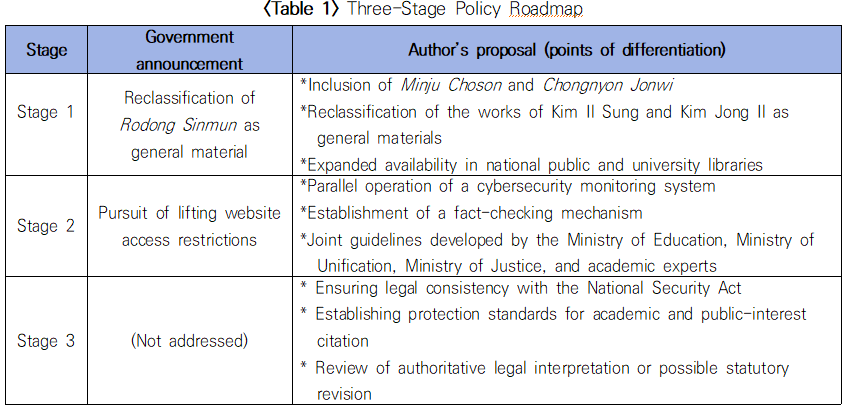
Stage 1: As already initiated, Rodong Sinmun, along with other North Korean newspapers such as Minju Choson (Democratic Korea) and Chongnyon Jonwi (Youth Vanguard), as well as the works of Kim Il Sung and Kim Jong Il, should be sequentially reclassified as general materials. These North Korean materials should be made available in public and university libraries nationwide so that not only researchers but also any interested citizen can access and read them.
Stage 2: After revising relevant legislation such as the Information and Communications Network Act through parliamentary legislation, access restrictions on official North Korean media websites, including those of the Korean Central News Agency and Rodong Sinmun, should be lifted. At this stage, technical monitoring systems should operate in parallel to assess cybersecurity risks, and fact-checking mechanisms should be established to address disinformation disseminated by North Korea. Consideration should also be given to developing joint guidelines involving the Ministry of Education, the Ministry of Unification, the Ministry of Justice, and academic experts.
Stage 3: This stage focuses on ensuring consistency between the National Security Act and the policy of openness. The government should establish clear guidelines on the use of North Korean materials, protecting academic and public-interest citation while setting standards that clearly distinguish genuine acts of aiding the enemy. Given that existing case law requires not mere possession or reading but an act of praise, incitement, or propaganda, the boundary between openness and punishment can be defined on a sound legal basis. -
The Lee Jae-myung administration’s policy of opening access to North Korean information is directionally sound in that it safeguards the public’s right to know and enhances accurate understanding of North Korea. Long-standing information blockade policies, sustained largely by inertia over several decades, required reassessment in light of changing times and the realities of inter-Korean relations, and the first step toward such a transition has now been taken. That said, current measures remain limited to allowing access to print newspapers. For the policy to move beyond declaratory intent and be tangibly felt by the public, follow-up actions including legal revision and online access must continue.
This paper examined three core issues surrounding the policy: trust in the public’s capacity for judgment, the relationship between information openness and security, and legal consistency. Considering the increased informational value of North Korean media under the Kim Jong Un era, North Korea’s abandonment of peaceful unification discourse and ideological appeals, and the asymmetry in information access between North and South, this analysis concludes that openness can function not as a security threat but as a security asset. The paper also proposed a three-stage policy roadmap that goes beyond official government announcements, with particular emphasis on the third stage of ensuring consistency with the National Security Act, an area not yet addressed by the government and representing the paper’s independent contribution.
Naturally, the advancement of information openness requires the building of social consensus and the gradual implementation of each stage. The government should listen carefully to public concerns and clearly explain the rationale for openness through transparent communication and education. At the same time, legal boundaries must be firmly maintained to prevent the misuse of North Korean information for acts that genuinely undermine national security.
As proclaimed in Article 19 of the Universal Declaration of Human Rights, free access to information is a universal right. A Republic of Korea that has overwhelmingly prevailed in system competition has no reason to fear the free flow of information. The party that should fear information openness is not South Korea, but the North Korean regime. Opening access to North Korean information will ultimately contribute to raising the quality of peace and unification discourse on the Korean Peninsula.
| Problem Statement
| Policy Implementation Status
| Analysis of Key Issues
| Limitations of the Current Policy
| Policy Recommendations
| Conclusion
1) Office of the United Nations High Commissioner for Human Rights, “Universal Declaration of Human Rights – Korean (Hankuko) Translation,” https://www.ohchr.org/en/human-rights/universal-declaration/translations/korean-hankuko (Search date: January 12, 2026).
2) Ko Dong-wook and Hwang Yoon-gi, “President Lee: ‘Restricting Access to Rodong Sinmun Treats Citizens as Susceptible to Propaganda,’” Yonhap News Agency, December 19, 2025.
3) Jung Ji-hye, “From Today, ‘Rodong Sinmun’ Freely Accessible: ‘Moving Beyond Confrontational and Severed North Korea Policy,’” Segye Ilbo, December 30, 2025.
4) Baek Seo-yeon and Park Hyo-jun, “‘Reopening Access to North Korean Media’ Debate Rekindled… Controversy over National Security Law Violations Inevitable,” The Seoul Shinmun, December 22, 2025.
5) Yoo Ja-bi, “Government to Reclassify Rodong Sinmun as ‘General Material’… ‘Official Measures Expected Next Week,’” Newsis, December 26, 2025.
6) Lee Je-hoon and Jang Ye-ji, “Rodong Sinmun Accessible Without Separate Procedures Starting Today,” The Hankyoreh, December 30, 2025.
7) Shin Hye-yeon, “Democratic Party Proposes Bill to Allow Access to North Korean Websites,” JoongAng Ilbo, December 15, 2025.
8) “AI Analytics Spots Kim Ju Ae Among 14,115 Hours of Footage,” Nikkei Asia, November 25, 2025, https://asia.nikkei.com/static/vdata/infographics/north-korean-daughter/ (Search date: November 25, 2025).
9) Rodong Sinmun, March 16, 2024, p. 3. “Hyangdo” is a term used in North Korea exclusively for the supreme leader and his designated successor.
10) Cheong Seong-chang, “The 9th Congress of the Workers’ Party of Korea and the Prospect of Officializing Kim Ju Ae’s Status as Successor,” Sejong Focus, January 2, 2026.
11) Rodong Sinmun, December 31, 2023.
12) Rodong Sinmun, December 31, 2023.
13) For the full text of North Korea’s Law on the Rejection of Reactionary Thought and Culture (enacted in 2020), see https://www.dailynk.com/english/wp-content/uploads/2023/03/PDF-반동사상문화배격법_영한본.pdf (accessed January 8, 2026).
14) Kim Nuri et al., Approaching Through Change: Fifteen Years of German Unification as Reflected by Key Actors (Seoul: Hanul Academy, 2006).
※ The contents published on 'Sejong Focus' are personal opinions of the author and do not represent the official views of Sejong Institue