File
File
|
A “Big Deal” Strategy for Building a Comprehensive Strategic Partnership between the Republic of Korea and France - An Exchange Framework and Implementation Roadmap Linking Nuclear-Powered Submarines, the Nuclear Fuel Cycle, and Defense Industrial Cooperation - |
| January 21, 2026 |
-
Seong-Chang CHEONGPrincipal Research Fellow, Sejong Institute | softpower@sejong.org
-
The 140th Anniversary of ROK–France Diplomatic Relations and President Macron’s Visit to Korea
The year 2026 marks the 140th anniversary of diplomatic relations between South Korea and France1) and presents a historic opportunity to elevate bilateral ties to a comprehensive strategic partnership. At the sidelines of the G20 Summit in South Africa in November 2025, President Lee Jae-myung and President Emmanuel Macron agreed to upgrade the relationship to a strategic partnership, and President Macron accepted an invitation to visit South Korea in 2026.2) It is widely expected that the visit will take place in the first half of the year. If realized, this would be the first visit by a French president to Korea in 11 years, following President Hollande’s visit in 2015.
France is uniquely positioned among Western countries as the only state that possesses both low-enriched uranium (LEU)-based nuclear-powered submarine technology and a complete nuclear fuel cycle. Moreover, French defense and nuclear technologies are not subject to U.S. International Traffic in Arms Regulations (ITAR), providing a high degree of autonomy in technology transfer. These attributes make France an optimal cooperation partner for South Korea.
Against this backdrop, this paper aims to propose concrete pathways for strategic cooperation between South Korea and France in areas such as nuclear-powered submarines, uranium enrichment and reprocessing, defense industries, and shipbuilding, with the forthcoming bilateral summit as a key catalyst. In particular, it examines the strategic reciprocal measures that South Korea could offer to elicit French cooperation in core technologies, sets out priority agenda items for the summit, and seeks to provide a policy foundation for building a long-term strategic partnership.
The Changing International Security Environment: Trump’s Second Term and the Reconfiguration of Alliances
The National Security Strategy released by the second Trump administration in December 2025 signaled a fundamental shift in the U.S. approach toward allies. The document reaffirmed “America First” and explicitly articulated a transition from burden-sharing to burden-shifting. It called on allies to assume primary responsibility for their own security and to contribute far more to collective defense, while declaring a strategic reorientation toward concentrating U.S. diplomatic and security resources in the Western Hemisphere, effectively a “Trump-era Monroe Doctrine.”
This shift in the U.S. strategic center of gravity has imposed a new imperative on key allies in Europe and Asia to secure greater strategic autonomy. Paradoxically, it has also expanded the space for strategic cooperation among middle powers such as South Korea and France. Both countries are core U.S. allies that have simultaneously pursued strategic autonomy, and the changing security environment has increased the need for mutually complementary cooperation. In particular, cooperation with France, whose sensitive military technologies are not subject to ITAR, offers South Korea a critical opportunity to diversify its channels of technological access.
Implications of the Gyeongju ROK–U.S. Summit
The ROK–U.S. summit held in Gyeongju in late October 2025 marked a historic turning point in South Korea’s nuclear policy. In exchange for substantial economic contributions, including large-scale investment in the declining U.S. shipbuilding industry, particularly the Philadelphia shipyard, South Korea succeeded in securing greater security autonomy from the United States in the form of approval to build nuclear-powered submarines and cooperation on the nuclear fuel cycle. According to the joint fact sheet, the United States approved South Korea’s construction of nuclear-powered attack submarines (SSNs) and committed to working closely with Seoul to advance the requirements for the shipbuilding project, including fuel procurement arrangements.
Even more significant was the explicit U.S. statement that, in accordance with the bilateral 123 Agreement and consistent with U.S. legal requirements, Washington supports a pathway leading to civilian uranium enrichment and spent fuel reprocessing for peaceful purposes in South Korea. In return, South Korea pledged an overall investment framework totaling USD 350 billion to support the revitalization of the U.S. shipbuilding industry, including USD 150 billion for shipbuilding cooperation under the MASGA framework and USD 200 billion in cash investments. Hanwha Group’s acquisition of the Philadelphia shipyard and its USD 5 billion investment symbolized the first concrete step in this process.
The core lesson of the Gyeongju agreement lies in the principle of quid pro quo. This provides an important precedent for negotiations with France. If South Korea seeks cooperation from France on nuclear-powered submarines and enrichment and reprocessing technologies, it must offer tangible contributions in areas of strategic importance to France. Negotiating leverage increases when cooperation is structured not as a single-issue transaction but as a comprehensive package linking multiple domains. -
Low-Enriched Uranium (LEU)-Based Nuclear-Powered Submarine Technology
France is the only country in the Western world that operates nuclear-powered submarines fueled by low-enriched uranium (LEU). This carries significant implications from a nonproliferation perspective and positions France as a critical cooperation partner for South Korea, which is seeking to pursue LEU-based nuclear-powered submarines.
The French Navy’s latest nuclear-powered attack submarine, the Suffren-class, represents a top-tier platform, with a submerged displacement of approximately 5,300 tons and a length of 99.5 meters.3) The defining feature of this submarine is its K15 reactor, which uses LEU enriched to approximately 5–6 percent.4) The reactor has a refueling cycle of roughly 10 years and supports a maximum speed of about 25 knots and an operational diving depth exceeding 300 meters.
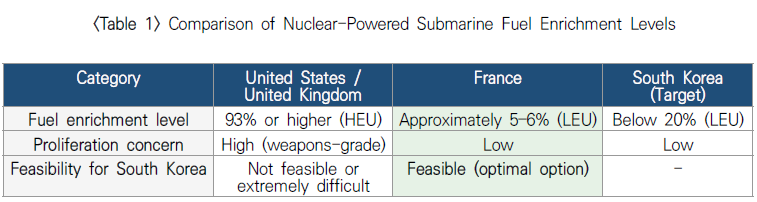
France’s LEU-based nuclear-powered submarine technology is well suited to South Korea’s requirements in several critical respects. First, it represents the only realistic pathway for South Korea to acquire nuclear-powered submarines while remaining compliant with the enrichment ceiling of below 20 percent stipulated under the ROK–U.S. Atomic Energy Agreement. The United States and the United Kingdom rely on highly enriched uranium (HEU) exceeding 90 percent, which is neither transferable nor politically feasible for South Korea. Second, France’s approach is fully compatible with the Nuclear Non-Proliferation Treaty (NPT), thereby minimizing international controversy and safeguarding South Korea’s nonproliferation credentials. Third, France has demonstrated flexibility in technology cooperation with non-nuclear-weapon states, as evidenced by its provision of hull design and non-nuclear systems support for Brazil’s nuclear-powered submarine program. In the case of South Korea, cooperation need not involve direct transfer of reactor core technology; instead, a tailored model could focus on LEU reactor design integration, safety validation, and joint development of non-nuclear subsystems.
France’s Suffren-class submarines are reported to have reduced acoustic signatures to one-thousandth of those of the preceding Rubis-class. Technologies such as pump-jet propulsion, vibration isolation systems, anti-resonance structures, and advanced hull acoustic masking are areas where cooperation is feasible without transferring sensitive nuclear technologies. In addition, the French Navy has accumulated over three decades of operational experience with LEU-based naval reactors, including fuel management, maritime nuclear safety, and sustained long-duration deployments. Cooperation in doctrine and training also carries significant value, including education of South Korean officers at the École des applications militaires de l’énergie atomique (EAMEA),5) commonly referred to as the École Atomique, as well as operational observation programs with the French Navy Staff and aboard the aircraft carrier Charles de Gaulle.
Following Australia’s termination of the €56 billion submarine contract with France in 2021 due to the formation of AUKUS, France has actively sought new strategic partners. In this context, former French Ambassador to South Korea Philippe Lefort’s public expression of interest in nuclear submarine cooperation with Seoul warrants particular attention.6)
World-leading spent nuclear fuel reprocessing capabilities
France possesses one of the most advanced nuclear fuel cycle capabilities in the world. The state-owned company Orano oversees the entire fuel cycle, including uranium mining, conversion, enrichment, spent fuel reprocessing, and waste management. Its flagship facility, the La Hague reprocessing plant, has been in operation since 1976 and is the largest reprocessing facility globally. With an annual capacity of approximately 1,700 tons and a cumulative processing record exceeding 36,000 tons of spent fuel, La Hague accounts for roughly 45 percent of global light-water reactor spent fuel reprocessing capacity (approximately 3,800 tons per year).7)
The La Hague facility employs the aqueous PUREX (Plutonium Uranium Refining by Extraction) process to separate reusable materials from spent fuel, recovering approximately 95 percent uranium and 1 percent plutonium, while vitrifying the remaining 4 percent of fission products for long-term storage. Beyond domestic use, France has reprocessed spent fuel from Germany, Japan, Switzerland, Belgium, the Netherlands, and Italy. Japan’s Rokkasho reprocessing facility is directly based on La Hague technology.
South Korea currently operates 24 nuclear reactors and stores more than 18,000 tons of spent nuclear fuel, a figure that continues to rise. Storage capacity at reactor sites is projected to reach saturation in the early 2030s, with Hanbit expected to reach capacity by 2030 and Hanul and Kori by 2031–2032. Cooperation with France could address this urgent challenge while advancing South Korea’s long-term objective of fuel cycle autonomy.
In the short term, South Korea could explore consignment reprocessing of spent fuel at La Hague, alleviating domestic storage pressures while generating service revenues for France. In the medium to long term, a hybrid model combining South Korea’s research into pyroprocessing with France’s PUREX expertise could be developed, or a reprocessing facility could be constructed in South Korea with French technical assistance. Recovered uranium and plutonium could be fabricated into MOX fuel, enhancing fuel self-sufficiency and reducing dependence on imported uranium, thereby strengthening energy security.
Cooperation in uranium enrichment
France also maintains world-class capabilities in uranium enrichment. Orano’s Georges Besse II enrichment plant, with an annual capacity of approximately 7,500 tSWU, is the largest commercial enrichment facility in Europe and accounts for around 15 percent of the global enrichment market. Based on centrifuge technology, it is recognized for its economic efficiency and operational reliability.
Amid Western efforts to reduce dependence on Russian enrichment services, Orano is pursuing a project to expand enrichment capacity by more than 30 percent. In this context, South Korea could participate through capital investment in exchange for guaranteed off-take rights to a fixed annual quantity of enriched uranium.
With an annual capacity of roughly 7,500 tSWU, even a 3–5 percent equity stake or equivalent long-term off-take arrangement would secure approximately 200–400 tSWU per year for South Korea. This approach constitutes a form of “virtual enrichment,” whereby practical enrichment capability is ensured through overseas assets rather than immediate domestic facilities. Given that a single LEU-based nuclear-powered submarine is estimated to require approximately 5–15 tSWU annually, depending on design and operational parameters,8) such arrangements would comfortably support submarine fuel needs while also stabilizing LEU supply chains for future nuclear exports. This would represent the most reliable and realistic means of stably procuring the low-enriched uranium fuel (below 19.75 percent) essential for the future operation of Korean LEU nuclear-powered submarines, free from U.S. control.
LEU-based nuclear propulsion requires fuel fabricated to specifications distinct from those used in civilian reactors. France, as the only Western country with sustained experience supplying LEU fuel to naval submarines and aircraft carriers, is uniquely positioned to serve as South Korea’s initial fuel supplier and technical partner. A phased approach would be realistic, leveraging French enrichment services and technical support in the early stages while gradually developing indigenous capabilities.
The revised 2015 ROK–U.S. Atomic Energy Agreement stipulates that enrichment activities require separate consent, and the October 2025 Gyeongju ROK–U.S. summit produced a principled approval for enrichment below 20 percent. However, political approval and actual technological capability are distinct. Joint research on centrifuge technology and personnel exchanges with France could provide South Korea with a critical stepping stone toward establishing its own enrichment capacity. -
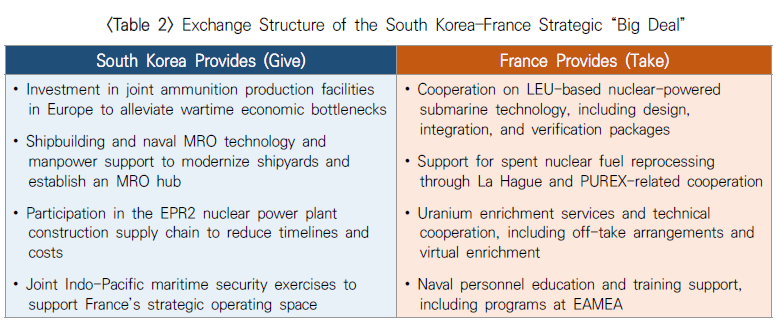
To secure France’s cooperation on core technologies, South Korea must provide strategic investment and partnership in areas of critical importance to France. France’s most pressing needs can be broadly grouped into three categories: strengthening defense industrial supply chains amid the prolonged Russia–Ukraine war, modernization of naval shipbuilding and maintenance including MRO capabilities, and stabilization of supply chains for new nuclear power plant construction projects, particularly the EPR2 program. South Korea possesses globally competitive capabilities in all three areas and is therefore an ideal partner to compensate for France’s current constraints. France’s priorities under a wartime economic posture require speed and scale, and South Korea is effectively the only partner capable of delivering both in the short term.
Defense industrial supply chain reinforcement
The prolonged Russia–Ukraine war has placed Europe under acute pressure to expand defense production capacity. European NATO members have supplied Ukraine with approximately 1,200 main battle tanks, more than 4,000 armored vehicles, and over 600 self-propelled artillery systems, significantly depleting their own defense stockpiles. France, following President Macron’s declaration of a “war economy,” has sought to increase production output but continues to face structural bottlenecks stemming from shortages of skilled labor and aging industrial facilities.
In the case of 155mm artillery ammunition, France has secured shell body production capacity but remains constrained in the production of modular charge systems, which currently meet only about half of operational demand. Even with sufficient shell bodies, a lack of propellant modules renders the ammunition unusable, making MCS production the key bottleneck determining overall output. The French Ministry of Defense planned from 2023 to increase monthly production from 1,000 rounds to 3,000 rounds by 2024, but limitations within the domestic defense industry have made it difficult to meet demand in the short term. This gap underscores the strategic value of South Korea’s defense industry, which is characterized by rapid mass production capabilities and highly automated manufacturing processes.
South Korean defense firms maintain annual artillery production capacities exceeding 200,000 rounds and have demonstrated global competitiveness in land systems such as the K9 self-propelled howitzer, K2 main battle tank, and Chunmoo multiple launch rocket system. Poland alone has committed to acquiring more than 360 K2 tanks valued at approximately USD 10.3 billion, 364 K9 howitzers valued at around USD 5 billion, Chunmoo and HOMAR-K systems worth roughly USD 9 billion, and 48 FA-50 light attack aircraft valued at approximately USD 3 billion, amounting to total contracts exceeding USD 27 billion.9) These figures illustrate the competitiveness of South Korean defense systems in the European market.
Rather than limiting cooperation to finished product exports, South Korea and France could maximize mutual benefits by establishing strategic joint production hubs within Europe. A concrete model would involve the creation of joint ventures between South Korean firms such as Hanwha Aerospace and Poongsan and French entities such as KNDS Nexter10) /Eurenco.11) By introducing South Korean automated production lines in mainland France or Eastern Europe, output of artillery shells and propellant charges could be increased by more than twofold. Mainland France offers political symbolism and domestic legitimacy, while Eastern Europe provides advantages in cost, labor availability, and proximity to the Ukrainian theater.
Shipbuilding and naval maintenance and repair cooperation
France retains substantial capabilities in naval shipbuilding through Naval Group, particularly in the construction of nuclear-powered submarines and aircraft carriers, but has long lost competitiveness in commercial shipbuilding. South Korea, by contrast, accounts for approximately 25 percent of the global shipbuilding market as of the first half of 2025 and is home to three global leaders, HD Hyundai, Samsung Heavy Industries, and Hanwha Ocean. These firms dominate high value-added vessel construction, including LNG carriers, ultra-large container ships, and specialized vessels.
The rapidly expanding global naval maintenance, repair, and overhaul market represents a major opportunity for bilateral cooperation. As of 2024, the global naval MRO market was estimated at approximately USD 57.7 billion and is projected to grow at an annual rate exceeding 7 percent. South Korean shipyards maintain skilled workforces and efficient processes by building both commercial and naval vessels concurrently, giving them strong competitiveness in MRO services. In particular, South Korea’s digital shipyard technologies and lifecycle support expertise are essential for the modernization of French shipbuilding infrastructure.
Under a cooperative model, South Korea could contribute technology and personnel to modernize French naval MRO facilities, helping position France as a regional MRO hub for Europe and the Mediterranean. This would enhance operational availability for the French Navy while strengthening the long-term competitiveness of the French shipbuilding sector. France’s overseas territories in the Indo-Pacific, including New Caledonia, further elevate the importance of maritime security and logistical support in the region. South Korea could support French strategic objectives through regularized joint naval exercises and logistical cooperation in the Indo-Pacific.
Nuclear power plant construction supply chain support
France has been pursuing a nuclear renaissance since President Macron’s 2022 Belfort Declaration. The centerpiece of this effort is the planned construction of six next-generation European Pressurized Reactor 2 units, with phased commissioning targeted from 2038 onward.12) However, Électricité de France has previously experienced severe delays and cost overruns in EPR projects. Finland’s Olkiluoto Unit 3, originally scheduled for completion in 2009, only entered commercial operation in 2023, while the Flamanville EPR has been delayed for more than twelve years. For EDF, securing stable supply chains and reducing construction timelines is a matter of strategic urgency.
South Korea reaffirmed its global competitiveness in nuclear power construction by winning the Dukovany nuclear power plant project in the Czech Republic in 2024, valued at approximately KRW 24 trillion, surpassing EDF.13) South Korea’s record of schedule adherence at the Barakah nuclear power plant in the UAE, combined with high-quality equipment supply chains and skilled construction labor, can make a tangible contribution to the EPR2 program.
If South Korean firms participate in the EPR2 supply chain, France can expect reduced construction costs and shortened timelines, while South Korea gains a strategic foothold in the European nuclear market. Over the longer term, South Korea and France could jointly develop next-generation nuclear technologies such as small modular reactors and pursue joint entry into third-country markets in Southeast Asia and Eastern Europe. Such cooperation would generate synergistic gains by strengthening the nuclear industries of both countries simultaneously.
Potential Competitive Frictions in ROK–France Defense Cooperation and Mitigation Strategies
For ROK–France strategic defense cooperation to succeed, potential areas of competition must be identified in advance and managed carefully. Cooperation and competition coexist, and long-term partnership is best sustained not by ignoring competitive elements but by addressing them transparently and institutionally.
First, competition in third-country defense export markets requires deliberate management. South Korea and France are direct competitors in key arms export regions such as the Middle East, Southeast Asia, and Latin America. South Korea’s K9 self-propelled howitzer and France’s CAESAR system, as well as South Korea’s KF-21 fighter and France’s Dassault Rafale, target overlapping market segments. To prevent excessive competition, the two governments should clearly delineate areas of cooperation, such as nuclear-powered submarines and joint ammunition production, from areas of competition, particularly conventional weapons exports. Establishing a structured strategic dialogue on third-country markets would help mitigate friction. In certain cases, complementary role-sharing may be feasible, for example through package exports that combine France’s strengths in aviation with South Korea’s competitiveness in ground systems.
Second, the issue of asymmetry in technology transfer must be handled prudently. Nuclear-powered submarine technology constitutes a core strategic asset for France, accumulated over decades, whereas South Korea’s contributions, such as ammunition production capacity or shipbuilding expertise, may be perceived as more readily substitutable. Given France’s precedent with Brazil, where only hull design was transferred while reactor development remained indigenous, South Korea should anticipate the possibility that cooperation on the K15 reactor would be limited to partial collaboration or black-box arrangements. To preserve negotiating leverage, South Korea should continue parallel efforts to develop indigenous naval small modular reactor capabilities and manage its dependence on French technology at a calibrated level. In practical terms, prioritizing cooperation packages focused on design integration, safety validation, and education and training, rather than full reactor core technology transfer, represents a realistic initial objective.
Third, alignment with Europe’s defense industrial autonomy agenda must be taken into account. Through instruments such as the European Defence Fund, the European Union is strengthening policies that prioritize intra-European defense cooperation and procurement. South Korean participation in joint ammunition production or naval MRO projects within Europe could potentially face resistance under this framework. To mitigate such risks, South Korea should pursue entry strategies centered on local joint ventures, technology transfer, and job creation, rather than simple exports. As demonstrated by the Polish case, packages incorporating licensed production and localized industrial integration represent a more viable model for sustained access to European defense markets.
Fourth, early coordination regarding U.S. International Traffic in Arms Regulations is essential. Some South Korean weapons systems incorporate U.S.-origin components, which may require prior approval from the U.S. government for third-party transfer. If U.S.-controlled components are embedded in jointly developed ROK–France systems or products intended for European export, ITAR-related constraints could impede implementation. Accordingly, the scope of ITAR applicability should be clarified at the outset of ROK–France defense cooperation, and, where necessary, advance consultations with the United States should be pursued to minimize uncertainty.
These potential friction points do not undermine the fundamental value of ROK–France cooperation. Rather, they represent issues that must be managed to ensure durability and credibility. If both sides address these challenges candidly at an early stage and pursue pragmatic solutions, the ROK–France strategic partnership can evolve beyond short-term transactional interests into a long-term model of sustainable and mutually reinforcing cooperation. -
ROK–France strategic cooperation should be advanced in a phased manner, taking into account trust-building requirements, legal and institutional foundations, and varying levels of technical complexity. The roadmap outlined below is intended to serve as a practical reference for future intergovernmental discussions between South Korea and France.
Phase I (2026): Summit Declarations, Letter of Intent on Nuclear Submarine Cooperation, and Defense MOUs
The objective of Phase I is to declare a strategic partnership and establish an overarching cooperation framework through a bilateral summit. Key deliverables should include a joint declaration upgrading bilateral ties to a Comprehensive Strategic Partnership, 14) a joint statement on enhanced nuclear cooperation, and a memorandum of understanding on expanded defense cooperation.
In the nuclear field, the two governments should initiate consultations on reviewing and revising the bilateral nuclear cooperation agreement,15) conclude a joint research agreement between the French Alternative Energies and Atomic Energy Commission (CEA) and the Korea Atomic Energy Research Institute (KAERI), and establish a working-level consultative body on spent fuel management cooperation. In the area of nuclear-powered submarines, the two defense ministers should exchange a letter of intent on submarine cooperation. This should be accompanied by a technology exchange MOU between Naval Group and Hanwha Ocean, the launch of consultations on naval reactor cooperation between TechnicAtome and KAERI, and agreement on dispatching South Korean naval officers for training at France’s EAMEA.
France’s nuclear-powered submarine capability is built upon an integrated ecosystem comprising TechnicAtome for reactor design and integration, Naval Group for submarine design and construction, and the CEA as the overarching nuclear authority. Accordingly, South Korea’s approach should encompass this entire technological and industrial network rather than rely solely on intergovernmental channels.
In the defense sector, a bilateral defense cooperation committee should be established, working-level consultations on ammunition production cooperation should begin, and test and evaluation processes for South Korean weapon systems such as the K9 self-propelled howitzer should be pursued in France. In shipbuilding, a bilateral working group should be formed to initiate discussions on joint development of environmentally friendly vessels. At this stage, South Korea should also announce plans for joint investment in ammunition production facilities in Europe and confirm participation in the EPR2 nuclear power plant supply chain to build strategic confidence with France.
Phase II (2027–2028): Naval Nuclear Cooperation Agreement, Enrichment Service Contracts, and Joint Ammunition Production
The objective of Phase II is to launch concrete cooperation projects and strengthen institutional foundations. In the nuclear domain, the bilateral nuclear cooperation agreement should be revised to include provisions on reprocessing cooperation, a pilot project for overseas reprocessing of spent fuel should be initiated, joint research on pyroprocessing should be expanded, and enrichment service contracts should be concluded.
In the nuclear-powered submarine domain, the two sides should sign a bilateral naval nuclear cooperation agreement, commence joint design of LEU-fueled naval reactors, conclude agreements on acoustic design and stealth-related technology cooperation, and implement on-site training and exchanges for South Korean technical personnel in France. In defense, joint ammunition production contracts should be concluded for facilities located in France or elsewhere in Europe, next-generation self-propelled artillery co-development projects should begin, and access for South Korean defense systems to the French and broader EU markets should be expanded. In shipbuilding, joint design projects for environmentally friendly vessels should be launched, accompanied by South Korean technical support for the modernization of the French shipbuilding industry.
Phase III (2029–2032): Enrichment Cooperation, Completion of Submarine Design, and Operation of Joint Ammunition Facilities
The objective of Phase III is full-scale implementation and delivery of tangible outcomes. In the nuclear sector, a pilot pyroprocessing facility should be constructed in South Korea with French technical support, a medium- to long-term roadmap for enrichment capacity acquisition should be established, and joint development of next-generation reactors, including SMRs, should begin.
In the nuclear-powered submarine sector, the design of a Korean LEU-powered nuclear submarine should be completed, prototype reactor construction and testing should be carried out, and construction of the lead vessel should commence. In defense, joint ammunition production facilities should enter full operation, joint development of next-generation weapon systems should be completed and transitioned to mass production, and joint exports to third-country markets should be pursued. In the Indo-Pacific domain, regular bilateral naval exercises should be institutionalized.
Phase IV (Post-2033): Institutionalization of a Quasi-Alliance Level Strategic Partnership
The vision of Phase IV is to elevate ROK–France relations to a quasi-alliance level strategic partnership. In the nuclear field, South Korea should secure a full nuclear fuel cycle capability, pursue joint nuclear power exports to third countries on a cooperative rather than competitive basis, and co-lead the development of next-generation nuclear technologies.
In the nuclear-powered submarine domain, South Korea should operate a fleet of six to eight LEU-powered nuclear submarines, fully localize maintenance and fuel management capabilities, and contribute substantively to Indo-Pacific maritime security. At the broader strategic level, regular summits and ministerial-level strategic dialogues should be institutionalized, bilateral coordination in the Indo-Pacific should be systematized, and joint action on the international stage should be expanded. Through this process, South Korea would become the second non-nuclear-weapon state to operate LEU-fueled nuclear-powered submarines, while France would establish a historic precedent as the first country to engage in nuclear submarine technology cooperation with a non-nuclear-weapon state. -
First, a whole-of-government preparatory task force should be established without delay to prepare for the ROK–France summit scheduled for the first half of 2026. South Korea and France have maintained cooperative relations under the “21st Century Comprehensive Partnership” established in 2004. However, in light of the rapidly evolving international environment and the elevated standing of both countries, the 140th anniversary of diplomatic relations in 2026 presents a timely opportunity to upgrade bilateral ties to a Comprehensive Strategic Partnership and to lay the foundations for substantive cooperation in defense, security, and future-oriented industries. To this end, nuclear energy and nuclear-powered submarine cooperation should be set as core agenda items, supported by close coordination among the Ministry of Foreign Affairs, the Ministry of National Defense, the Ministry of Trade, Industry and Energy, and the Ministry of Science and ICT. Coordination led by the National Security Office at the Presidential Office is essential to ensure policy coherence and negotiating momentum.
Second, South Korea should prepare a concrete package of proposals in areas where France has pressing needs. Specific elements such as the scale and conditions of joint defense industrial investments, the scope of shipbuilding and MRO technology support, and participation in nuclear power plant supply chains should be clearly articulated and used as negotiating leverage. Rather than focusing solely on South Korea’s own demands, the key to successful negotiations lies in first demonstrating how South Korea can meet France’s strategic requirements.
Third, South Korea should clearly explain to the United States that ROK–France cooperation is complementary to, rather than competitive with, the ROK–US alliance, and seek prior understanding. LEU-based nuclear-powered submarine technology is not an area in which the United States possesses comparable capabilities. Cooperation with France therefore fills a capability gap rather than undermining alliance interests. Transparent communication is needed to explain that French technology is essential for translating the approval for nuclear-powered submarine construction obtained under the Gyeongju agreement into practical implementation, thereby preventing unnecessary misunderstandings.
Fourth, the Ministry of National Defense and the ROK Navy should initiate early engagement with the French Navy and Naval Group to explore concrete avenues for cooperation. Proactive people-to-people exchanges should be pursued, including dispatching ROK naval officers to the École des applications militaires de l’énergie atomique for training and institutionalizing regular bilateral naval exercises. Technology cooperation ultimately rests on trust between individuals, making early human exchanges particularly valuable.
Finally, to complete a strategic partnership with France, South Korea should proactively propose institutional safeguards such as a Joint Technology Control Committee. France is likely to seek strong control over the operation and export of weapons systems incorporating its core technologies, particularly in the nuclear and submarine domains. By proposing trust-based control mechanisms in advance, including explicit provisions to prevent unauthorized diversion and to require prior consent for third-country transfers, South Korea can address French security concerns and remove one of the most significant obstacles to technology transfer.
The establishment of a ROK–France Comprehensive Strategic Partnership goes beyond bilateral cooperation and presents a new model for securing strategic autonomy among middle powers. If South Korea succeeds in acquiring LEU-based nuclear-powered submarine capabilities and a complete nuclear fuel cycle through cooperation with France, it would mirror France’s own achievement of strategic autonomy in the 1960s through an independent path. In the twenty-first century, South Korea, in partnership with France, could thus complete a new model of strategic autonomy in Asia. This would represent a historic realization of the shared value of autonomous national defense embraced by both countries.
| The Strategic Rationale for ROK–France Cooperation in a New Security Environment
| France’s Core Capabilities: The Key to Advancing South Korea’s Strategic Objectives
| France’s Strategic Needs and What South Korea Can Offer
| Phased Implementation Roadmap
| Policy Recommendation
1) June 4, 1886 marks the conclusion of the Treaty of Friendship, Commerce and Navigation between Korea and France.
2) Kim Jaekyung, “President Lee Expresses Hope to Upgrade Korea–France Ties to a ‘Strategic Partnership,’” MBC News, November 23, 2025.
3) The French Ministry of the Armed Forces’ official description of the characteristics of the Suffren-class nuclear-powered attack submarine is available at https://www.defense.gouv.fr/marine/marins/marins-nucleaires-dattaque-sna-type-suffren
4) World Nuclear Association, “Nuclear-Powered Ships,” Updated Tuesday, 4 February 2025, https://world-nuclear.org/information-library/non-power-nuclear-applications/transport/nuclear-powered-ships (Search date: 2026.1.16.).
5) Link: https://www.defense.gouv.fr/marine/mieux-nous-connaitre/ecoles-formations/lecole-applications-militaires-lenergie-atomique-eamea
6) “French Envoy Hints at Nuclear Sub Cooperation with Korea,” The Korea Herald, September 24, 2021; Choi Jihyun and Kim Juhun, “‘Nuclear submarines and aircraft carriers do not require U.S. technology’… France signals willingness for defense cooperation with Korea,” Ajou Economy, September 18, 2021. Philippe Lefort, then French Ambassador to the Republic of Korea, stated at a press briefing held shortly after the launch of AUKUS that France was prepared to cooperate with Korea in all fields, including nuclear waste reprocessing and nuclear propulsion technology.
7) Orano, “Orano la Hague: the world leader in recycling nuclear materials,” Orano Group Official Website, https://www.orano.group/en/nuclear-expertise/orano-s-sites-around-the-world/recycling-spent-fuel/la-hague/unique-expertise (Search date: 2026.01.16).
8) Assuming the annual production capacity of Georges Besse II (approximately 7,500 tSWU), a 3–5% equity share corresponds to roughly 225–375 tSWU per year; for the purposes of policy discussion, this paper presents the range as approximately 200–400 tSWU. The annual enrichment requirement for a single LEU nuclear-powered submarine varies depending on reactor output, fuel design, and whether a lifetime core is adopted; accordingly, this paper cites a range based on open-source literature (approximately 5–15 tSWU).
9) Kim Sunghoon, “Second Export Contract for K2 Tanks to Poland Finalized… KRW 8.8 Trillion, ‘Largest Ever,’” Maeil Business Newspaper, July 1, 2025; Kim Gye-yeon, “ROK Defense Ministry Official: ‘KRW 10 Trillion in Commercial Bank Loans for Defense Exports to Poland,’” Yonhap News Agency, March 16, 2024.
10) KNDS (formerly Nexter) is Europe’s largest land systems manufacturer, created through the merger of France’s Nexter and Germany’s KMW. KNDS’s flagship products—the CAESAR self-propelled howitzer and the Leclerc main battle tank—compete directly with South Korea’s K9 self-propelled howitzer and K2 main battle tank in global markets, particularly in Europe and the Middle East.
11) Eurenco is a France-based company specializing in military explosives, propellants, and modular charge systems (MCS), and has emerged as a key partner in efforts to expand Europe’s ammunition supply chain following the war in Ukraine.
12) “France calls for nuclear 'renaissance' to end reliance on fossil fuels,” Euronews, 11/02/2022.
13) Ministry of Trade, Industry and Energy, “Team Korea Secures Preferred Bidder Status for Czech Nuclear Power Plant Project Worth KRW 24 Trillion,” Korea Policy Briefing, July 18, 2024. The Czech government has estimated the projected cost of constructing Dukovany Units 5 and 6 at approximately 400 billion Czech koruna (about KRW 24 trillion, or USD 17.3 billion).
14) During President Roh Moo-hyun’s visit to France in 2004, South Korea and France established the “Comprehensive Partnership for the 21st Century.”
15) Agreement between the Government of the Republic of Korea and the Government of the French Republic for Cooperation in the Peaceful Uses of Nuclear Energy [Issue date: April 4, 1981], https://www.law.go.kr/LSW/trtyInfoP.do?mode=4&trtySeq=1676 (Search date: January 16, 2026).
※ The contents published on 'Sejong Focus' are personal opinions of the author and do not represent the official views of Sejong Institue