File
File

|
[Outlook on Global Affairs 2026-Special Issue No.4] North Korea’s Domestic Outlook for 2026 |
| December 11, 2025 |
-
Peter WardResearch Fellow, Sejong Institute | pward89@sejong.org
-
Over the past year, there have been notable changes in North Korea’s domestic political environment, military sector, and social and ideological sphere. In early 2026, the 9th Congress of the Workers’ Party of Korea is expected to convene. If held, the Congress is likely to bring adjustments to the structure of the political system and turnover among elite cadres, and to unveil major strategic initiatives, including a new five-year plan for national defense science development and weapons systems modernization, as well as a new national economic development plan.
In addition, developments such as Kim Jong Un’s articulation of the “Hostile Two-State Theory” at the 9th Plenary Meeting of the 8th Central Committee of the Workers’ Party of Korea in December 2023—under which South Korea is defined as a U.S. client state and a principal adversary of North Korea—and the further elaboration of Kimjongunism are expected to bring significant changes in the ideological and social spheres. At the same time, large-scale investment in the health sector is under way as part of North Korea’s regional economic development policy, with plans to expand these efforts in 2026. Accordingly, the importance of the health sector within the regime’s social policy framework is likely to increase further.
This paper analyzes the major trends observed in North Korea’s political, military, and social domains during 2025 and examines the developments and changes anticipated in 2026. On this basis, it seeks to present key policy implications for the South Korean government’s approach toward North Korea. -
Potential Leadership Changes and Amendments to Party Rules
The early-year decision to replace Premier Kim Tok Hun with Pak Thae Song has been widely interpreted as a renewed emphasis on science and technology. Pak previously served as Secretary for Science and Education of the Workers’ Party of Korea (WPK) Central Committee (2022–2024) and as Vice Chairman of the Central Committee in charge of science and education (2017–2020), aligning with Kim Jong Un’s repeated calls for “breakthrough improvements” in the education sector. Alongside Pak, the newly appointed Deputy Premier Kim Jong Gwan previously served as Minister of National Defense (2019–2021) and Vice Premier of the Ministry of National Defense (2021–2024). This appointment has been interpreted as reflecting Kim Jong Un’s intention to involve the military (Ministry of National Defense and the Korean People’s Army) more deeply in the management of the cabinet-led economy. This may include efforts to more effectively mobilize military resources and manpower for the civilian economy and, potentially, to convert some military production facilities to civilian use. In light of the ongoing “20×10 Regional Development Policy,” such measures are broadly consistent with current policy directions. However, given the continued expansion of the defense industrial sector and North Korea’s sustained role in the Russia–Ukraine war, the resources that can realistically be shifted to the civilian sector may remain limited. Instead, efforts are more likely to focus on improving the efficiency with which already-deployed military personnel, including those assigned to civilian construction sites, are utilized.
Meanwhile, following the failed launch of the second Choe Hyon–class destroyer of the Korean People’s Navy, the Kang Kon, Ri Hyong Son, then deputy director of the Munitions Industry Department of WPK Central Committee, was reportedly arrested. At the same time, Jong Kyong Thaek, Director of the General Political Bureau, was demoted from the rank of full general to senior colonel as a result of the incident. Reports also indicated a series of personnel changes involving corps-level commanders, the director of the Artillery Bureau, and the director of the Security Bureau. These measures can be interpreted as an extension of Kim Jong Un’s personnel management approach, which emphasizes performance-based cadre control—clearly differentiating rewards and penalties according to outcomes. Similar incidents to the Kang Kon case could emerge in other sectors next year. In addition, as North Korea’s elite cohort continues to age, natural retirements, health-related departures, and deaths of senior officials are likely to increase.
Elite restructuring in the coming year appears to be largely unavoidable. The Party Congress, which is likely to be convened in the first half of next year, will provide Kim Jong Un with an opportunity to carry out wide-ranging personnel changes across the core power institutions, including the Central Committee (and its specialized departments), the Politburo, the Party Secretariat, and the military. According to analysis by Dr. Han Ki Beom, the turnover rate at the 8th Party Congress (2021) reached 66 percent (166 replacements out of 250 positions, with 84 retained). Over the past four years, turnover among full and alternate members of the Central Committee has reached 54 percent (with 55 full members replaced, or 40 percent, and 79 alternate members replaced, or 71 percent). In light of these figures, substantial personnel changes are also expected at the next Party Congress.
Party congresses are also traditionally accompanied by revisions to the Party Rules and structural adjustments to the party–state system. At the previous Party Congress, the position of First Secretary was newly established, institutionalizing a mechanism for acting leadership or succession, and provisions were added to enable collective decision-making by the Politburo in contingency situations. Although the direction of the next round of revisions remains unclear, recent intensification of propaganda and ideological campaigns highlighting Kim Jong Un’s revolutionary thought suggests a high likelihood that “Kimjongunism” will be further elevated.
The Rise of Kim Ju Ae and Succession Implications
The rise of Kim Ju Ae, widely viewed as Kim Jong Un’s most likely successor, has continued. Believed to have been born in 2013 and currently about 13 years old, she has gradually expanded her public presence since first appearing in state media in 2022. In 2025, she accompanied her father at ceremonies marking the launch of two destroyers, and notably also accompanied him on his visit to China in September to attend China’s Victory Day commemorations.
However, according to open sources, there have been accounts that when Kim Jong Un arrived in Beijing, Kim Ju Ae attempted to greet senior Chinese officials, including China’s foreign minister, who had come to receive him, but that the Chinese side largely ignored or treated her coolly. Following this, Kim Ju Ae did not appear in public for approximately two months after returning to North Korea. She reappeared on November 30, when Rodong Sinmun reported her attendance at events marking the 80th anniversary of the founding of the Korean People’s Army Air Force.
Debate also continues over whether Kim Jong Un has a son. Some figures, including former Director of National Intelligence Service Park Ji won, have claimed that a son exists and that Kim Ju Ae is being used as a “diversion” to obscure the true succession line. By contrast, Dr. Seong Chang Cheong of Sejong Institute, based on his analysis of Ri Sol Ju’s public activities, assesses that the likelihood she gave birth to a son is very low, and notes as supporting evidence that Kim Jong Un has never referred to a “son” in conversations with foreign counterparts.
Looking ahead, Kim Ju Ae is likely to continue appearing at major events and to increase the frequency of her public appearances. If she were to emerge in a prominent manner at the next Party Congress, this would constitute a very clear signal that she is being groomed for senior positions and for succession. However, given her young age, even if she were to disappear from public view for a period of time, this would not necessarily warrant the interpretation that she has been excluded from the succession structure. It also remains uncertain when North Korean media might formally reference Kim Ju Ae by name or confer an official title, and even if such references were to occur, it is unlikely that her formal status as a “successor” would be explicitly designated next year.
Analysis of Kim Jong Un’s Public Activities
An analysis of Kim Jong Un’s public activities this year indicates that he continued to place primary emphasis on military affairs, although to a somewhat lesser extent than in the previous year (see Figure 1). In particular, compared with 2024, foreign affairs related activities increased markedly, while economic related activities declined noticeably. Participation in political events also decreased significantly.
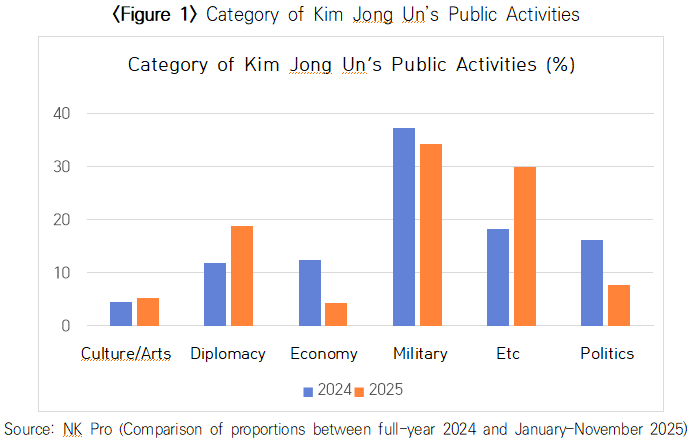
Taken together, these trends suggest that, amid the deepening of relations with China and Russia, Kim Jong Un has placed greater emphasis on diplomacy and external relations, while continuing to focus steadily on military development. According to data from the Korea Institute for National Unification (KINU), although based on limited publicly available information, the number of occasions on which Kim Jong Un conducted public activities outside Pyongyang appears to have declined this year. In addition, the size of the group accompanying him has been significantly reduced. This is a phenomenon commonly observed in highly centralized authoritarian systems and may indicate a narrowing of the circle of key individuals involved in policymaking. Within the accompanying group, the proportion of military personnel and, in particular, cabinet and government elites has declined more sharply than that of party elites.
Nevertheless, the individuals who appeared most frequently alongside Kim Jong Un this year were Pak Jong Chon (military background, currently holding party positions), Jo Yong Won (party), Pak Thae Song (cabinet), No Kwang Chol (military), and Jo Chun Ryong (party). These figures are not new faces but core officials who have consistently remained close to Kim Jong Un over the past five years. This suggests that Kim Jong Un’s inner circle has remained broadly stable and has not undergone major change.
Looking ahead to next year, attention to regional economic development is expected to continue under the 20×10 Regional Development Policy, and there is a high likelihood that a new five year economic development plan will be unveiled at the party congress. Accordingly, the share of Kim Jong Un’s on site inspections and public activities devoted to the economic sector is likely to increase again. At the same time, as new weapons systems enter early stages of development, the number of military related field inspections may decline somewhat. However, testing and training activities aimed at signaling deterrence against “hostile forces” and facilitating the operational deployment of more mature technologies are expected to continue and could even increase.
The fact that Kim Jong Un’s core inner circle has remained stable in recent years suggests that he places a high level of trust in his current group of close associates. However, as noted above, a party congress is typically a period of large scale personnel changes within the Central Committee, and it is therefore difficult to rule out the possibility that adjustments may also occur within Kim’s top inner circle in response to broader shifts in the lower elite strata. -
Kim Jong Un presented a five year plan for the development of national defense science and weapons systems at the 8th Party Congress in January 2021. Under this plan, North Korea has pursued a comprehensive expansion of military capabilities across both the strategic and tactical domains. In the nuclear field, the plan emphasizes the development of tactical nuclear weapons and so called “super-large” nuclear warheads. In the missile domain, it highlights Intercontinental Ballistic Missiles (ICBMs) with ranges of approximately 15,000 kilometers, Hypersonic Glide Vehicles (HGVs), solid fuel ICBMs capable of both ground and sea based launch, and the acquisition of multiple independently targetable re-entry vehicle (MIRV) technology to enhance penetration and evasion capabilities. In the naval domain, North Korea is pursuing the modernization of medium-sized submarines and, ultimately, the construction of nuclear-powered submarines. In the reconnaissance and space domain, the plan calls for the development of military reconnaissance satellites. In the unmanned systems domain, North Korea is seeking to build drone forces capable of both reconnaissance and strike missions.
In 2025, North Korea continued to conduct tests of newly developed and developmental weapons systems. These included a hypersonic intermediate-range ballistic missile (IRBM) in January, a ship launched strategic cruise missile in January, a submarine launched cruise missile in February, an air defense system in March, an air-to-air missile in May, and a hypersonic flight vehicle in October. In addition, the continued testing of short range ballistic missiles (SRBMs) appears to be linked to performance improvements incorporating Russian technology, and North Korean produced SRBMs are reported to have been used extensively in Russia’s war in Ukraine. Observers have noted that the frequency of tests directly linked to the nuclear program has declined significantly compared to 2022–24, which may reflect a strategic adjustment.
Nevertheless, North Korea continues to deepen and expand its military modernization. This year, Kim Jong Un inspected a nuclear powered missile submarine under development, new unmanned capabilities, a new missile defense system, a new ICBM, and surface combatant forces that had not previously been a primary focus, all pursued under the five year plan (see Chart 1). Drones, electronic warfare (EW), missile defense, naval modernization, and certain missile technologies appear to be supported by Russian technical assistance and transfers, although the scope of such support remains unclear and varies by sector.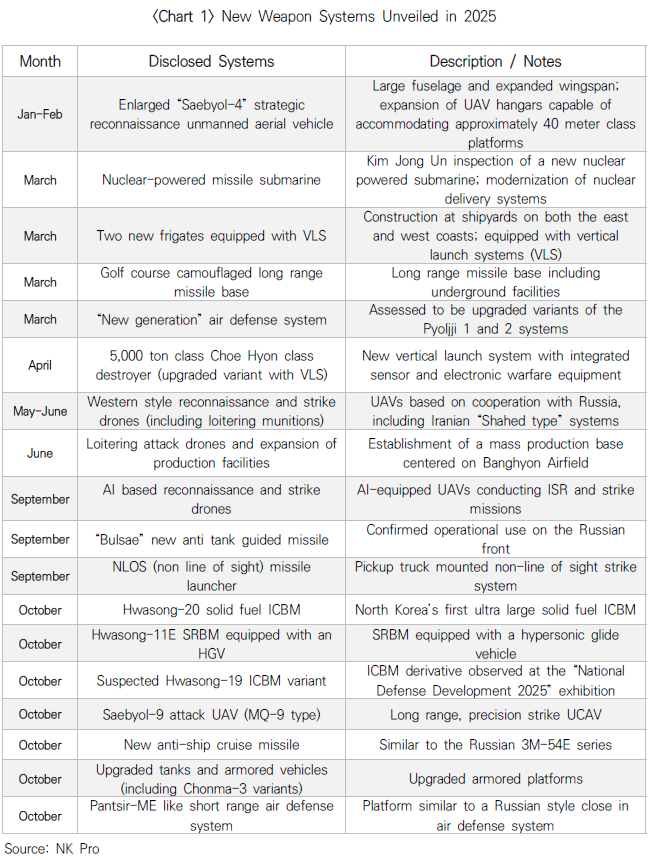
Although North Korea has not conducted a nuclear test since 2017, the likelihood that it will undertake nuclear weapons related tests is increasing in light of indications that the Trump administration intends to proceed with nuclear weapons related testing. However, unless tactical nuclear capabilities are tested, questions regarding their reliability and operational viability will persist.
The North Korean regime is also likely to seek to demonstrate that the Hero Kim Kun Ok (tactical nuclear attack submarine) is operational. To date, this submarine is assessed not to have even departed port, and its SLBM launch capability remains uncertain. If the requisite technology is secured, an attempt could be made next year.
Separately, the regime is likely to present new weapons development objectives, including modernization of its tank forces, development of mass producible drones including FPV drones, and large scale deployment of electronic warfare (EW) capabilities that appear to have been acquired from Russia. In addition, Kim Jong Un has shown strong interest in naval and air force modernization, and further advances in these two domains are anticipated.
At the same time, North Korea’s cyber capabilities are becoming increasingly sophisticated, and North Korean cyber threat actors are operating more effectively in the theft of trade secrets and virtual assets (cryptocurrency). Over the next year, further “innovation” in this area is expected as major North Korean cyber organizations develop new means and techniques to achieve these strategic objectives. Moreover, according to recent analysis based on academic papers and materials published by North Korea itself, there is also the prospect that these artificial intelligence capabilities will increasingly be applied across a wider range of weapons systems. -
In 2025, developments in the social sector continue to place sustained emphasis on public health as part of the “20×10 Regional Development Policy” launched in late 2023 (ten year plan to construct economic facilities such as factories and grain sales outlets, as well as health care facilities, in 20 counties each year) At the same time, the North Korean government continues efforts to block external influences, particularly the spread of South Korean culture, and to entrench “socialist norms” within North Korean society.
Public Health
The flagship social sector project this year is the Pyongyang General Hospital, which opened in October 2025, five years later than the originally stated target of October 2020. South Korea’s Ministry of Unification has assessed that the absence of advanced medical equipment such as MRI machines is highly likely due to sanctions, noting that it remains difficult to secure the special approvals or sanctions exemptions required to procure such equipment.
This year, Kim Jong Un conducted a series of inspections of hospital construction sites in Kangdong (February, June, and October 2025), Kusong (June), and Ryonggang County (September). As reflected in this schedule, this year’s hospital construction objectives were limited to the completion of three pilot hospitals intended to serve as “models” for future large scale construction. In a February speech, Kim Jong Un stated the following:
“This year, we should build these three hospitals well to establish models and accumulate experience, and from next year onward, construct hospitals simultaneously in 20 cities and counties every year without exception.”
Given the delays in the Pyongyang General Hospital project and the continued lack of some equipment, whether these plans can be realized remains uncertain. The Kangdong hospital was completed in late November, but construction of the Kusong and Ryonggang hospitals is still ongoing.
Because this is an area in which North Korea particularly seeks cooperation with Russia, there is some possibility that tangible outcomes could emerge. Nevertheless, the goal of constructing 20 hospitals annually appears excessively ambitious, and future downsizing or a redefinition of objectives may be required. In particular, the capital costs associated with the large scale introduction of advanced medical equipment are substantial, and it remains uncertain whether cooperation with Russia could offset these costs to any significant degree.
There is also the issue of a shortage of medical personnel with the experience and training necessary to operate such facilities. According to World Bank estimates, North Korea has approximately 3.7 physicians per 1,000 people, a higher figure than South Korea’s 2.5, but deficiencies in the education level and clinical experience of medical staff remain major obstacles to strengthening public health capacity. Accordingly, policies aimed at addressing this problem may be articulated more actively next year.
Ideology and Culture
In late 2023, Kim Jong Un declared the formal termination of the peaceful unification line maintained by his father and grandfather. This move forms part of a fundamentally altered strategy toward South Korea and simultaneously represents an extension of ongoing ideological and propaganda campaigns aimed at blocking the influence of South Korean culture within North Korean society.
This year, the North Korean leadership, including Kim Yo Jong and Kim Jong Un, has issued multiple statements indicating that future relations with South Korea and boundary related issues will be codified in law. On August 19, Kim Yo Jong stated the following at a consultative meeting with senior officials of the Ministry of Foreign Affairs of the Democratic People’s Republic of Korea:
“Kim Yo Jong, vice department director, said that in Seoul, regardless of which administration is in power or who is involved, people freely indulge in dreams, interpret them at will, make unfounded conjectures, and congratulate themselves, to the point that it seems almost like an endemic condition to blurt out so called ‘hopes’ and ‘plans’ at their own discretion, and she laid bare what she described as the peculiar traits of South Koreans and the malicious intentions they pursue.
(...) She added that the South Korean people appear to be satisfied merely with hearing such determinations filled with the fantasies of government officials that are impossible to realize.”
Although this statement was fundamentally directed at South Korea, it is noteworthy as the first instance in which a North Korean leader directly criticized “the entire South Korean people,” rather than a specific group within South Korean society. This may indicate that future domestic propaganda in North Korea could increasingly reinforce messages that dehumanize South Korea as a whole. If so, this would form part of an ideological response strategy aimed at offsetting the appeal of South Korean popular culture.
In the cultural sphere, the North Korean government is also attempting to improve the quality of its own cultural content. In early 2024, North Korea released a big budget film, 72 Hours, depicting the outbreak of the Korean War. The film displayed noteworthy characteristics in that it portrayed ordinary South Korean residents in human terms and somewhat reduced elements of Kim Il Sung’s deification. Because the film was produced prior to the articulation of the “two hostile states” doctrine, its depiction of South Korean residents can be seen as contrasting with current policy orientations. At the same time, some observers interpret this as suggesting that Kim Jong Un may be seeking to partially scale back excessive elements of personal idolization. However, recent military parades featuring portraits of Kim Jong Un and new murals that place greater emphasis on his glorified image indicate that these trends may be coexisting.
Perhaps the most noteworthy North Korean cultural production this year is the new TV drama series “A New Spring in the Baekhak Plain.” The series presents a relatively frank portrayal of internal problems in North Korea, including cadre corruption, collusion between officials and market traders, explicit references to the failure of the agricultural policy known as the field responsibility system, the prevalence of false reporting and exaggeration, the poor state of rural education, and potential class tensions between the cadre stratum and lower level residents. Although produced as entertainment, the drama simultaneously reflects the social and economic pathologies as diagnosed by the North Korean authorities.
Of particular note is the drama’s realistic depiction of how various economic crimes, including bribery, theft of state property, and falsified performance reporting, are often addressed not through substantive punishment but through symbolic disciplinary measures such as self criticism, warnings, and cleaning duties. Additional cultural content grounded in this form of “realism” may emerge next year. Such content could not only help illuminate the actual conditions of North Korean society, but also serve as a means for the regime to more effectively communicate to the population the boundaries between permitted and prohibited behavior. -
Considering the changes observed this year and the developments anticipated next year, a number of policy relevant implications can be drawn.
First, in the political domain, there is a high likelihood that the next Party Congress will see the promotion of new, and somewhat younger, cadres from the lower tiers of power, including regional elites and lower level Party and military officials. However, because the top tier of the elite has remained relatively stable in recent years, the core inner circle that works most closely with Kim Jong Un is likely to experience more limited change compared to the rate of turnover among members of the Central Committee and its specialized departments, or institutions such as the General Staff Department of the Korean People’s Army.
Second, Kim Jong Un’s public activities and policy priorities next year are expected to concentrate more heavily on the economic and military sectors. This reflects the fact that the “20×10 Regional Development Policy” will enter its third year, a new economic Five Year Plan will begin, and various new weapons systems partially unveiled this year are likely to proceed through development, testing, and deployment. Some systems may remain long term development projects, such as a nuclear powered submarine, while others have already been deployed but will require repeated field training to enhance operational capability, such as air defense systems.
Third, the Party Congress scheduled for next year will be a pivotal event for clarifying North Korea’s defense posture and weapons development trajectory over the subsequent five years. Kim Jong Un is likely to present a new five year plan for the development of national defense science and weapons systems, which, as already signaled, is likely to include objectives for large scale modernization of tactical and conventional forces.
Fourth, noteworthy changes are also emerging in the ideological and inter Korean domains. Kim Yo Jong’s August statement disparaging the entire South Korean population suggests that North Korea’s internal propaganda may increasingly reinforce a dehumanization framework directed at ordinary South Koreans. Because the “two hostile states” doctrine conflicts with North Koreans’ traditional conception of a single nation, the regime may intensify propaganda and ideological campaigns to entrench this line, which constitutes a highly negative signal for the future of inter Korean relations.
| Political Outlook
| Military Outlook and Weapon System Development
| Social Domains (Public Health, Ideology, and Culture)
| Assessment and Policy Implications
※ The contents published on 'Sejong Focus' are personal opinions of the author and do not represent the official views of Sejong Institue