File
File

|
Post-New START: Toward a New Era of Nuclear Arms Competition? |
| February 10, 2026 |
-
Sang Hyun LEEEmeritus Senior Fellow, Sejong Institute | shlee@sejong.org
-
The U.S.–Russia New Strategic Arms Reduction Treaty(New START) expired on February 5, 2026. This marks the end of the New START Treaty, which limited the number of nuclear warheads and delivery vehicles for Russia and the United States, the two nations possessing 90% of the world’s nuclear weapons. With the termination of the New START Treaty, which has played a crucial role in U.S.-Russia nuclear arms competition and strategic stability, the global nuclear control and disarmament regime is now engulfed in immense uncertainty about its future.
Following the United States, Russia developed nuclear weapons, and after a nuclear balance was largely achieved, the two nations began negotiations for nuclear disarmament and arms control. Having come to the brink of nuclear war during the Cold War's Cuban Missile Crisis (1962), the United States and Russia (then the Soviet Union) signed the Strategic Arms Limitation Treaty(SALT I) in 1972. This was followed by SALT II (1979), the Intermediate-Range Nuclear Forces Treaty(INF, 1987), START I (1991), and START II (1993), and the Strategic Offensive Reductions Treaty(SORT, 2003).
New START was negotiated under relatively tight deadlines as a temporary measure to address the loss of transparency and predictability in strategic balance following the expiration of the START I Treaty in December 2009. The reason these negotiations could not occur earlier was that the George W. Bush administration showed no interest whatsoever in arms control. President Barack Obama, who took office in 2009, had to take urgent action together with Russia. Negotiations began in the summer of 2009 and proceeded at a record pace. The treaty was signed in the spring of 2010 and entered into force in early 2011.
These time constraints defined the treaty's limited scope. New START focused on restoring verification, data exchange, and confidence-building mechanisms as its core objectives, while the actual reduction levels remained relatively modest. The reductions themselves remained largely symbolic. The 'accounted warhead number' under the 2002 SORT treaty, 2,200 (actually fewer in practice), was merely reduced to 1,550. More ambitious and contentious issues were deliberately deferred to future negotiations to avoid delaying the talks.
Essentially, New START was a treaty designed to stabilize the strategic relationship between the United States and Russia while they negotiated a more comprehensive follow-on arms control agreement. However, as has now become clear, such negotiations ultimately failed to materialize. The so-called “Strategic Stability Dialogue“ was far from substantive negotiations, and the brief high-level meetings held just once or twice a year were insufficient to produce results. It was woefully inadequate. The working groups established at the end of 2020 and 2021 showed some potential, but they could not operate for a sufficient period of time. Consequently, New START has assumed a role not originally intended for it: becoming the central pillar of the arms control regime.
The New START treaty signed in Prague in 2010 by U.S. President Barack Obama and Russian President Dmitry Medvedev limited the two countries' nuclear delivery vehicles, such as Intercontinental Ballistic Missiles(ICBMs), Submarine-launched Ballistic Missiles(SLBMs), and strategic bombers, to 700, with a total of 1,550 nuclear warheads. It also included provisions for: ▲18 on-site inspections of each other's nuclear facilities annually ▲ Exchange of weapons and facility data twice yearly ▲ Exchange of information on ICBMs and SLBMs five times yearly. Consequently, the global number of nuclear warheads, which had peaked at around 70,000 in the 1980s, was reduced to 12,000. By keeping each other within a “predictable category,” the U.S. and Russia were able to achieve a balance known as “strategic stability.“
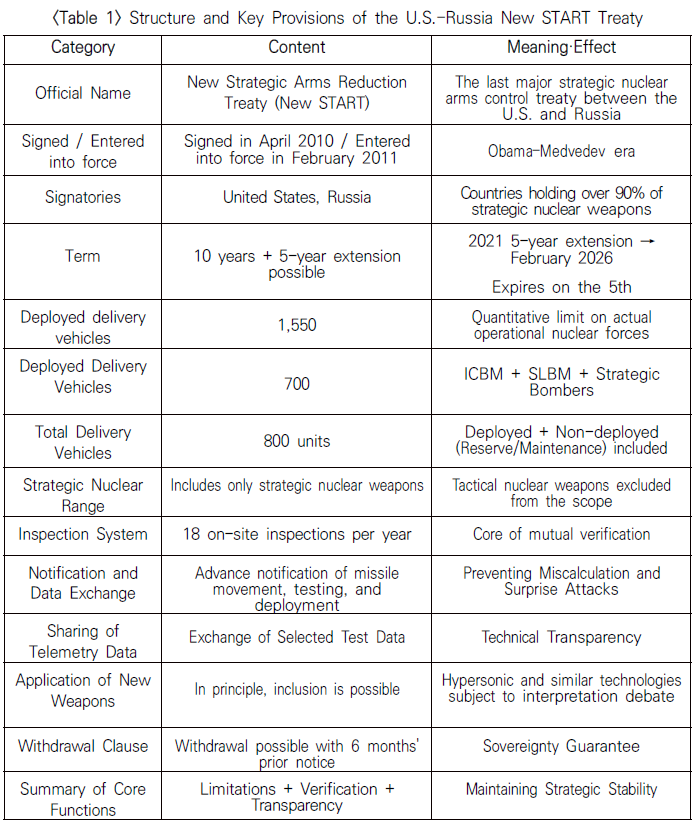
New START was not merely a “treaty to reduce the number of nuclear weapons,” but rather a comprehensive management, verification, and prediction system that effectively lowered the possibility of nuclear war. The treaty included various mechanisms such as inspections, information sharing, verification, and confidence-building measures to enhance transparency, serving as an essential institutional framework for maintaining 'strategic stability' between the two major nuclear powers in a holistic sense.
However, following Russia's invasion of Ukraine in 2022, the deterioration of U.S.-Russia relations dealt a significant blow to New START. In 2023, Russian President Vladimir Putin declared the suspension of New START, stating that "the United States and the West are supporting Ukraine and engaging in hostile acts against Russia." In response, the United States also announced it would cease providing nuclear weapons information to Russia. Key provisions of New START, such as on-site inspections and information sharing, effectively became obsolete from this point onward.
In September 2025, Putin stated, "I am willing to extend New START for one year," but U.S. President Donald Trump said in a January 2026 New York Times interview, "If it expires, it expires." This reflects the Russia-Ukraine war has led to an analysis that the underlying motive is for the U.S. and Russia, who no longer trust each other, to establish a new “'nuclear order” favorable to their own countries. To date, no progress has been made on a successor agreement to New START. -
The New START treaty has expired, but in reality, the global nuclear non-proliferation regime had been gradually weakening even before that. Nuclear weapons still exist, but an era has arrived where they no longer play a decisive role in international politics. Since the Cold War, nuclear weapons have been regarded as the ultimate means of deterring war between great powers, compelling extreme caution from leaders, and underpinning “strategic stability.” The problem is that policymakers and experts remain largely unaware that this framework has already collapsed in reality, and nuclear deterrence is quietly dying.1)
Evidence of nuclear deterrence's dysfunction in reality is readily apparent. Russia, the world's largest nuclear power, has repeatedly suffered strikes on its territory and military infrastructure using weapons supplied by other nuclear states. Yet nuclear deterrence failed to prevent the adversary's military actions. Neither Russia nor the West treats nuclear weapons as the absolute benchmark for political and military red lines anymore. The U.S. and Russia appear indifferent to the impending expiration of New START, the last remaining significant nuclear arms reduction treaty. This demonstrates that the classical logic of "deterring the enemy solely by the existence of nuclear weapons" no longer holds.
One major reason for this change is the decline in nuclear weapons' status as a “shock technology.” Nuclear weapons were the ultimate weapon of terror and shock that emerged after Hiroshima and Nagasaki. However, as with all technologies, over time the world adapts, taboos weaken, and alternative or complementary means emerge. Nuclear weapons are no exception. Their strategic centrality is gradually diminishing due to the development of new weapon technologies.
The most representative examples are the revolutionary advancements in AI and non-nuclear strategic means. AI drastically shortens decision-making time and enables sustained competition at the threshold of war through cyber warfare, information warfare, precision strikes, and unmanned systems. While these tools do not instill the apocalyptic terror of nuclear weapons, they are effective means of producing tangible political and military outcomes. As such diverse alternatives to nuclear weapons emerge, nuclear weapons themselves are becoming increasingly difficult to use due to their sheer destructiveness and increasingly obsolete in real-world competition due to their relative slowness.
The problem is that while nuclear weapons still exist, deterrence is weakening and the arms control and verification system is collapsing, creating an ambiguous state where neither deterrence nor disarmament prevails, leading to a more dangerous future. As a result, nuclear weapons remain symbolic, but crises occur more frequently and ambiguously. Compounding this, a nuclear arms race fueled by AI makes control and verification far more difficult. Thus, while nuclear deterrence may not collapse overnight, it is quietly, unevenly, and unnoticed by many, in decline. If this shift is not acknowledged, the international community will soon find itself unprepared to confront the technological and geopolitical shock of unchecked nuclear proliferation and competition, with its control mechanisms gone.
Following New START, the world stands on the brink of returning to an era of nuclear arms races and proliferation. Even the nuclear arsenals of Russia and the United States, constrained under New START, already posed an unacceptable threat to humanity. Should this treaty expire, the risk of nuclear weapons use will grow even greater due to the potential for renewed and intensified nuclear arms competition. Increasing the global stockpile of nuclear weapons benefits no nation. Instead, all nuclear-armed states must comply with and implement existing international nuclear disarmament agreements.
The immediate military consequence of New START's termination is the resurgence of nuclear arms competition caused by the collapse of the upper limit on nuclear weapon quantities and deployments. Both the United States and Russia will face no constraints on rapidly redeploying inactive and non-deployed warheads, potentially leading to a sharp increase in the number of operational warheads within a short period. A particularly significant multiplier effect is expected for SLBMs(Submarine-Launched Ballistic Missiles). In the worst case scenario, since neither side would know how much the other has increased its nuclear deployments, a conservative assumption would create an incentive to deploy more, potentially leading to a vicious cycle of the classic security dilemma.
The risk of miscalculation due to the structural collapse of strategic stability would also surge dramatically. The absence of inspection and notification mechanisms increases the likelihood that training, movement, and technical tests could be mistaken for preparations for an attack. This heightens the temptation for preemptive strikes during crises. Such temptations also exert pressure on nuclear doctrine. The proportion of readily deployable low-yield nuclear weapons and tactical nuclear weapons could expand, increasing the risk that the threshold for nuclear use could be lowered politically and militarily. Pressure to possess superior weapons compared to adversaries could lead to a situation where advanced new weapons such as hypersonic glide vehicles(HGVs), nuclear-powered torpedoes(Poseidon), nuclear-armed cruise missiles, and space-AI integrated C2 systems are developed simultaneously. This would likely result in a scenario where both qualitative and quantitative competition run rampant.
The cascading collapse of the global nuclear order is also a matter of concern. The abandonment of disarmament negotiations by the world's top nuclear powers, the U.S. and Russia, sends the message that "nuclear-armed states do not honor their reduction commitments." This increases the potential incentive for non-nuclear states to pursue nuclear weapons, thereby weakening trust in the nuclear non-proliferation regime. For China, closely watching the U.S. and Russia's actions, this provides ammunition to strengthen the argument: "Why should we exercise restraint when the U.S. and Russia are engaged in an unrestricted nuclear arms race?" This will inevitably send a cascading signal to India, Pakistan, and North Korea as well.
Although New START has expired, the legal obligation for nuclear-armed states, including Russia and the United States, to negotiate for nuclear disarmament and an end to the arms race has not disappeared. This obligation stems from the Nuclear Non-Proliferation Treaty(NPT), adopted in 1968 and extended indefinitely in 1995. The next review conference for this treaty is scheduled to take place in New York this April-May. At this meeting, nuclear-weapon states must explain what progress they have made over the past five years in implementing the treaty and how they intend to fulfill these commitments over the next five years. Disarmament measures become even more crucial during periods of heightened international tension. The current grave international security environment should not be an excuse for inaction, but rather a catalyst urging urgent disarmament action.
The Treaty on the Prohibition of Nuclear Weapons(TPNW) plays a crucial role in these uncertain times. It is the only globally applicable treaty currently in force that explicitly prohibits all nuclear weapons activities, including the use, testing, and development of nuclear weapons. This sends a powerful message that a new arms race is not only morally unacceptable but also illegal under international law in most parts of the world. At the time of writing, numerous countries are already parties to or signatories of the TPNW. Every nation that joins this treaty sends a clear message to nuclear-armed states that they stand on the wrong side of history. Joining the TPNW is a crucial step every country can take to press for disarmament in these perilous times.
In the spring of 2023, Russia declared it would "suspend" its participation in New START. The United States denied the legality of this measure, citing the absence of provisions for suspension within the treaty text. Conversely, Russia justified it based on Article 72 of the Vienna Convention on the Law of Treaties, which permits the suspension of treaty implementation unless explicitly prohibited. According to the Vienna Convention, suspension is possible at any time and does not require specific justification.
In practical terms, the suspension of implementation means that Russia remains bound by the quantitative and qualitative limits of New START, but is no longer obligated to carry out the treaty’s operational measures, including inspections and data exchanges (under the Vienna Convention, a state that suspends treaty implementation must retain the ability to return to full compliance at any time). As a result, the treaty has lost a substantial portion of its original purpose. While the numerical limits continue to provide a certain degree of transparency, the more central element, namely the verification regime, has in effect been frozen.
President Vladimir Putin's proposal from autumn 2025 to informally comply with the quantitative and qualitative limits of New START effectively extends the treaty's 'suspended state' unchanged. The likelihood of Russia agreeing to restore the verification regime, even unofficially, is extremely low, and any counterproposal in that direction would almost certainly be rejected. Moreover, the verification regime cannot be restored by a unilateral decision of the U.S. administration; it requires funding through the federal budget, making approval by the U.S. Congress highly probable.
Therefore, Putin's proposal is likely to remain largely symbolic in nature. Both sides are already planning or executing programs that could alter the strategic balance in the long term. The United States can expand its strategic forces in response to China, while Russia continues testing systems not covered by New START, such as the Burevestnik nuclear-powered cruise missile or the Poseidon nuclear-powered underwater torpedo. At the same time, the strategic balance possesses a highly resilient nature, meaning it will take years for these programs and other similar initiatives to have a tangible impact. In this context, Putin's proposal could provide limited, though very minimal, predictability for the next 2 to 5 years.2)
Compliance with New START's limitations could have more meaningful political effects within the context of the nuclear non-proliferation regime. For years, non-nuclear-weapon states have increasingly criticized nuclear-weapon states for failing to properly implement Article VI of the Nuclear Non-Proliferation Treaty(NPT), which requires them to pursue nuclear disarmament. The expiration of New START just months before the NPT Review Conference begins in New York on April 27 is likely to amplify these concerns significantly. A joint announcement by the United States and Russia pledging to uphold at least some elements of the expired treaty, combined with a commitment to resume negotiations, could help alleviate the impending crisis to some extent albeit limited, mitigate the impending crisis. -
The greatest challenge following the expiration of New START is whether the international community can establish a new nuclear arms reduction agreement. In some respects, New START inevitably concluded a series of treaties negotiated over more than 50 years. From the outset, this treaty was meant to pave the way for the next generation of treaties, but regrettably, that did not happen. The treaty reflected the traditional arms control agenda, focusing on delivery vehicles and the total number of warheads that could be deployed in a first strike, while treating nuclear weapons separately from conventional military capabilities. These principles were acceptable for an 'interim treaty,' but they are not suited to the new international security environment. Future arms control efforts must address a much broader range of issues.
First, it is necessary to include other nuclear-armed states in some manner, particularly China, and furthermore the United Kingdom and France. Nuclear-armed states outside the Nuclear Non-Proliferation Treaty (NPT), such as India, Pakistan, North Korea, and Israel, are still unlikely to be included in the next phase of arms control. However, some level of commitment from these states to refrain from expanding their nuclear arsenals may still be necessary.
Furthermore, restrictions and reductions must be applied to the entire stockpile of nuclear weapons, encompassing all delivery systems and deployment methods, regardless of whether they are deployed or not. This approach resembles the concept proposed by President Obama in 2010 and would indirectly encompass intermediate-range and tactical nuclear weapons, which have long been excluded from arms control discussions. At a minimum, management is needed for missile defense systems possessing the capability to intercept strategic delivery vehicles. Neither Russia nor China would agree to leave elements with the potential to disrupt strategic balance unchecked without any measures.
From a theoretical standpoint, there is also a need to regulate long range conventional strike weapons that could enable the conduct and potential success of large scale warfare without crossing the nuclear use threshold. Since all missiles already possess or have the potential for dual-use (conventional/nuclear) capabilities, the issue of conventional capabilities cannot be addressed solely through an approach focused on delivery vehicles, as in existing arms control treaties. It is no longer feasible to consider all missiles as potential nuclear delivery vehicles, and the focus of regulation must shift to stockpiles of nuclear warheads. Finally, restrictions on space-based systems, including missile defense components and anti-satellite weapons, could also be considered.
The challenges are immense. Multilateral arms control has not been effectively implemented since the 1922 Washington Naval Treaty, and stockpiles of nuclear weapons, long-range conventional weapons, and space weapons have never been regulated or subject to verification. Therefore, concluding a single comprehensive treaty is unrealistic. A more feasible path is to achieve progress through multiple agreements that are interconnected but have different legal statuses. Negotiating such an agenda will require considerable time, even under favorable conditions.
Given today's unstable international environment and heightened risk of escalation, which is as high as during the worst periods of the Cold War, a more immediate and achievable goal may be negotiating new risk reduction and confidence-building measures(CBMs). While the existing risk reduction and CBM regime negotiated and established during the Cold War remains functional, it is insufficient to address today's challenges.
Within the U.S. government and opposition, there are growing calls to use the expiration of New START as an opportunity to secure overwhelming nuclear superiority, including the Golden Dome (space-based missile defense system). Anya Pinker, a U.S. defense analyst, recently stated in a Congressional Research Service(CRS) report, "Opinions are divided within the United States on whether extending the treaty would be strategically beneficial to the U.S." The argument is that over 50 years of nuclear arms control agreements have hindered the expansion of U.S. military capabilities.3)
Russia also stated, "We are preparing for any scenario," and is developing new assets such as the next-generation ICBM known as "Satan-2," the Kinzhal long-range cruise missile carried by strategic bombers, and the Oreshnik medium-range ballistic missile. Both nations are caught in a vicious cycle, accelerating nuclear weapons development while declaring, "We cannot trust the other side." Nikolai Sokov, a nuclear negotiator from the former Soviet Union, stated, "Without a new agreement, both sides will have no choice but to act based on worst-case assumptions."
The outlook for a new nuclear control regime to replace New START remains uncertain. The U.S. maintains that "any new agreement must include China." While the U.S. was bound by New START, China freely strengthened its nuclear arsenal. In fact, the U.S. Department of Defense recently stated in a report that "China's nuclear warheads will exceed 1,000 by 2030" and "China has likely deployed over 100 solid-fuel Dong Feng-31 ICBMs in silo complexes near the Mongolian border." Trump also stated in a New York Times interview, "We will make a better deal. It is desirable for China, Russia, and the United States to pursue denuclearization as much as possible," directly mentioning "Chinese participation."
However, China has consistently emphasized that its nuclear arsenal lags far behind those of the U.S. and Russia, refusing to accept identical reduction obligations. Therefore, it is unlikely to respond positively to this U.S. proposal. Russia also remains passive on the issue of Chinese participation. Russia is instead insisting that "nuclear powers France and the UK must be included" in new arms reduction negotiations. -
If the U.S.-Russia nuclear control system completely collapses, not only the two major nuclear powers but also official nuclear states like China, the UK, and France, as well as unofficial nuclear states like North Korea, could plunge into a nuclear arms race. U.S. Senator Ed Markey (Democrat) stated, "If the U.S. develops nuclear weapons beyond New START limits, Russia and China wil folow suit," adding, "This would spark a new arms race we neither need nor can win." Former Russian President Medvedev recently remarked in an interview, "If New START ends, more countries will become nuclear-armed," predicting that "some nations will conclude that possessing nuclear weapons is the optimal choice." Should such a "global nuclear competition" fully materialize, the security of the Korean Peninsula would inevitably take a direct hit. Experts point out, "Strategic preparedness, including not only the existing extended deterrence based on the ROK-U.S. alliance but also a 'Plan B' encompassing nuclear development, is urgently needed."4)
While Trump focuses on securing the right to deploy a Golden Dome over Greenland and Putin seeks to unilaterally bind the U.S. through unverified extensions, the essential dialogue between the two sides remains absent. The last bastion of nuclear control that has sustained humanity for 50 years is vanishing entirely, yet both leaders are solely preoccupied with calculating their own tactical gains. The bigger problem is that both sides accept the end of New START as a "tolerable outcome." Trump devalues the existing agreement by touting the nebulous goal of "a better deal, including China." Putin reveals his lack of genuine disarmament will by proposing an extension without restoring verification.
Consequently, after February 5, the world will enter an anarchic nuclear arms race where norms, ceilings, and transparency have all vanished. For the first time since the 1970s, the world will face an era with no legal constraints on U.S. and Russian strategic nuclear forces. The U.S. is pursuing the Golden Dome, Russia seeks to neutralize it with hypersonic missiles and nuclear-powered drones, and China quietly expands its nuclear arsenal. In this process, the risks of miscalculation and escalation within the international community will be far higher than during the Cold War.5)
Where norms disappear, uncertainty fills the void. The world is now stepping into greater uncertainty than ever before. The collapse of nuclear norms between the United States and Russia will send a significant signal—whether intended or not—to other nuclear powers and aspiring nuclear states. Its repercussions will shake the global and regional security order as a whole, extending far beyond U.S.-Russia relations.
The Korean Peninsula cannot escape the repercussions. With North Korea's nuclear capabilities advancing and calls for self-reliance for nuclear-power technology is growing louder within South Korea, it is time for the nation to deliberate on the optimal course of action. The collapse of the U.S.-Russia nuclear order will erode the confidence in extended deterrence held by numerous allies and partners sheltered under America's nuclear umbrella. The instability in the U.S.-China-North Korea nuclear triangle will structurally amplify discussions in South Korea about nuclear potential, tactical nuclear redeployment, and independent nuclear armament. From South Korea's perspective, the likelihood increases that the U.S. will face simultaneous growth in nuclear and conventional burdens across multiple theaters (Europe, the Middle East, Indo-Pacific), creating greater political room for the credibility of extended deterrence (especially its speed and resolve in crises) to be shaken. Given that U.S. extended deterrence relies more on political will and force deployment than on institutional frameworks, South Korea must redouble its efforts to solidify operational deterrence procedures, exercises, and deployments with the United States.
| What will End?
| What changes will occur after New START expires?
| What are the challenges after New START?
| What are the implicatinos for the Korean Peninsula?
1) Alex Kolbin, “Nuclear deterrence is dying. And hardly anyone notices,” Bulletin of the Atomic Scientists, January 30, 2026 (https://thebulletin.org/2026/01/nuclear-deterrence-is-dying-and-hardly-anyone-notices/).
2) Vienna Center for Disarmament and Non-proliferation((VCDNP) Evaluation, https://vcdnp.org/end-of-new-start/
3) Anya L. Fink, “Extension of New START Central Limits: Overview of the Expert Debate,” Congressional Research Service, Updated January 30, 2026.
4) 『Yonhap News』, 2026-02-03, https://www.yna.co.kr/view/AKR20260203001900071?section=search.
5) Taeyouk Ha, former ROK Ambassador to the Kingdom of Sweden, Korea University, Asiatic Research Institute Research Fellow,“U.S.-Russia, Neglecting the Last Remaining Mechanism of Nuclear Arms Control,” 『Korea Diplomacy Plaza』, February 3, 2026 | ⅩⅩⅥ - 5
※ The contents published on 'Sejong Focus' are personal opinions of the author and do not represent the official views of Sejong Institue