File
File

|
From Denuclearization to a Freeze: South Korea's Strategy for Resolving the North Korean Nuclear Issue, the Abduction Issue, and Japan–DPRK Relations:
― Redesigning Northeast Asian Security Through U.S.–ROK–Japan Coordination and Strategic Mediation ―
|
| May 14, 2026 |
Seong-Chang CHEONG
Vice President, Sejong Institute | softpower@sejong.org
Introduction: Three Barriers and South Korea's Strategic Choice
Japan–DPRK relations remain an unfinished chapter of East Asian diplomacy: more than eighty years after Korea's liberation from Japanese colonial rule in 1945, the two countries have yet to normalize ties. The Japan–DPRK Pyongyang Declaration,1) adopted at the Pyongyang summit in September 2002, laid out a broad framework encompassing early normalization, economic cooperation, and the comprehensive resolution of the abduction, nuclear, and missile issues—yet negotiations have made no meaningful progress for over two decades.
The current deadlock in Japan–DPRK negotiations stems from a structure in which three barriers mutually reinforce and paralyze one another. First, North Korea refuses to provide additional cooperation on the abductee issue,2)
which Japan has designated its top priority. Second, the comprehensive UN Security Council sanctions3)
imposed in response to North Korea's nuclear and missile development have categorically foreclosed the space for economic cooperation between the two countries. Third, the gap between the "complete denuclearization" sought by the United States, South Korea, and Japan on one side, and North Korea's insistence on retaining its status as a nuclear-armed state4) on the other, has eliminated any negotiating space.
In the face of these three barriers, South Korea's role has been excessively passive. Seoul has stood by as a bystander to Japan–DPRK negotiations, but with inter-Korean relations completely severed, the time has come to think proactively about a new approach—one in which South Korea steps forward as a "strategic mediator" between Japan and North Korea as a means of laying the groundwork for a resumption of inter-Korean dialogue. This paper proposes a new strategic direction in which the South Korean government first drops the idealistic but unrealistic goal of a "Korean Peninsula free of nuclear weapons" as a precondition for negotiations, then leads efforts through U.S.–ROK–Japan coordination to achieve a freeze on North Korea's nuclear and missile programs, while actively supporting Japan in its pursuit of normalization with North Korea and resolution of the abduction issue.
I. The Structural Dilemma of the Abduction Issue and a Realistic Approach to Resolution
1. The Paradox: The More North Korea Cooperates, the Greater Its Costs
The aging of abduction victims' families has reached a critical stage.5) Many members of the Families Association are now in their 80s or older, and some have passed away without ever learning whether their loved ones are still alive. The urgency of resolving the abduction issue has now transcended humanitarian urgency and become a matter of historical duty.
And yet North Korea's rational incentive to cooperate on the abduction issue is extremely low. In the current structure, the more sincerely North Korea cooperates, the more it stands to lose rather than gain. As long as UN Security Council sanctions remain in force, the scope of economic compensation Japan can offer is limited—even if North Korea were to repatriate all abduction victims and provide a full accounting. Moreover, a paradoxical dynamic operates whereby each new disclosure North Korea makes is received not as evidence of "cooperative progress" but as "further confirmation of a past state crime."
The failure of the 2014 Stockholm Agreement6)
illustrates this structural problem well. North Korea established a special investigation committee and promised a comprehensive reinvestigation, but when immediate compensation failed to materialize in the course of implementation, it ultimately abandoned the agreement. Responsibility for the breakdown does not lie solely with North Korea, however: Japan's reimposition of its unilateral sanctions and the domestic hardline public opinion on the abduction issue also served to narrow the space for implementation. Kim Yo Jong's conciliatory remarks in 2024 and her subsequent hardline reversal7)
can be understood in the same context. North Korea repeats a pattern of keeping the door to negotiations ajar while refusing to move when there is no prospect of meaningful compensation.
2. Building a Phased Incentive Structure: Institutionalizing "Action for Action"
Resolving the abduction issue requires moving beyond moral appeals and constructing a system in which concrete compensation automatically triggers at each stage of North Korean cooperation. The following three-phase incentive structure is proposed.
In the first, confidence-building phase, the humanitarian exemption provisions under UN Resolution 17188)
would be utilized to exchange food, medicine, and medical equipment assistance—along with permissions for meetings involving the families of abductees and personnel movements related to remains verification—for North Korea's commencement of a reinvestigation. This represents the minimum feasible starting point within the existing sanctions regime.
In the second, intermediate phase, Japan's reversible relaxation of a portion of its unilateral North Korea sanctions would be linked to North Korea providing verifiable information and permitting meetings with survivors. At this stage, snapback clauses9) that automatically restore sanctions in the event of a violation of commitments must be included, so as to secure the confidence of Japanese domestic public opinion.
In the third and final phase, the completion of a resolution of the abduction issue would be linked to Japan–DPRK normalization. Upon normalization, North Korea would acquire the standing to receive large-scale economic cooperation funds from Japan as part of settling claims arising from Japan's colonial rule—modeled on the 1965 ROK–Japan Claims Settlement Agreement. The scale of this final compensation could serve as the most powerful incentive for resolving the abduction issue.
II. From Denuclearization to a Freeze: The Need for South Korea's Strategic Pivot
1. The Practical Limits of a "Complete Denuclearization" Policy
North Korea has enshrined its status as a nuclear-armed state in law and in its constitution through the Law on Nuclear Forces Policy adopted in 2022 and the constitutional amendment of 2023. According to analysis by Lee Sang-gyu, Director of the Nuclear Security Research Division at the Korea Institute for Defense Analyses, North Korea possesses up to 150 nuclear warheads as of 2025, and is projected to hold up to 243 warheads by 2030 and up to 429 by 2040.10) The IAEA has also continuously reported the expansion of enrichment activities at Kangson and Yongbyon and signs of new suspected facilities.11) In this reality, conditioning negotiations on "complete, verifiable, and irreversible denuclearization" (CVID) amounts to nothing more than demanding that North Korea dismantle a core pillar of its regime security.
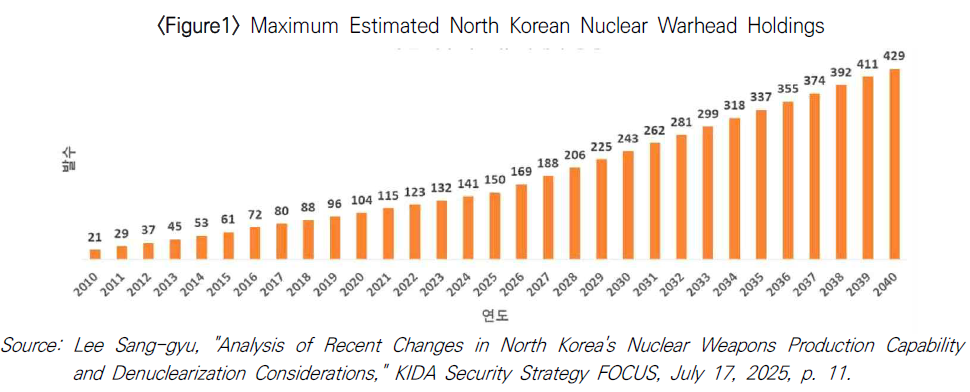
The more strictly the United States, South Korea, and Japan treat denuclearization as a prerequisite for opening negotiations, the less reason North Korea has to come to the table, and the more it accelerates the quantitative and qualitative expansion of its nuclear capabilities. Prominent American experts such as Frank Aum and Ankit Panda have similarly pointed to the unrealism of setting complete denuclearization as a short-term negotiating goal, proposing instead a shift toward an approach that prioritizes "stable coexistence" and nuclear management.12)
2. South Korea Must Change Its Policy First
There is something South Korea must do first in order to break the deadlock in Japan–DPRK negotiations: officially formalize a policy shift that drops "complete denuclearization" as a negotiating objective and establishes, as the realistic first-stage goal, a freeze on North Korea's nuclear and medium- to long-range missile development.
It must be acknowledged that freezing North Korea's nuclear capabilities to slow the pace at which the nuclear threat grows is realistically a more urgent task than allowing the situation to continue as it is, with North Korea's capabilities expanding exponentially. That said, achieving a credible freeze on North Korea's nuclear and medium- to long-range missile development is itself an extremely difficult undertaking, and close consultations among the United States, South Korea, and Japan—and among the United States, South Korea, Japan, and China—will be necessary to identify how such an objective can be achieved.
If South Korea takes the lead on this transition, it can also persuade the United States and Japan. Statements suggesting de facto recognition of North Korea as a nuclear-armed state have already emerged from President Trump and the US Secretary of Defense, and voices within the American expert community calling for negotiations aimed at nuclear arms reduction rather than the unrealistic goal of denuclearization continue to grow. It is only when South Korea first escapes the "denuclearization as precondition" framework that the political space opens for the United States and Japan to exercise flexibility. This is precisely the strategic choice South Korea must make now.
3. A Nuclear and Missile Freeze Is Not Acceptance of Nuclear Possession
The most common objection to the freeze approach is the charge that it amounts to de facto recognition of North Korea's status as a nuclear-armed state. This concern is understandable. A freeze, however, is fundamentally different from legally recognizing that status. A freeze is a risk-management measure that halts any further expansion of North Korea's nuclear capabilities.
The more fundamental answer to this objection lies in South Korea's acquisition of nuclear latency. Just as Japan could develop nuclear weapons within months if its government made such a decision, South Korea must also acquire comparable nuclear latency. Japan is already a de facto nuclear-threshold state, possessing advanced nuclear technology, large plutonium stockpiles, and precision missile capabilities. South Korea, too, should build a comparable level of nuclear latency on the basis of its world-class nuclear technology. Nuclear latency is distinct from nuclear armament. It means acquiring the technical capacity without withdrawing from or violating the NPT framework. Through this, South Korea can secure the ultimate means of self-help against the North Korean nuclear threat while simultaneously sending North Korea a powerful strategic signal: if North Korea continues to advance its nuclear capabilities, South Korea may proceed to nuclear armament as well. Moreover, South Korea's acquisition of nuclear latency goes beyond simple deterrence of the North: by providing the domestic persuasive argument that accepting a nuclear freeze would not create a security vacuum, it creates the political conditions under which the government can decide on the "freeze-first" policy shift. This is the realistic answer demonstrating that opting for a nuclear freeze does not leave the country defenseless against the nuclear threat.
III. The Structure of the Grand Bargain: The Trilateral Linkage of Freeze, Sanctions Relief, and Normalization
1. Core Elements of the Package Deal
Only a grand bargain that packages a North Korean nuclear and missile freeze together with corresponding measures by the United States, South Korea, and Japan can break through the current triple deadlock. The core elements of this grand bargain are as follows:
| △ | North Korea immediately ceases nuclear testing and test launches of intercontinental ballistic missiles (ICBMs) and intermediate-range ballistic missiles (IRBMs), freezes the further expansion of nuclear material production facilities such as Yongbyon, and accepts limited monitoring by international organizations including the IAEA. |
| △ | The United States, South Korea, Japan, and the international community conditionally ease UN Security Council sanctions against North Korea in proportion to North Korea's freeze measures. Snapback clauses must be incorporated so that sanctions are automatically restored if North Korea violates its freeze commitment. |
| △ | U.S.–DPRK liaison offices are established and normalization negotiations are initiated; Japan–DPRK normalization negotiations are formally resumed. |
| △ | Four-party ROK–DPRK–U.S.–China negotiations to convert the Korean Peninsula armistice into a peace treaty are pursued. |
2. Sanctions Relief Is the Key to Resolving the Abduction Issue
The most important chain reaction in this grand bargain is the positive ripple effect of sanctions relief on the resolution of the abduction issue. Once the conditional easing of North Korea sanctions becomes possible under a nuclear and missile freeze agreement, Japan–DPRK normalization negotiations will emerge as a realistic agenda item. If Japan and North Korea normalize relations, North Korea will gain the prospect of receiving large-scale economic cooperation funds from Japan, and this enormous economic incentive will lead North Korea to cooperate more actively on the abduction issue.
In other words, the abduction issue, the nuclear freeze, sanctions relief, and normalization are not separate agenda items but a single mutually reinforcing package. South Korea's role is to become the strategic mediator that coordinates this package within the trilateral U.S.–ROK–Japan framework and persuades North Korea to come to the negotiating table. With inter-Korean dialogue channels currently severed, South Korea's mediation can take the form of coordination within the U.S.–ROK–Japan framework, indirect message delivery through the United States and China, and participation in designing conditions for dialogue with North Korea through ROK–Japan diplomatic consultations.
IV. Japanese Capital Inflows and North Korean Change: An Opportunity to Restart Inter-Korean Cooperation
1. Changes Within North Korea That Japan–DPRK Normalization Would Bring
Once Japan–DPRK diplomatic relations are established and Japanese capital and technology begin flowing into North Korea, significant changes in the North Korean economy and society will follow. The precedent of Japanese capital serving as an important engine of South Korean economic development after the normalization of ROK–Japan relations in 1965 carries important implications for Japan–DPRK relations as well.
As Japanese capital enters North Korea and economic opening proceeds, perceptions of the outside world among North Korean elites and ordinary citizens will begin to change. The more tangible economic benefits become, the greater the relative cost North Korea pays for adhering to its hardline nuclear posture. This creates room for North Korea's foreign policy to shift from ideological rigidity toward pragmatism. And as North Korea's foreign policy turns pragmatic, the possibility of pragmatic inter-Korean cooperation grows accordingly.
2. The Opportunity for Inter-Korean Rapprochement That Japan–DPRK Improvement Opens
Paradoxically, in the current situation—with inter-Korean relations completely blocked—actively helping to improve Japan–DPRK relations may be South Korea's indirect route to restoring its own relationship with North Korea. As North Korea accumulates experience in negotiation and cooperation with the outside world through the Japan–DPRK normalization process and confirms the practical benefits involved, its incentive to open the door to dialogue and cooperation with the South will also grow.
If South Korea plays a supporting and facilitating role in Japan–DPRK negotiations, this will simultaneously have the effect of deepening ROK–Japan cooperation. As the two countries share intelligence on and coordinate diplomacy toward North Korea throughout the normalization process, the positive ripple effects will extend to the ROK–Japan relationship as a whole. Creating a virtuous cycle in which relations among South Korea, Japan, and North Korea improve simultaneously—that should be South Korea's strategic objective.
Of course, there are concerns that the rapid deepening of DPRK–Russia military cooperation may reduce North Korea's incentive to pursue negotiations with South Korea and Japan. However, deepening dependence on Russia actually amplifies North Korea's vulnerabilities. The fact that North Korea's true path to economic recovery ultimately requires normalization with Japan—East Asia's economic powerhouse—does not change.
IV. Japanese Capital Inflows and North Korean Change: An Opportunity to Restart Inter-Korean Cooperation
1. From Information Sharing to a Joint Response System
Even if a nuclear and missile freeze is agreed upon, North Korea's existing nuclear capabilities remain intact. Negotiations and deterrence must therefore be pursued simultaneously as complements rather than alternatives. Through the 2023 Camp David Summit,13)
the United States, South Korea, and Japan activated a real-time system for sharing North Korean missile warning data, and have deepened extended deterrence consultations through14)
These are, however, only a starting point. The United States, South Korea, and Japan must institutionalize joint threat assessments of North Korea's nuclear and missile threats, integrated missile defense operating procedures, and a nuclear crisis joint consultation mechanism—going beyond information sharing. They must also complete a genuine joint response system encompassing joint responses to cyberattacks, maritime interdiction cooperation, coordinated anti-submarine warfare operations, and the establishment of a crisis management hotline.
2. South Korea's Acquisition of Nuclear Latency: The Strategic Foundation of Deterrence
Alongside strengthening joint U.S.–ROK–Japan deterrence capabilities, South Korea must pursue the independent acquisition of nuclear latency. Just as Japan possesses the technical capacity to develop nuclear weapons within months if the government so decides, South Korea must equip itself with an equivalent level of nuclear latency. This means the systematic development of advanced nuclear technology capabilities, enrichment and reprocessing technologies, and precision missile capabilities within the NPT framework.15)
South Korea's nuclear latency functions as a powerful strategic signal to North Korea. The realistic possibility that South Korea could proceed to nuclear armament if North Korea continues to advance its nuclear capabilities will reinforce North Korea's perception that agreeing to a nuclear and missile freeze is, in fact, in its own interest. At the same time, this serves as a persuasive answer to domestic public opinion that accepting a North Korean nuclear freeze does not leave South Korea in a state of defenselessness against the nuclear threat.
Conclusion and Policy Recommendations
The normalization of Japan–DPRK relations is a historic task—the elimination of the last vestige of the Cold War structure in Northeast Asia. Yet in the current configuration, where the multiple barriers of the abduction issue, nuclear weapons, missiles, and North Korea sanctions are intertwined, no single party's individual effort alone can open a breakthrough.
South Korea holds the key. It is only when South Korea first escapes its reflexive attachment to the idealistic but wholly unrealistic goal of a "Korean Peninsula free of nuclear weapons" and pivots to prioritizing a freeze on North Korea's nuclear and missile programs that the space opens for the United States and Japan to adjust their North Korea policies with flexibility. South Korea's policy shift leads to a redesign of U.S.–ROK–Japan coordination, and that coordination builds the foundation for the grand bargain. The core policy recommendations to this end are as follows:
First, the South Korean government should officially reset its short-term policy objective toward North Korea to a "nuclear and missile freeze" and take the lead in having this adopted as a common U.S.–ROK–Japan objective through consultations with the United States and Japan.
Second, the United States, South Korea, and Japan should sound out North Korea—through China or back channels—about the outlines of a grand bargain linking a North Korean nuclear and missile freeze, the conditional easing of UN Security Council sanctions, and the normalization of U.S.–DPRK and Japan–DPRK relations. Snapback clauses should be included to guarantee the reversibility of implementation.
Third, in Japan's abduction issue negotiations, South Korea should provide diplomatic support and coordinate within the U.S.–ROK–Japan framework so that the denuclearization precondition does not obstruct Japan–DPRK negotiations.
Fourth, South Korea should pursue the acquisition of nuclear latency as a substantive core task of its security strategy. This should be achieved through the systematic development of advanced nuclear technology, enrichment, and reprocessing capabilities within the NPT framework. Of course, given the reflexive and irrational resistance of U.S. nonproliferation advocates to the very expression "nuclear latency," it would be advisable at the governmental level to avoid this term and instead emphasize that it is absolutely necessary—from the perspective of economic security—for South Korea to secure the rights and capabilities for uranium enrichment and spent-fuel reprocessing.
Fifth, elevate the U.S.–ROK–Japan joint deterrence framework from information sharing to the level of joint threat assessment, nuclear crisis consultation, and integrated missile defense.
The clock for the families of abduction victims, and the clock of North Korea's advancing nuclear capabilities, do not stop. When South Korea decides and acts first, the United States and Japan can follow. South Korea's role as a strategic mediator must begin right now.
- The Japan–DPRK Pyongyang Declaration, signed on September 17, 2002, established the framework for early normalization of diplomatic relations, with Japan agreeing to provide economic cooperation in the form of grant aid, long-term low-interest loans, and humanitarian assistance through international organizations following normalization. The declaration also set out principles for the comprehensive resolution of issues concerning abductions, nuclear weapons, and ballistic missiles. Rodong Sinmun, September 18, 2002; Ministry of Foreign Affairs of Japan, https://www.mofa.go.jp/region/asia-paci/n_korea/pmv0209/pyongyang.html
- The Japanese government officially recognizes 17 individuals as abduction victims and maintains the position that 12 of them have yet to return. Ministry of Foreign Affairs of Japan, Diplomatic Bluebook 2025, https://www.mofa.go.jp/policy/other/bluebook/2025/en_html/chapter2/c020203.html
- The UN Security Council has imposed comprehensive sanctions on North Korea through resolutions 1718 (2006), 1874 (2009), 2087 (2013), 2270 and 2321 (2016), and 2371, 2375, and 2397 (2017), covering bans on major North Korean exports, caps on petroleum product imports, financial and maritime sanctions, and prohibitions on overseas labor exports.
- North Korea adopted the Law on Nuclear Forces Policy in September 2022, codifying conditions for nuclear use and command structures, and enshrined the pursuit of nuclear capability in its constitution through a 2023 amendment. The report to the Ninth KWP Congress in 2026 reaffirmed that the status of a nuclear-armed state is "irreversible and permanent."
- Under the Stockholm Agreement of May 2014, North Korea promised to establish a special investigation committee and conduct a comprehensive reinvestigation of all Japanese nationals, including abduction victims. However, when North Korea resumed nuclear and missile tests in 2016, Japan tightened its unilateral sanctions, and North Korea unilaterally announced the suspension of the investigation and dissolution of the committee. See Ministry of Foreign Affairs of Japan, https://www.mofa.go.jp/a_o/na/kp/page4e_000377.html
- In February 2024, Kim Yo Jong indicated room for improvement in relations if Japan no longer treated the abduction issue and the right to self-defense as obstacles. She subsequently reversed course, and in March 2026 stated that there would be no summit unless Japan abandoned its "anachronistic practices."
- The UN 1718 Sanctions Committee operates procedures for the conditional approval of exemptions for humanitarian activities in North Korea; multiple humanitarian aid project exemptions were approved in 2026. https://main.un.org/securitycouncil/en/sanctions/1718/exemptions-measures/humanitarian-exemption-requests
- A snapback clause is a legal mechanism designed to automatically restore previous sanctions or measures if a party to an agreement violates its commitments. A similar device was applied in the 2015 Iran nuclear agreement (JCPOA).
- Lee Sang-gyu, "Analysis of Recent Changes in North Korea's Nuclear Weapons Production Capability and Denuclearization Considerations," KIDA Security Strategy FOCUS, July 17, 2025.
- IAEA Director General Rafael Grossi, in Board of Governors reports covering 2025–2026, noted the expansion of uranium enrichment activities at Kangson and Yongbyon, indications of new suspected facilities, and the continued operation of the Yongbyon light water reactor, stating that North Korea's nuclear material production capacity is increasing "very seriously." IAEA, June 2025, https://www.iaea.org/newscenter/statements/iaea-director-generals-introductory-statement-to-the-board-of-governors-9-june-2025
- In a Carnegie Endowment for International Peace report published in April 2025, Frank Aum and Ankit Panda proposed "stable coexistence" and a priority on nuclear management and crisis reduction, rather than complete denuclearization, as the direction for reorienting US North Korea policy. https://carnegieendowment.org/research/2025/05/pursuing-stable-coexistence-a-reorientation-of-us-policy-toward-north-korea
- At the 2023 Camp David U.S.–ROK–Japan Summit, the three countries adopted real-time sharing of North Korean missile warning data, a multi-year trilateral training plan, and a commitment to rapid consultations in the event of a crisis. White House, Camp David Principles, August 18, 2023.
- The ROK–U.S. Nuclear Consultative Group (NCG). The ROK–U.S. Nuclear Consultative Group (NCG) was launched under the Washington Declaration of 2023; at its fourth meeting in 2025 it deepened nuclear and strategic planning, information-sharing protocols, and crisis-time nuclear consultation procedures. U.S. Department of Defense joint press statement, https://www.defense.gov/News/Releases/Release/Article/4026575/joint-press-statement-on-the-fourth-nuclear-consultative-group-meeting/
- CHEONG Seong-Chang, "South Korea's Spent Nuclear Fuel Storage Crisis and the 2030 Warning: US Constraints, Japan's Precedent, and a Realistic Roadmap for Korea–France Cooperation," Sejong Focus, April 21, 2026; CHEONG Seong-Chang, "Strategy and Roadmap for ROK–France Nuclear-Powered Submarine Cooperation: A LEU-Based Naval Integration and Mutually Beneficial Partnership Model," Sejong Focus, February 10, 2026; CHEONG Seong-Chang, "Two Pathways for ROK–US Nuclear Submarine Fuel Cooperation and a Strategy for Persuading the US Congress: A 'Two-Track' Approach Combining a Separate Agreement and AUKUS-Style Legislation," Sejong Focus, April 29, 2026.
※ The views expressed in this Sejong Focus are those of the author and do not necessarily reflect the official position of the Sejong Institute.