File
File
|
Lessons from the Swedish Model for Engagement with North Korea |
| November 4, 2025 |
-
Jeong-kyu LeeVisiting Research Fellow, Sejong Institute | jklee87@mofa.or.kr
-
The Korean Peninsula has remained one of the central security issues in international politics even after the end of the Cold War. North Korea’s development of nuclear weapons and its repeated provocations not only destabilize security in Northeast Asia but also pose a serious challenge to the sustainability of the international nuclear non-proliferation regime (NPT). Major actors, including South Korea, the United States, China, Russia, and Japan, have attempted various strategies in response, yet the North Korean nuclear issue has repeatedly fallen into stalemate without a fundamental resolution.
In this context, the engagement model employed by neutral middle-power states such as Sweden has drawn renewed attention. Since establishing diplomatic relations with North Korea in 1973, Sweden has maintained one of the few resident embassies in Pyongyang among Western countries and has sustained diplomatic channels with the North. It has also served as the protecting power for the United States, Canada, and Australia, effectively functioning as an intermediary connecting North Korea with the Western world.1)
This paper examines Sweden’s engagement model with North Korea and explores its implications for the security environment on the Korean Peninsula and for South Korea’s foreign policy. The analysis focuses on four key elements: (1) Sweden’s tradition of neutral diplomacy, (2) its role as a protecting power and mediator, (3) its humanitarian assistance and development cooperation, and (4) its long-term trust-building strategies. Ultimately, the study seeks to identify the strategic implications of middle-power diplomacy and its relevance for Korean Peninsula security. -
Concept of Engagement
In international relations, engagement refers to a strategy aimed at gradually integrating a target state into international norms and institutions.2) While deterrence and containment rely on coercive pressure, engagement seeks to influence a state’s behavior through cooperation and dialogue.3)
Middle-Power Diplomacy
Countries such as Sweden do not possess the military or economic capabilities of major powers, yet they play meaningful roles in international politics as mediators or intermediaries, norm entrepreneurs, and trust-builders.4)
Sweden’s policy toward North Korea can be understood as a representative case of middle-power diplomacy. It is not a marginal or limited role; rather, it performs complementary and facilitating functions within the multilayered framework for addressing the North Korean nuclear issue. -
Tradition of Neutral Diplomacy
Since the end of the Second World War, Sweden has pursued an active agenda of humanitarian and peace-oriented diplomacy while maintaining a policy of military non-alignment.5) Sweden’s policy of non-alignment, which has continued for more than two centuries since the 1815 Congress of Vienna, is distinct from the legally codified permanent neutrality of states such as Switzerland or Austria; it functions instead as a foreign and security policy doctrine. Sweden’s approach is built on the principle of “freedom from alliances in peacetime aiming at neutrality in the event of war,” meaning that military non-alignment in peacetime is intended to prevent unwanted entanglement in wartime conflicts.6) This long-standing tradition of neutral foreign and security policy also shaped Sweden’s relationship with North Korea. Sweden was able to maintain diplomatic engagement with states across both blocs, and North Korea found Sweden to be an accessible Western channel. Pyongyang viewed Sweden’s inclusive diplomacy favorably, and Sweden’s mixed-economy model was regarded by North Korea as a potential reference point for its own underdeveloped economy. These factors enabled the two countries to build a relatively cooperative relationship. However, Russia’s invasion of Ukraine in 2022 fundamentally altered Sweden’s security calculus. The war made Sweden’s potential security risks tangible, prompting Stockholm to abandon its long-standing neutral posture and seek more credible security guarantees by joining NATO. In doing so, Sweden effectively ended its traditional policy of military non-alignment.
Role as a Protecting Power
Sweden operates an interest section7) in Pyongyang that handles U.S. consular affairs in the absence of a U.S. embassy.8) This function goes far beyond administrative services; it provides a strategic channel that can serve as an informal line of communication between Washington and Pyongyang during periods of tension.9) Sweden had initially considered closing its embassy in Pyongyang in 1994, but after the United States concluded the Geneva Agreed Framework with North Korea and sought smoother communication with Pyongyang, Washington asked Stockholm to retain its presence and assume the role of protecting power. Sweden accepted the request, rescinded its decision to withdraw, and continued to operate the embassy to ensure, for US, both diplomatic access and the safety of its citizens visiting North Korea. Sweden’s role proved critical in 2018 when North Korea released three detained American citizens.10) As the United States’ protecting power in Pyongyang, the Swedish Embassy engaged in close consultations with North Korean authorities, contributing substantially to their eventual release. Following the announcement, the U.S. Department of State issued a spokesperson’s statement expressing deep appreciation for Sweden’s dedicated efforts, extending particular thanks to Jonas Wendel, the Swedish ambassador to North Korea, and his embassy team. Swedish Foreign Minister Margot Wallström also issued an official statement on the government website welcoming the release. She noted that Sweden had engaged North Korea through multiple channels, including the Swedish Embassy in Pyongyang, the North Korean Embassy in Stockholm, and the March 2018 foreign minister–level talks during North Korean Foreign Minister Ri Yong-ho’s visit to Stockholm, all of which contributed to the negotiation process.
Humanitarian Assistance
The Swedish International Development Cooperation Agency (Sida) has expanded its humanitarian assistance to North Korea since the severe famine of the 1990s.11) This area of cooperation, separated from political and military issues, has provided a foundation for maintaining a basic level of engagement even during periods of heightened tension.
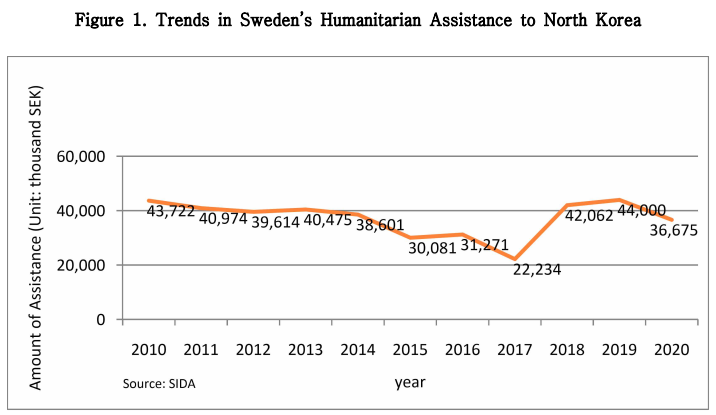
In the mid-1990s, as North Korea faced severe food shortages caused by natural disasters, Pyongyang requested assistance from various international organizations, including the UN Department of Humanitarian Affairs (UNDHA), the World Health Organization (WHO), and the United Nations Children’s Fund (UNICEF). It also permitted the presence of international relief organizations in Pyongyang. To deliver humanitarian aid, international agencies mobilized a wide range of NGOs, and roughly 130 relief organizations worldwide participated in assistance efforts, with the World Food Programme (WFP) playing the largest role. Sweden began providing humanitarian assistance to North Korea in 1995 and maintained uninterrupted support of roughly 4 to 5 million USD annually until 2020. At one point, in 2011, Sweden ranked first among donor countries in terms of per-country humanitarian contributions to North Korea.
Unlike development aid, which reflects both donor priorities and recipient development needs, humanitarian assistance is provided on the basis of humanitarian need and is intended to remain neutral, independent, and insulated from political conditions. In contrast to many European states, Sweden’s humanitarian assistance to North Korea was not significantly curtailed in response to political events such as nuclear tests, underscoring its commitment to humanitarian principles.12) Looking at the pattern of EU humanitarian assistance to North Korea through the European Commission’s Humanitarian Aid Office (ECHO), funding dropped sharply after North Korea’s 2006 nuclear test, rose gradually until peaking in 2011, and then fell dramatically again in 2012, after which support remained nearly suspended. In contrast, Sweden’s humanitarian assistance fluctuated slightly in response to North Korea’s nuclear tests and moves to strengthen its nuclear capabilities, but overall remained at an annual level of roughly 4 to 5 million USD. Sweden also engaged in continuous consultations with the United Nations to ensure that humanitarian aid to North Korea remained exempt from sanctions, and ultimately secured the relevant exemptions.13) The reason behind these efforts is that Sweden adheres to the principle of providing assistance wherever humanitarian needs exist, delivering aid in a fair, neutral, and independent manner regardless of the recipient country’s political situation.
Capacity-Building Programs
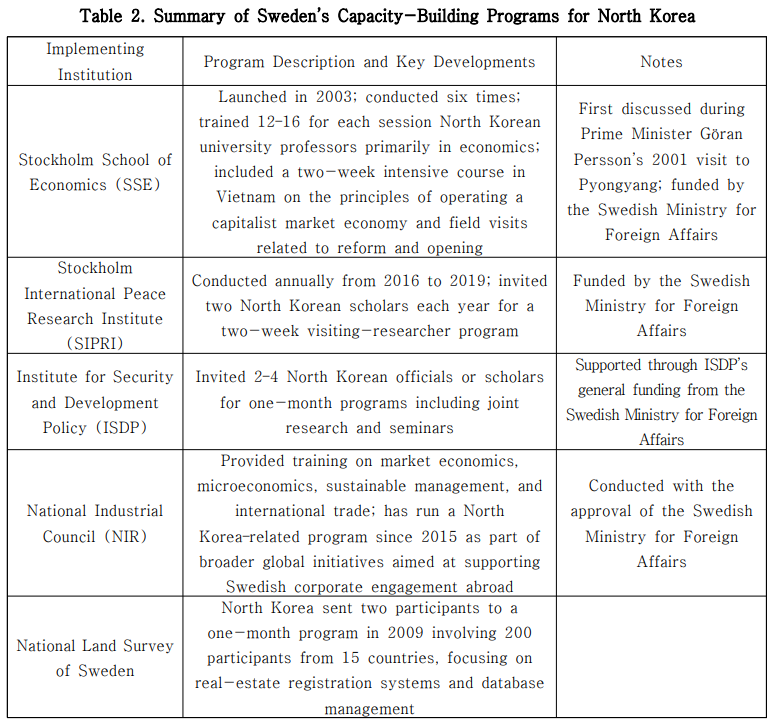
Engagement with North Korea takes many forms across different countries, including humanitarian assistance, trade, strategic dialogue, human rights, and denuclearization initiatives. Sweden’s approach, however, has been characterized by a strong emphasis on humanitarian aid and capacity-building programs. In particular, Sweden’s active and sustained capacity-building efforts distinguish its engagement from that of other European states. Sweden’s programs were designed from a long-term perspective to strengthen the skills and knowledge of North Korean officials and scholars in anticipation of potential political and economic reforms. The origins of these initiatives can be traced to the late 1990s, when North Korea requested training in market economics from Sweden. The effort gained momentum after Swedish Prime Minister Göran Persson visited Pyongyang in 2001, during which Chairman Kim Jong-il expressed interest in the Swedish model and requested educational opportunities related to the capitalist market system.
Sweden’s capacity-building programs for North Korea were carried out primarily through non-governmental academic and research institutions such as the Stockholm School of Economics, the Stockholm International Peace Research Institute (SIPRI), and the Institute for Security and Development Policy (ISDP).
Quiet Mediation Diplomacy
Sweden favors “quiet diplomacy” rather than highly public engagement. One month before the first North Korea–United States summit in Singapore in May 2018, Sweden negotiated with North Korean authorities to secure the release of three detained U.S. citizens. In early 2019, one month before the second summit in Hanoi, Sweden facilitated the first face-to-face meeting between Stephen Biegun, newly appointed U.S. Special Representative for North Korea, and North Korea’s counterpart Choe Son-hui. The meeting was arranged at Hagaholmssund, aresort and conference center outside Stockholm, where Sweden hosted a trilateral session among the chief negotiators from South Korea, the United States, and North Korea.14) In October 2019, when Chairman Kim Jong-un halted all dialogue with the United States in dissatisfaction over the no-deal outcome of the second North Korea–U.S. summit in Hanoi, Sweden quietly facilitated senior working-level talks between Washington and Pyongyang in Stockholm. Through these efforts in both 2018 and 2019, Sweden helped sustain North Korea–U.S. dialogue, including summit diplomacy, by serving as a discreet intermediary behind the scenes.15)
Why does Sweden position itself as a mediator in international conflicts? Sweden believes that its own security, grounded in a long-standing policy of neutrality, depends on a peaceful and stable international environment. In its view, global peace is strengthened only when conflicts are resolved peacefully and sources of instability are removed. Peaceful conflict resolution therefore contributes directly to the secure environment Sweden seeks as for the protection from war. To pursue this goal, Sweden has actively used diplomacy to facilitate resolution of the international conflict and, on the economic side, has expanded development assistance to reduce economic instability in poorer countries as a form of preventive peacebuilding. Sweden’s long-standing efforts for peace on the Korean Peninsula, including sustained humanitarian assistance to North Korea, stem from this strategic outlook.
In the spring of 2017, Sweden served as President of the UN Security Council during its term as a non-permanent member. Stockholm viewed this as an opportunity to take a more active role on the North Korea issue. Foreign Minister Margot Wallström began moving more decisively to support a peaceful resolution of the crisis. During this period, she met Kent Härstedt, a Social Democratic Party parliamentarian with extensive expertise and experience on North Korea. At the meeting, Härstedt emphasized that the moment presented the best opportunity for Sweden to engage more actively on the North Korean issue. Having maintained contacts with North Korea for years and visited the country regularly since 1996, Härstedt had built a broad network among senior North Korean officials.16) When Härstedt visited North Korea, he maintained such close relationships with senior officials that figures at the very top of the hierarchy, including Kim Yong-nam, President of the Presidium of the Supreme People’s Assembly, and Foreign Minister Ri Yong-ho, would accept invitations to dinner at the Swedish Embassy in Pyongyang. Considering that such high-ranking figures in North Korea typically meet foreign visitors only when they are heads of state, this level of access was regarded as highly unusual and indicative of an exceptionally privileged relationship.17)
In 2017, the Swedish government appointed Kent Härstedt as its special envoy for the Korean Peninsula and began full-fledged mediation efforts aimed at promoting peace with North Korea.18) The envoy’s mandate was to facilitate dialogue and build trust.
While both mediators and intermediaries are third parties rather than parties to a conflict, their roles differ. A mediator aims directly at resolving the dispute itself. An intermediary, by contrast, seeks to ease tensions and create an atmosphere conducive to resolution by conveying messages between the parties, arranging meeting venues, and helping improve mutual understanding.19) In other words, the role is to assist the parties in moving toward a resolution. The Swedish government has consistently maintained that its involvement in peace efforts with North Korea is limited to that of a facilitator. It does not view itself as a mediator like the four major powers surrounding the Korean Peninsula. In media interviews, Foreign Minister Margot Wallström stated, “The more we present ourselves as playing a central role, the more we risk being held responsible if the process fails. That is not a position we want to be in. We have therefore made it clear that our role is limited to providing assistance.”20) As Foreign Minister Wallström’s remarks indicate, Sweden has defined its role strictly as that of a facilitator, focusing on creating conditions for dialogue, encouraging communication, and providing venues for meetings. In other words, Sweden remained faithful to the role of an intermediary rather than that of a mediator.
However, Russia’s invasion of Ukraine in 2022 and Sweden’s decision to join NATO in 2023 brought a major shift in its traditional neutrality policy. Within this new geopolitical context, Sweden’s engagement policy toward North Korea has been adjusted, unlike the past, as part of a broader security alignment and implementation of sanctions.
More recently, Sweden has adopted a dual-track approach: joining international efforts to strengthen coordination on North Korea’s nuclear and missile development, while at the same time maintaining channels for dialogue on humanitarian assistance and human rights.21) In particular, the Swedish Ministry for Foreign Affairs has continued providing non-political humanitarian assistance to vulnerable groups in North Korea within the framework of UN sanctions. At the same time, Sweden has strengthened its role as an international platform for research and dialogue on arms control and denuclearization on the Korean Peninsula, centered around institutions such as the Stockholm International Peace Research Institute (SIPRI).
Although Sweden’s accession to NATO makes it difficult to sustain its previous neutrality policy with the same intensity, Stockholm has not abandoned its willingness to remain engaged with North Korea. This commitment was clearly demonstrated when the Swedish government appointed Ambassador Peter Semneby, a career diplomat specializing in conflict resolution, as its special envoy for the Korean Peninsula in 2023. Semneby visited South Korea in 2025 and met with Unification Minister Jeong Dong-young during his trip.22) It appears that Sweden is not currently engaging in active, high-level contact with North Korea through its special envoy, but it is nonetheless preparing for future opportunities should conditions become favorable.
In the aftermath of the war in Ukraine, Sweden’s engagement with North Korea has effectively shifted from the role of a neutral mediator to that of a normative participant. Rather than the traditional balanced diplomacy grounded in neutrality, Sweden has moved toward aligning its approach with NATO and European Union sanctions policy. As a result, Sweden’s North Korea policy now reflects a complex blend of security-oriented realism and humanitarian idealism. -
Need for Third-Country Mediation Channels
The Swedish case illustrates the importance of having a neutral buffer in times of crisis. Such channels can be highly useful when dealing with sensitive issues that cannot be resolved directly by countries like South Korea, the United States, China, and Japan.23)
Institutionalizing a Humanitarian Approach
South Korea also needs to institutionalize humanitarian assistance that is separated from political and military issues. By working with international organizations and NGOs, as Sweden has done, Seoul can maintain at least a minimal channel of communication even during periods of sanctions.
Linkage with Multilateral Diplomacy
The Swedish model worked effectively because it was integrated into broader multilateral frameworks such as the European Union and the United Nations, rather than being pursued as a purely unilateral approach.24) South Korea should likewise broaden its cooperation network beyond the United States, China, and Russia, and expand future channels of engagement with European Union member states.
Strengthening Middle-Power Diplomacy
Sweden, despite its small size, was able to secure meaningful diplomatic leverage. This suggests that South Korea, by mobilizing a broader middle-power network, can address North Korea issues within a more multilateral and cooperative framework.25)
- The Swedish model offers useful insights, but it also has clear limitations. First, Even Sweden’s influence is inherently constrained due to North Korea’s structural distrust of foreign countries. Second, any fundamental resolution of the North Korean nuclear issue ultimately depends on strategic agreement between the United States and China. The Swedish model should therefore be viewed as a complementary tool rather than an alternative to South Korea’s diplomacy, serving as a supplemental rather than primary mechanism.
-
Sweden’s engagement model with North Korea offers three important lessons for addressing issues on the Korean Peninsula: the value of a neutral and trusted channel, the importance of sustaining humanitarian engagement, and the potential of middle-power diplomacy. South Korea should draw on these elements and pursue multilateral and middle-power cooperation alongside the major-power framework centered on the United States and China.
The foundation for Sweden’s effective mediation lies above all in its long-standing and unwavering humanitarian assistance, its capacity-building programs for North Korean scholars and officials, and its maintenance of high-level contacts and dialogue channels even under international sanctions. By first earning Pyongyang’s trust through such normative engagement, Sweden positioned itself to play an effective intermediary role between North Korea and the Western world.
The Korean Peninsula peace process is not a short-term political event but a long-term, structural process of building trust. While the primary agents of inter-Korean relations are, of course, North and South Korea—and meaningful progress requires the cooperation of both the United States and China—the current stalemate calls for additional avenues of engagement. In this context, drawing on a neutral third party with experience in engaging North Korea, such as Sweden, as an honest broker is a policy option worth careful consideration. The Swedish model is not a complete solution in itself, but it can function as a useful complementary mechanism within the broader security architecture of the Korean Peninsula.
| Introduction
1) Karin Jönsson, Sweden’s Relations with North Korea: A History of Engagement, Stockholm: Swedish Institute of International Affairs, 2019, p. 15.
| Theoretical Framework: Middle-Power Diplomacy and Engagement Strategies
2) Alastair Iain Johnston and Robert Ross (eds.), Engaging China: The Management of an Emerging Power, Routledge, 1999.
3) 전재성, 관여정책의 국제정치이론적 기반과 한국의 대북 관여 정책, 국제정치논총 제43집 제1호, 2003.
4) Andrew F. Cooper, Richard A. Higgott, and Kim Nossal, Relocating Middle Powers: Australia and Canada in a Changing World Order, UBC Press, 1993.
| Sweden’s Engagement Model Toward North Korea
5) Gunnar Åselius, “Sweden’s Security Policy in the Cold War,” Journal of Peace Research, Vol. 32, No. 1 (1995), pp. 9-21.
6) 이정규, ‘스웨덴의 대북한 관여 정책 연구 : 규범적 관여 외교에서 평화 중개외교로’, 북한대학원대학교 박사학위 논문, 2023.
7) The system of protecting powers (or interest sections) dates back to the 1870–1871 Franco-Prussian War and was formally codified in the 1929 Geneva Convention on the Treatment of Prisoners of War. Notable examples of protecting power arrangements include: the Swiss Embassy serving both Georgia and Russia; the Swiss Embassy in Iran representing the interests of the United States, Saudi Arabia, and Egypt; the Italian Embassy in Iran representing Canadian interests; the Canadian Embassy in Oman representing Iranian interests; the Pakistani Embassy in the United States representing Iranian interests; the Qatari Embassy in Afghanistan representing U.S. interests; the Czech Embassy in Syria representing U.S. interests; and the Swedish Embassy in North Korea representing the interests of the United States, Canada, and Australia. (Source: Wikipedia)
8) Ministry for Foreign Affairs of Sweden, Sweden in North Korea: Protecting Power Mandates, Stockholm, 2020.
9) The Swedish Embassy in Pyongyang serves as the interests section for the United States. An interests section is a diplomatic mission that performs the functions of a protecting power. A protecting power is a third country that, at the request of one party, is entrusted with safeguarding the interests of that state or its nationals within the territory of another party when the two states lack diplomatic relations because of armed conflict, war, or a break in diplomatic ties. In practical terms, this means that Sweden, through its embassy in Pyongyang, protects U.S. interests in North Korea and handles consular matters for U.S. citizens, since the United States has no diplomatic relations with North Korea and no resident mission in Pyongyang.
10) Kim Dong-chul, Tony Kim, and Kim Hak-song were all Korean American citizens who were arrested by North Korean authorities in 2016 and 2017, tried, and either imprisoned or assigned to labor at an agricultural work site. The Swedish Embassy also represents the interests of Canada and Australia, and it played a central role in securing the release of two other detainees: Reverend Hyeon Soo Lim, a Korean Canadian national released in August 2017, and Alek Sigley, an Australian student released in June 2019.
11) Sida (Swedish International Development Cooperation Agency), Annual Report on Humanitarian Assistance to DPRK, 2021.
12) 고상두, 『유럽 중립국의 대북정책 특징과 시사점: 스위스와 스웨덴을 중심으로』, 국회 입법조사처 용역보고서, 2021; European Commission, EDRIS database; http://webgate.ec.europa.4u/hac.
13) “IFRC “유엔, 인도 지원 대북 제재 예외 분위기 탄력”,” 『연합뉴스』, 2018년 11월 30일; https://www.yna.co.kr/view/AKR20181130014500504?input=1195m(검색일 : 2022.8.9.)
14) Although the meeting was formally hosted by the Stockholm International Peace Research Institute (SIPRI), it was in fact organized and directed by the Swedish Ministry for Foreign Affairs.
15) Anna Wieslander, “Sweden’s Role in the North Korea Talks,” Carnegie Endowment for International Peace, March 2019.
16) Kent Härstedt served as a five-term member of parliament for the Social Democratic Party from 1998 to 2018, representing the city of Helsingborg in southwestern Sweden. From 2014 to 2017, he served as Vice President of the Parliamentary Assembly of the Organization for Security and Co-operation in Europe (OSCE). During this period, he acted as the OSCE Special Co-ordinator for the Ukrainian parliamentary elections and as the OSCE Special Co-ordinator for the Belarusian presidential election.
17) “Sweden’s and Wallstrom’s unknown role in the game about North Korea”, Dagens Nyheter, 2018년 5월 31일, https://www.dn.se/nyheter/politik/sveriges-okanda-roll-i-spelet-om-nordkorea/
18) Given the limited role Sweden could play on Korean Peninsula issues, the Swedish government kept the appointment of Kent Härstedt as its special envoy for the Korean Peninsula as low-key as possible in its public communications.
19) Bjereld, Ulf, “Critic or Mediator? Sweden in World Politics, 1945〜90”, 『Journal of Peace Research』, Feb. 1995, Vol.32, No. 1, pp. 23〜35
20) Dagens Nyheter, May, 31, 2018, op. cit.
21) The Swedish Ministry for Foreign Affairs stated in an official announcement that North Korea’s missile provocations constitute a challenge to international norms, just as Russia’s unlawful invasion does, and it framed the defense of a rules-based international order as a core principle of its North Korea policy. The 2023 NATO Strategic Concept also defined North Korea’s nuclear program as a real threat to international security, and the Swedish government aligned itself with this position.
22) 2025.9.15.자 통일부 보도자료 참조.
| Implications for Security on the Korean Peninsula and Republic of Korea’s Foreign Policy
23) Hazel Smith, North Korea: Markets and Military Rule, Cambridge University Press, 2015, pp. 210-212.
24) Andrei Lankov, “Humanitarian Engagement with North Korea,” Asian Perspective, Vol. 41, No. 2 (2017), pp. 189-210.
25) Björn Jerdén, “Small States and Mediation Diplomacy: The Case of Sweden,” European Review of International Studies, Vol. 7, No. 1 (2020), pp. 55-74.
| Limitations and Considerations
| Conclusion
※ The contents published on 'Sejong Focus' are personal opinions of the author and do not represent the official views of Sejong Institue