File
File

|
[Outlook on Global Affairs 2026-Special Issue No.13] 2026 Outlook on Nuclear Order & U.S. Nuclear Strategy |
| December 11, 2025 |
-
Bee Yun JoResearch Fellow, Sejong Institute | bjo87@sejong.org
- The international nuclear order is characterized by the intensification of competition and the advance of multipolarization amid the prolonged Russia-Ukraine war, instability in the Middle East, the continued advancement of North Korea’s nuclear capabilities, and the deepening strategic competition among the United States, China, and Russia. At present, official U.S. planning documents have not yet been released. President Trump has repeatedly delivered contradictory messages, alternating between statements that “new nuclear weapons are not necessary” and references to the “resumption of nuclear testing.” These statements have increased uncertainty regarding potential changes in the nuclear order and U.S. nuclear strategy in 2026. Nevertheless, the FY2026 budget proposals released in May 2025 by the U.S. Department of Energy and the Department of Defense could indicate the substantive direction and priorities of U.S.‘s nuclear strategy and nuclear modernization under the second Trump administration. On this basis, this article examines changes in the nuclear order in 2025 and assesses the status of nuclear strategy and modernization under the second Trump administration using the FY2026 budget proposals and recent presidential statements. It further assesses that in 2026, U.S. nuclear strategy may continue in ways that expand nuclear use options and pursue a more proactive and flexible nuclear posture within a multipolar environment. The paper also examines the implications for the Korean Peninsula and for U.S. extended deterrence policy toward the Korean Peninsula.
-
The Nuclear Multipolar Era and the United States
The central themes of the nuclear order in 2025 were “competition” and “multipolarization.” Policy circles in the United States have already emphasized the emergence of a “two nuclear peer competitor environment” driven by China and Russia.1) The Nuclear Employment Planning Guidance2) revised under the Biden administration in March 2024 also described the U.S. security environment as a multipolar crisis in which the United States must deter Russia, China, and North Korea simultaneously in both peacetime and wartime.3) Former Commander of U.S. Strategic Command General Anthony J. Cotton4) similarly stated on multiple occasions before and after his term that the United States faces a “multipolar crisis surrounded by two nuclear peer competitors and potential adversaries.5) Although official planning documents of the second Trump administration, including the National Security Strategy (NSS), the National Defense Strategy (NDS), and the Nuclear Posture Review (NPR), had not yet been released as of November 30, 2025, the Trump administration’s assessment does not appear to differ significantly.
On October 29, 2025, President Trump stated on his social media that the United States may need to conduct nuclear tests. He asserted that although the United States possesses the largest nuclear arsenal, Russia ranks second and China a “distant third,” adding that China would “reach [the U.S. level] within five years.” Developments such as Russia’s increasingly visible potential for tactical or limited nuclear use following the Russia Ukraine war, Russia’s redeployment of tactical nuclear weapons in Belarus, China’s nuclear modernization,6) and the de facto build-up of nuclear capabilities by Iran and North Korea have further reinforced assessments within the United States that the international environment is characterized by intensified nuclear competition and an emerging multipolar nuclear order.
Trump’s Second-Term Nuclear Strategy: Potential Recalibration of Priorities and Scope of Use
As the multipolarization of the nuclear order becomes increasingly embedded in U.S. threat perceptions, the direction of the Trump administration’s second-term nuclear strategy remains unclear. In particular, expectations that a NPR may not be issued under Trump’s second term further increase uncertainty regarding the future of the administration’s declaratory nuclear policy and whether the more assertive orientation of the first term’s nuclear policy will reemerge. For example, the 2018 NPR released during Trump’s first term expanded the scope of U.S. nuclear use to include “Significant Non-Nuclear Strategic Attack (SNNSA).” It specified such attacks to include assaults on U.S., allied, or partner civilian populations and infrastructure, as well as attacks on U.S. or allied nuclear command and control and early warning systems. This shift was widely assessed as an assertive change in nuclear doctrine that effectively broadened the conditions under which nuclear weapons could be employed.
By contrast, the Biden administration’s 2022 Nuclear Posture Review partially narrowed and softened this language. While affirming that nuclear weapons are not required solely to deter nuclear attacks, it stated that they may also be necessary in a “narrow range of other high consequence, strategic level attacks.” This formulation adjusted, to some extent, the more expansive and assertive language used in the 2018 NPR.
In a context where a transactional approach toward allies is shaping the overall foreign policy orientation of Trump’s second term, a central issue in assessing potential changes in U.S. nuclear strategy is whether the United States will restore the scope of nuclear use to the level articulated in the 2018 NPR, maintain or further narrow the more limited approach of the Biden period, or present selective and conditional use options with respect to prioritized threats.
Meanwhile, “Operation Midnight Hammer,” conducted by the Trump administration in June 2025, involving preemptive strikes on three Iranian nuclear facilities, may be interpreted as a symbolic illustration of a preemptive and assertive strategic orientation under Trump’s second term. In the absence of an official NPR, this incident may be viewed as an example of the administration’s tendency to manage the nonproliferation environment through the use of military force and to adopt an early and proactive posture in responding to nuclear related threats.
Trump’s Second-Term Nuclear Modernization: Continuity amid Declaratory Shifts
Moreover, the direction of U.S. nuclear modernization remains highly uncertain amid the declaratory shifts and/or oscillations associated with President Trump. Unlike Trump’s first term, when the administration strongly advanced nuclear force modernization from the outset and completed the development, production, and initial deployment of two new low-yield nuclear warheads (B61-12·W76-2) within the term (with the B61-12 completed under the Biden administration), President Trump in 2025 has delivered some contrasting messages regarding nuclear modernization. For example, on February 13, 2025, he stated that the United States already possesses “too many” nuclear weapons and that there is no need to build “brand new nuclear weapons.” By contrast, around the time of the U.S.–China summit held on the margins of APEC in late October 2025, he again emphasized the necessity of nuclear modernization, including the possible resumption of U.S. nuclear testing.
Despite mixed declaratory signals, the budget request points to sustained commitment to nuclear modernization. According to estimates by the U.S. Center for Arms Control and Nonproliferation, the FY2026 request for nuclear weapons programs across the Department of Defense (delivery systems) and the Department of Energy (nuclear warheads) reflects an increase of roughly 26% compared with the current year (see Table 1).
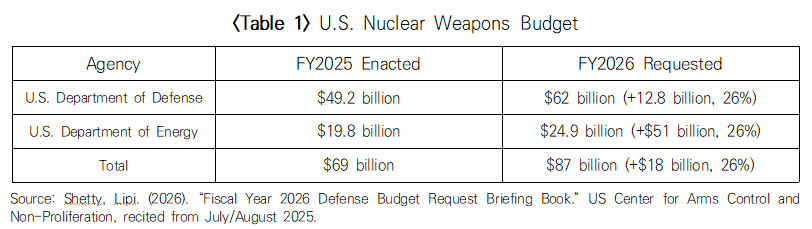
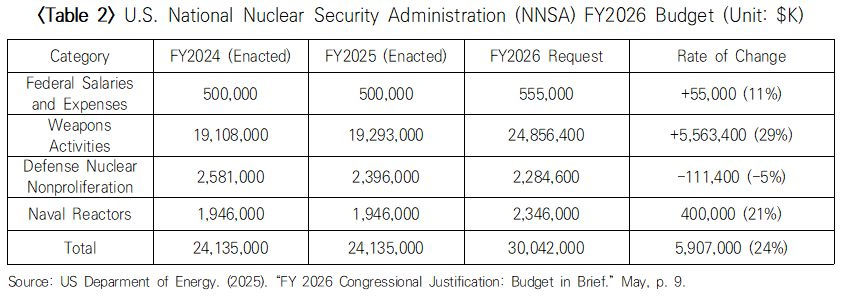
More specifically, the FY2026 Department of Energy budget request released in May 2025 declares that the United States aims to enter a “golden era” of securing leadership in energy, advancing scientific research, and protecting the nation, and identifies nuclear security and the strengthening of nuclear infrastructure as core components of this effort.7) A particularly notable point is that, despite President Trump’s sometimes contradictory statements, the budget structurally supports the administration’s intention to pursue nuclear modernization in Trump’s second term. The FY2026 request states that an “historic” $30 billion is allocated to the National Nuclear Security Administration (NNSA), which oversees the production, maintenance, and development of U.S. nuclear warheads. It identifies four priority investment areas: maintenance of the nuclear stockpile; modernization of tactical and strategic warhead programs; modernization of nuclear production facilities and capabilities; and recapitalization of essential infrastructure and the science and technology base.8) In aggregate terms, the NNSA FY2026 budget is projected to increase by approximately 24 percent ($5.9 billion), compared with the Biden administration period. These increases are concentrated in areas directly associated with the expansion of core nuclear capabilities, including federal salaries and expenses related to personnel (+11%), weapons activities (+29%), and naval reactors (+21%), while funding for nonproliferation activities is projected to decline by 5 percent (see Table 2). Although the absence of official planning documents makes it difficult to draw definitive conclusions about the direction of the second Trump administration’s nuclear strategy and modernization agenda, the budgetary trajectory suggests that a more selective and more assertive approach to nuclear strategy and modernization is likely to continue.
-
2026 Nuclear Order & Possibility of Nuclear Testing by Major Powers
The nuclear order in 2026 is likely to evolve in a direction that further consolidates nuclear competition among major powers, centered in particular on President Trump’s public references to the possible resumption of U.S. nuclear testing. In October 2025, following the U.S.–China summit held on the margins of the APEC meeting, President Trump stated that “with others doing testing, I think it’s appropriate that we do also,” thereby publicly raising the possibility of the first U.S. nuclear test in 33 years since 1992. As debate over a potential resumption of U.S. nuclear testing intensified, Secretary of Energy Chris Wright conducted media interviews to clarify and contain the implications of the President’s remarks.9) Secretary Wright emphasized that the “nuclear testing” referenced by President Trump did not refer to underground nuclear explosive tests of the type conducted prior to 1992, but rather to noncritical, nonnuclear experiments that do not produce a self-sustaining nuclear chain reaction and are limited to technical tests designed to assess the safety and functionality of weapons systems.
Nevertheless, the issue of a possible resumption of U.S. nuclear testing is likely to remain a central point of contention in 2026. Within the United States, arguments in favor of resuming nuclear testing have persisted, citing concerns over the reliability of an aging nuclear arsenal, the advancement of nuclear capabilities by competitors such as China and Russia, and technical uncertainties resulting from the prolonged suspension of testing.10) President Trump broadly shares this underlying assessment and has maintained that a resumption of testing could be justified if deemed necessary. This context suggests that, even if official statements and declaratory rhetoric are moderated, debate over the resumption of U.S. nuclear testing is unlikely to subside easily within the United States.
Meanwhile, the only location in the United States capable of conducting an immediate nuclear test is the Nevada National Security Site (NNSS). Experts assess that the United States would require at least 36 months of preparation to resume underground nuclear testing.11) This assessment suggests that the United States could enter a practical phase of preparations for renewed testing beginning in 2026. If the United States were to resume nuclear testing, many experts anticipate that it would trigger a domino effect of renewed testing by other states. In addition to North Korea, Russia has already repeatedly raised the need to resume nuclear testing in the course of developing new strategic systems, including nuclear-powered cruise missiles and nuclear-powered torpedoes (Poseidon-type systems). China has also long pointed to the relative disadvantages created by the Partial Test Ban Treaty (PTBT),12) given that its historical nuclear testing was limited to a total of 47 tests, and a U.S. decision to resume testing could serve as a decisive incentive for China to restart its own nuclear testing. Experts further assess that if China’s nuclear force—projected to expand to more than 1,000 warheads by the 2030s—were to resume nuclear testing, it would significantly accelerate warhead validation, miniaturization, and the optimization of multiple independently targetable reentry vehicle (MIRV) designs. Taken together, a U.S. resumption of nuclear testing could prompt renewed testing by competitors, including China, Russia, and North Korea, and potentially accelerate the emergence of a fully developed multipolar nuclear competition beyond the current “two-peer nuclear challenge” framework.
Active Nuclear Modernization: Emphasis on Sea-Based Forces, Tactical Capabilities, and New Flexible Nuclear Forces
U.S. nuclear modernization in 2026 is expected to center on budgetary increases aimed at establishing a more flexible nuclear posture. More specifically, the priorities of nuclear modernization in 2026 are projected to be most evident in the naval domain. Two features stand out in the FY2026 budget request: a substantial increase in funding for the W93 warhead, and a notable reduction in funding for the W87-1 warhead. The W93 warhead (estimated yield 330–350 kilotons), which is intended for U.S. Submarine-launched Ballistic Missiles (SLBMs), is allocated approximately $807 million in the FY2026 budget request. This represents an increase of about $350 million compared to the $465 million actually executed in FY2025, nearly doubling the previous level. The decision to significantly expand funding for the W93 program, despite the warhead not yet having reached the final design completion stage, is assessed as part of a strategy to accelerate the early modernization of U.S. nuclear forces in the maritime domain, including SSBNs, which are characterized by high survivability, particularly in response to China and Russia. By contrast, the budget for the W87-1 warhead (estimated yield 300–475 kilotons), which is intended for deployment on U.S. Intercontinental Ballistic Missiles (ICBMs), is projected to decline by approximately 36 percent, to a total of $649 million, compared with $1 billion executed in FY2025.
In addition, the Trump Administration in its second term is projected to continue strengthening the modernization of U.S. tactical nuclear forces in 2026. In particular, production of the high-yield gravity bomb B61-13, which was developed under the Biden Administration, is expected to expand further. The FY2026 budget request allocates $49 million for the program, approximately three times the level of the previous year’s execution. Moreover, the first production unit (FPU) was delivered in May 2025, one year ahead of schedule. This accelerated production milestone suggests that full-scale manufacturing of the B61-13 is likely to advance more rapidly in 2026. At the same time, the Trump Administration has allocated an additional $172 million in the FY2026 budget request to the Nuclear-Armed Sea-Launched Cruise Missile (SLCM-N) program, which had alternated between cancellation and restoration during the Biden Administration. The Department of Defense’s FY2026 budget request also includes $1.8 billion for SLCM-N, representing an approximately fifteenfold increase compared to the $130 million appropriated in FY2025.13) Taken together, these allocations move the SLCM-N program into full-scale Development and Engineering (Phase 6.3),14) reflecting the Trump Administration’s policy direction toward establishing nonstrategic and tactical nuclear options in the maritime domain.
Furthermore, in 2026, the United States is expected to continue efforts to secure and accelerate next-generation nuclear capabilities. One notable change in the FY2026 budget request is the substantial increase in funding for Studies & Assessments. Whereas a total of $69 million was executed in FY2025, the FY2026 request allocates approximately $150 million, representing an increase of about 117%. These programs support work on next-generation strategic warhead designs, next-generation reentry vehicles, and options for engaging hard and deeply buried targets (HDBTs).
Taken together, the FY2026 budget request seeks to pursue seven nuclear force programs concurrently, a level of parallel activity rarely seen in the post–Cold War period. Moreover, the emphasis on maritime, tactical, and next-generation nuclear capabilities may be understood as measures aimed at expanding the spectrum of nuclear use options and establishing a more flexible nuclear posture. This suggests that the trajectory of U.S. nuclear modernization is shifting from the maintenance of deterrence toward the (re)establishment of both quantitative and qualitative advantages. Should nuclear testing resume, a development that remains controversial, U.S. nuclear modernization efforts could be further accelerated.
Offensive Turn in Nuclear Strategy: Expansion of Usable Nuclear Options
Offensive shift in the Trump Administration’s second-term nuclear strategy in 2026 is expected to be most clearly reflected in the future trajectory of SLCM-N and the B61-13. First, the advancement of SLCM-N may be viewed as a key indicator symbolically demonstrating that the Trump Administration’s second-term nuclear strategy is expanding beyond defensive deterrence toward offensive nuclear operational capabilities that take actual use scenarios into consideration. Those who have questioned the program, including within the Biden Administration, have argued that SLCM-N would blur the boundary between nuclear and conventional operations and increase the risk of escalation arising from misperception and miscalculation in crisis situations, and have therefore called for termination of the program. Nevertheless, the Trump administration’s first FY2026 budget request includes an additional $172 million for SLCM-N. If acceleration proceeds, this would effectively expand U.S. sea-based nonstrategic nuclear options, while strengthening an offensive deterrence posture aimed at countering China’s and Russia’s A2/AD environments.
The additional production and deployment of the B61-13 also warrants close attention. Under previous plans, the United States intended to consolidate its air delivered tactical and strategic gravity bombs around the new B61-12, which offers variable yields ranging from approximately 0.3 to 50 kilotons, while gradually retiring the higher yield B61-7, which has yields estimated at 10 to 360 kilotons. However, amid the rapidly changing security environment following the Russia-Ukraine war, the Biden Administration in its late presidency decided to develop the B61-13 by redesigning and integrating the B61-7 warhead into the new B61-12 bomb casing, thereby preserving a high yield gravity bomb option. As noted above, the first production unit (FPU) of the B61-13 was completed in May 2025, approximately one year ahead of schedule, and the Trump Administration’s FY2026 budget proposal triples the prior year’s production funding, signaling an intention to accelerate full scale production. The expansion of high yield gravity bomb production can be interpreted as reinforcing the Trump Administration’s nuclear signaling and retaliation posture and as further reflecting the operationalization of a more forward leaning nuclear strategy. In particular, because the B61-13, like the B61-12, can be carried by both fighter aircraft and strategic bombers, it significantly broadens the range of nuclear options available to the United States in a crisis. -
In summary, the nuclear order in 2026 is entering a transitional phase in which the structural consolidation of competition and multipolarity is intersecting with U.S. efforts to develop a more active and flexible nuclear posture. Although the second Trump Administration has conveyed mixed signals at the declaratory level, the nuclear modernization plans reflected in the FY2026 budget proposal converge on a direction that effectively expands U.S. nuclear employment options, with particular emphasis on sea based, tactical, and new nuclear capabilities. For South Korea, these shifts present both an opportunity to strengthen the credibility of the ROK-U.S. extended deterrence framework and a concurrent challenge: how to ensure that deterrence and defense on the Korean Peninsula remain a sustained priority at a time when U.S. attention and resources are increasingly dispersed across multiple theaters.
In particular, the United States and South Korea reaffirmed U.S. extended deterrence commitments to South Korea and the continuation of the Nuclear Consultative Group (NCG) through a Joint Fact Sheet released in November 2025. At the same time, however, the United States has emphasized in both official and unofficial statements that primary responsibility for the defense of the Korean Peninsula should rest with the ROK military. The Joint Fact Sheet also reflected a more advanced level of ROK-U.S. agreement on strategic flexibility, signaling a direction toward strengthening deterrence not only against North Korea but also with China in mind. However, the scope of this adjustment was limited to conventional forces. The two sides agreed only to “strengthen U.S. conventional deterrence against all regional threats to the Alliance, including North Korea,” without explicitly addressing the applicability of tactical or nonstrategic nuclear capabilities.
Accordingly, while the B61-12 and the B61-13—whose production is expected to expand under the second Trump administration—could serve as potential instruments for broadening U.S. nuclear extended deterrence options for the Korean Peninsula, the likelihood that these systems would actually be deployed on or near the Peninsula remains uncertain. Future developments related to North Korea’s threat environment, the depth of discussions within the NCG, and the extent to which ROK-U.S. strategic dialogue deepens may warrant consideration of a declaratory policy that leaves open the applicability of new nuclear capabilities. In this sense, South Korea faces the task of more precisely aligning the objective of strengthening alliance-based extended deterrence with the direction of the United States’ evolving emphasis on an active and flexible nuclear posture.
In this context, sustained efforts will be required to further develop the ROK-U.S. policy framework on Conventional Nuclear Integration (CNI). In the Joint Fact Sheet, the concept of CNI was not included.15) This omission suggests the need for reaffirming CNI discussions within the NCG framework in order to clarify the role of the ROK armed forces within U.S. nuclear strategy and to enable the timely application of new capabilities. In particular, the declaratory emphasis placed by the United States on a “ROK military-led defense of the Korean Peninsula” risks being interpreted from North Korea’s perspective as a “division of commitment” or as a signal of weakened extended deterrence resolve.16) The concept of CNI, which symbolically makes visible the integration of U.S. nuclear strategy and the role of the ROK military, is therefore more important than ever, and there is a growing need to signal in an appropriate manner that new U.S. nuclear capabilities are also being actively applied to the Korean Peninsula.
Moreover, ROK-U.S. cooperation in the nuclear and defense industrial sectors, together with strengthened ROK–U.S.-Japan security cooperation, is no longer a secondary consideration but a core instrument for securing South Korea’s national security in an emerging multipolar nuclear order. As U.S. nuclear modernization accelerates, South Korea faces growing pressure to expand the scope of extended deterrence cooperation beyond traditional military operations to include cooperation in nuclear energy and defense industries. Recent preliminary understandings between the United States and South Korea regarding cooperation on nuclear powered submarines can be interpreted as a symbolic turning point that illustrates the potential for such expansion. Although legal and institutional constraints, including those stemming from the U.S. Atomic Energy Act (AEA), remain in place, the structural risks associated with nuclear multipolarization require a clear understanding of the evolving direction of U.S. nuclear strategy and a more proactive effort to identify practical pathways for expanding bilateral cooperation in nuclear and defense technologies. At the same time, Japan has moved to activate and further institutionalize its extended deterrence dialogue with the United States, while actively strengthening its counterstrike capabilities centered on the acquisition of Tomahawk. Given that Tomahawk platforms operated by Japan could eventually serve as potential platforms for SLCM-N, this development underscores the need for close trilateral consultation and coordination among the United States, South Korea, and Japan in response to North Korean and broader regional threats. In this evolving nuclear environment, South Korea should seek to position itself not as a passive recipient of policy outcomes but as an active architect that links ROK-U.S. extended deterrence, nuclear and defense industrial cooperation, and ROK-U.S.–Japan security cooperation to maximize deterrence against North Korea and other regional challenges.
| Changes in the Nuclear Order in 2025 and the United States
| 2026 Nuclear Order Outlook & Trump Administration: Key Issues and Outlook
| Implications for South Korea
1) Péczeli, Anna. (2025). “Managing Escalation: America’s Two-peer Nuclear Problem.” Survival, Vol. 67, No. 3, pp. 25-48.; CGSR. (2023). China’s Emergence as a Second Nuclear Peer. Livermore, CA: Lawrence Livermore National Laboratory.
2) The document remains classified; however, key elements became publicly known after the U.S. Department of Defense submitted to Congress, on November 15, 2024, the so called “Section 491 Report,” containing material cleared for public release.
3) US Department of Defense. (2024). “Report on the Nuclear Employment Strategy of the United States.” - “to deter Russia, the PRC, and the DPRK simultaneously in peacetime, crisis, and conflict”
4) In September 2025, Richard A. Correll, then Vice Commander of U.S. Strategic Command(U.S. Navy admiral), was nominated as the new Commander of U.S. Strategic Command. He was confirmed by the Senate in November 2025 and assumed office in December.
5) ” Senate Committee on Armed Services. (2024. 2. 29.). “Statement of Anthony J. Cotton Commander United States Strategic Command Before the United States Senate Committee on Armed Services.”
6) China’s nuclear forces are assessed to be the fastest growing and most rapidly modernizing among the world’s nine nuclear armed states. Estimates indicate an increase from approximately 270 warheads to 350 warheads between 2017 and 2021. The U.S. Department of Defense projects that China could possess around 700 nuclear warheads by 2027 and approximately 1,000 by 2030. US Department of Defense. (2023). “Military and Security Developments Involving the People's Republic of China.”
7) US Deparment of Energy. (2025). “FY 2026 Congressional Justification: Budget in Brief.” May, p. 5.
8) US Deparment of Energy. (2025). “FY 2026 Congressional Justification: Budget in Brief.” May, p. 4.
9) The New York Times. (2025. 11. 2). “New Weapons Testing Won’t Include Nuclear Explosions, Energy Secretary Says.”
10) Track 1.5 dialogue at U.S. Lawrence Livermore National Laboratory, December 2024.
11) BBC. (2025.10.30.) “Trump directs nuclear weapons testing to resume for first time in over 30 years.”
12) The Partial Test Ban Treaty (PTBT), concluded in 1963 by the United States, the United Kingdom, and the Soviet Union, prohibits nuclear tests in the atmosphere, outer space, and underwater, while permitting underground nuclear testing.
13) US Department of Defense. (2025). “Defense Budget Overview: US Department of Defense FY 2026 Budget Request.”
14) US Deparment of Energy. (2025). “FY 2026 Congressional Justification: Budget in Brief.” May, p. 11.
15) This language was included only in the joint statement of the U.S.–ROK Military Committee Meeting (MCM), which was released publicly in an unusual departure from past practice: US Joint Chiefs of Staff. (2025. 11. 3.). “Joint Statement of the 50th Republic of Korea and United States Military Committee Meeting between Chairman of the Joint Chiefs of Staff Gen. Dan Caine and Chairman of the Republic of Korea Joint Chiefs of Staff Gen. Jin Yong-Sung.”
16) To be published Jo, Bee Yun. (2025). “Dispatch from Taiwan: Seoul’s Strategic Blind Spot and the Division of Labor Narrative.” Atlantic Council.
※ The contents published on 'Sejong Focus' are personal opinions of the author and do not represent the official views of Sejong Institue